
Wishes for A Soul
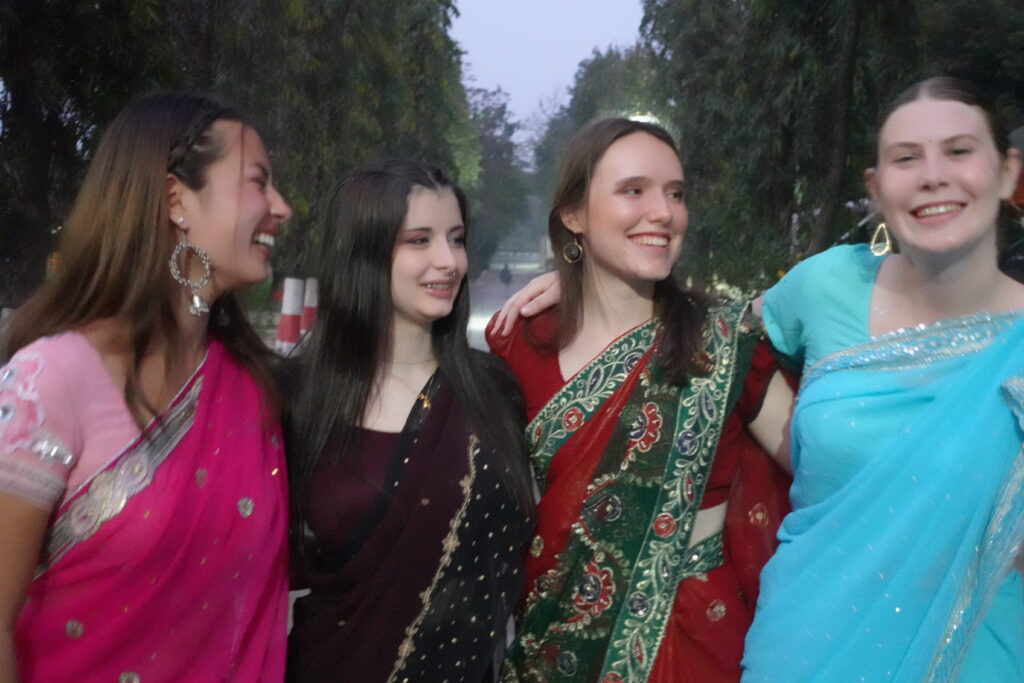
This evening, we had the opportunity to participate in the Hindu ritual of Hari Ki Pari, a fire ceremony (Aarti) on the banks of the Ganga river attended by thousands of people every evening at sunset.
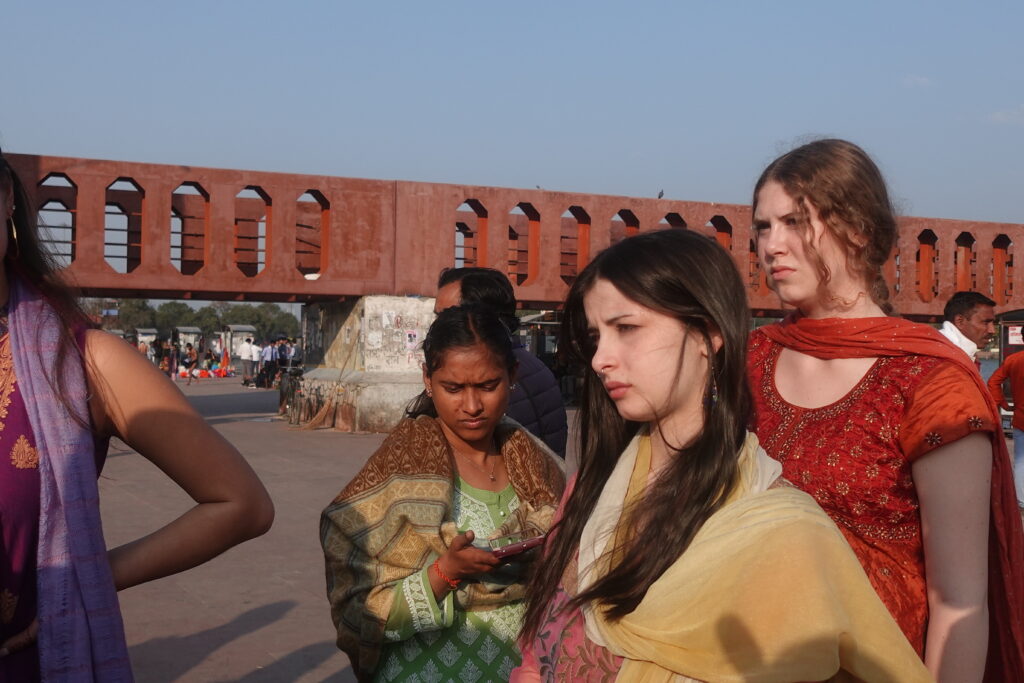
I knew very little about the Ganga Aarti except that we would light a boat and let it float down the river. But everything I had assumed was so wrong. As the local sunset hour of 5:30 approached, flocks of people arrived at the steps along each side of the river. Everything was beautiful down to the smell of the incense as the monks burned little piles of wood. The river was a clear bright blue, and people were bathing and blessing themselves with the water. We got there an hour early in order to get good spots on the river. Thanks to our guide Asis, we got a spot directly across from the monks that performed the chants and offerings to the Ganga. It was quite a long time of chanting but during that time people chatted and watched. Pilgrims at the riverside would pour milk, salt, and marigolds into the water as an offering. It was a ritual to honor the gods and the dead. You could buy these small leaf boats stitched together with twigs and filled with flower petals. A single candle of cotton and loose wax nestled in the center. As the chanting came to an end, everyone started to light their boats and float them down the river.
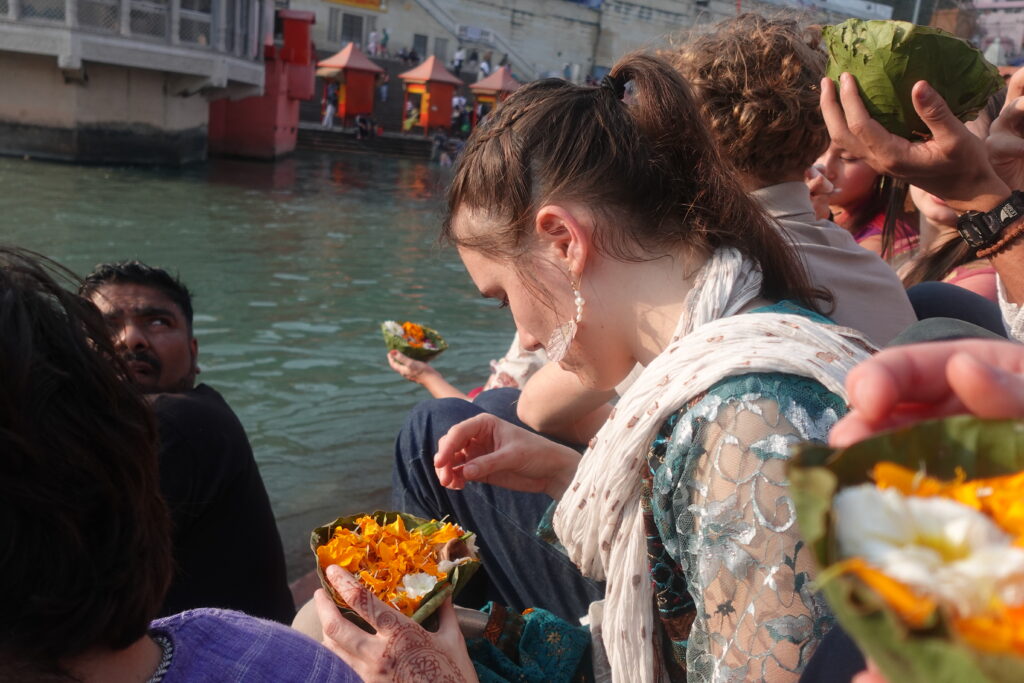
I chose to honor my grandmother with my boat. I never met her. She was murdered before I had the chance to meet her in this life. But I came to know her through my moms’ stories and through pieces stitched together by the people who loved her. I know she was strong. I know she laughed loudly. I know she carried dreams bigger than the town she lived in. And I know she wished she could have traveled the world, but she never got the chance. So I chose to let the boat go with a wish that even if her body couldn’t go anywhere, her soul could travel the world just as fiercely as she lived it.

Insight from an Expert

When we found out that we would be meeting Ronjona Banerjee, we were all very excited, because we were very interested in hearing what she had to say. We would be meeting her at dinner at our host Shantam’s house. We all knew that she was a journalist who focused on major social issues and politics, but we could find very little out about her otherwise. Interested in learning about what the news was in India from her perspective, we were surprised to find ourselves talking about the Epstein files. We didn’t know that the files had also heavily affected India, and we soon learned that there was a massive coverup for all the names mentioned.
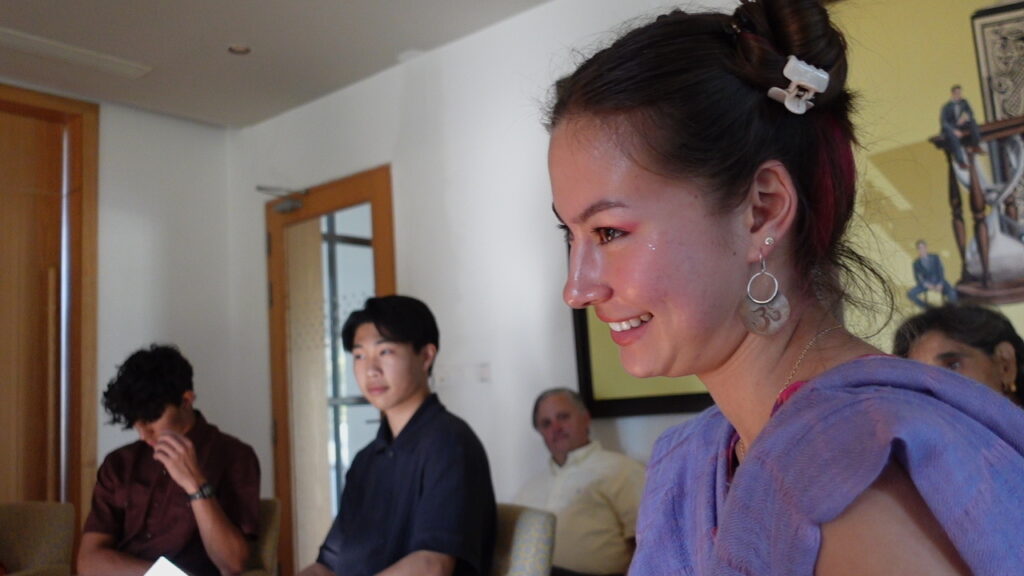
This led to a conversation about how we notice in the news that almost anyone, given a wealth of power and money, becomes incredibly corrupt and even sociopathic. We discussed whether or not human nature is to become corrupt, or whether a certain type of person, prone to corruption, naturally gravitates towards power. Whether that level of depravity is innately human, and wealth and power finally gives you one ability to indulge it, or if wealth and power breeds that depravity, is a question we all share.
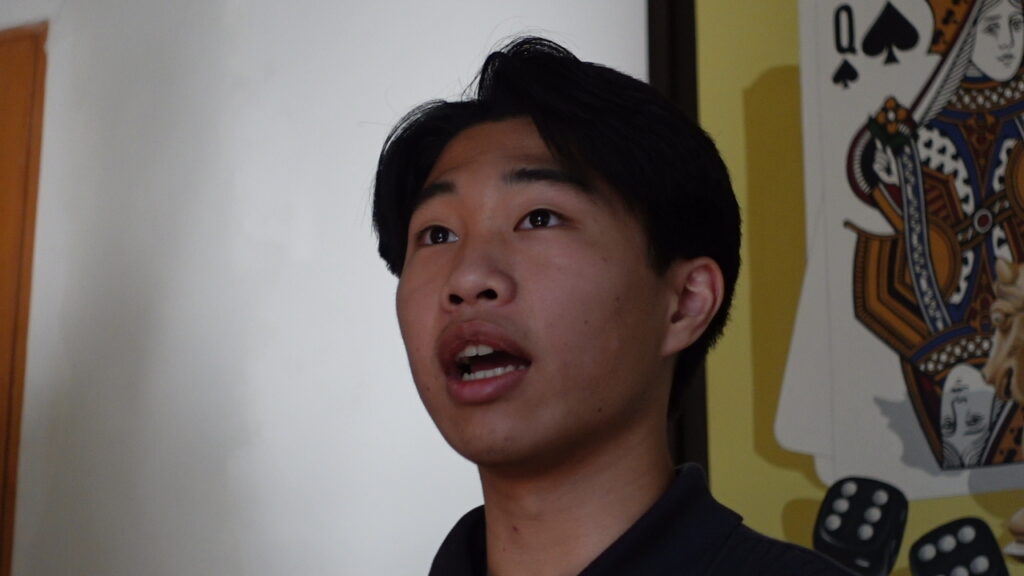
We also asked her about where India stands in the progression LGBTQ+ rights. We had researched this, and the answers seemed unclear. She explained how it used to be illegal to be gay, but recently a law passed saying that you now couldn’t be prosecuted for it. That being said, gay marriage is still not recognized by the government. She also explained how these issues really only mattered for men. She said that women don’t really face any issues because quote “It doesn’t affect the patriarchy so nobody really cares.”
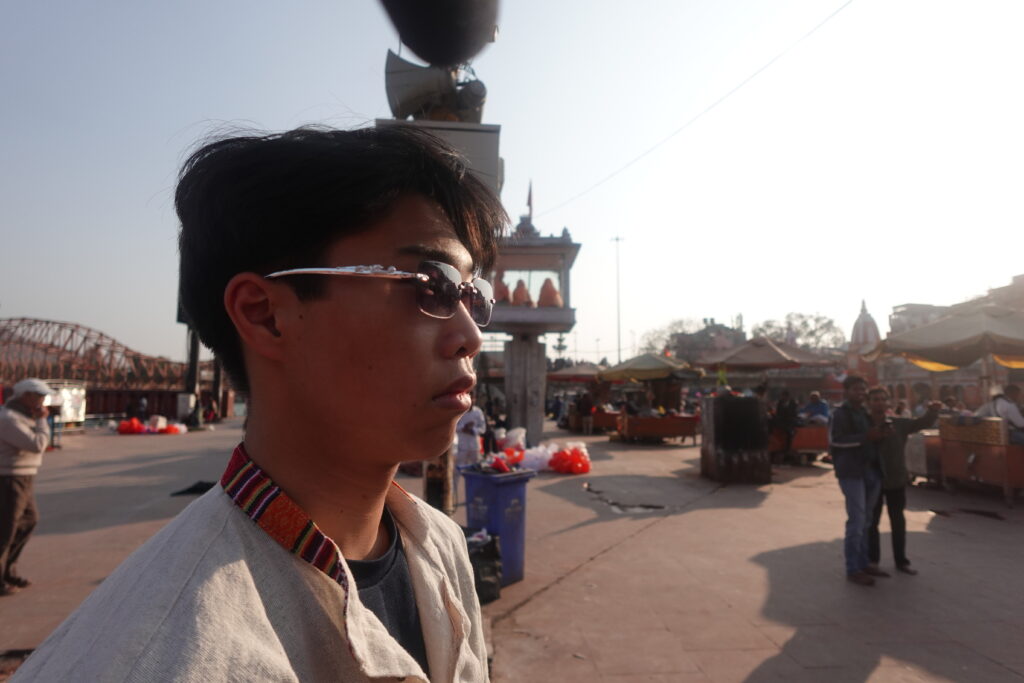
For men, homosexuality was a huge issue when it was illegal, because men commonly hold hands in India unromantically. Because you have to pay for bail, many police officers took advantage of this propensity for hand holding, and huge numbers of men were wrongly arrested. The idea of homosexuality was also used to excuse gang violence and violence against lower castes.
Ronjona also explained that caste has nothing to do with how much money a person has. This is a misconception many people carry. Caste is entirely a birthright, and you can discern caste based on a person’s last name, whom they associate with, and the color of their skin. Caste, religion, and one’s region of origin are all ways people discriminate against each other in India. The country is so diverse and full of so many different kinds of people that the ways in which to judge one another are endless. Ronjona explained that even the types of food people eat is telling of their “place” in others’ eyes. Vegetarianism is linked to religious practices, but it is also something reserved for the wealthy. The poor eat meat.
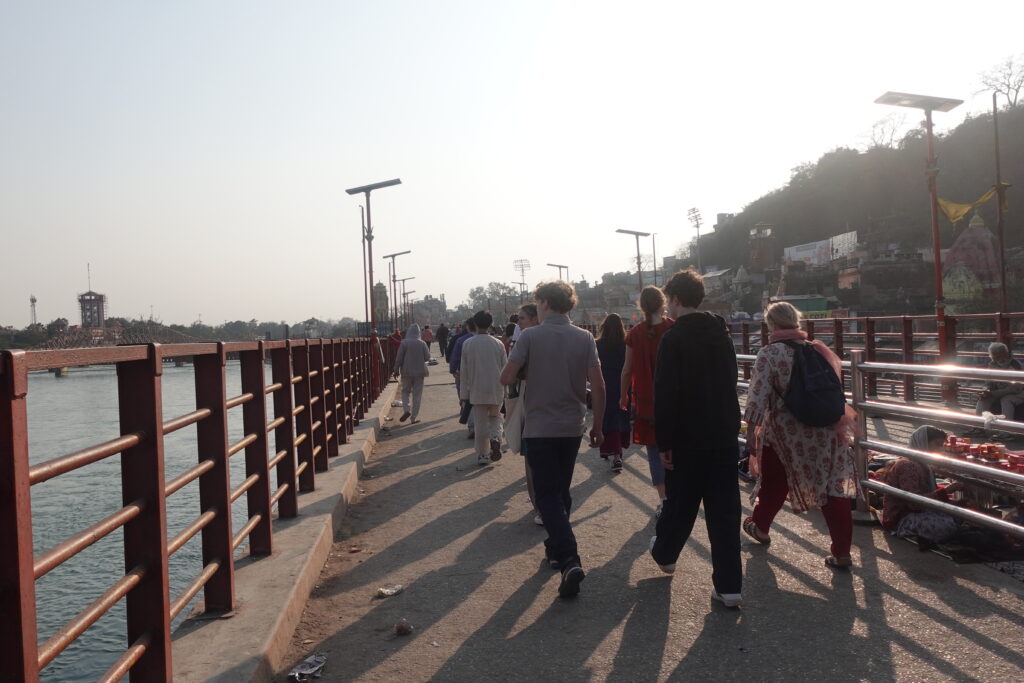
Overall, our talk with Ronjona was very interesting, because we got a different look at how people viewed news across the world, and what politics are like in India. Although we had learned about India and the news in the country, we hadn’t talked to an expert on the subject, so it was interesting to compare her views on the world with ours and other journalists we interviewed in DC.

Sri Ram Mandir School
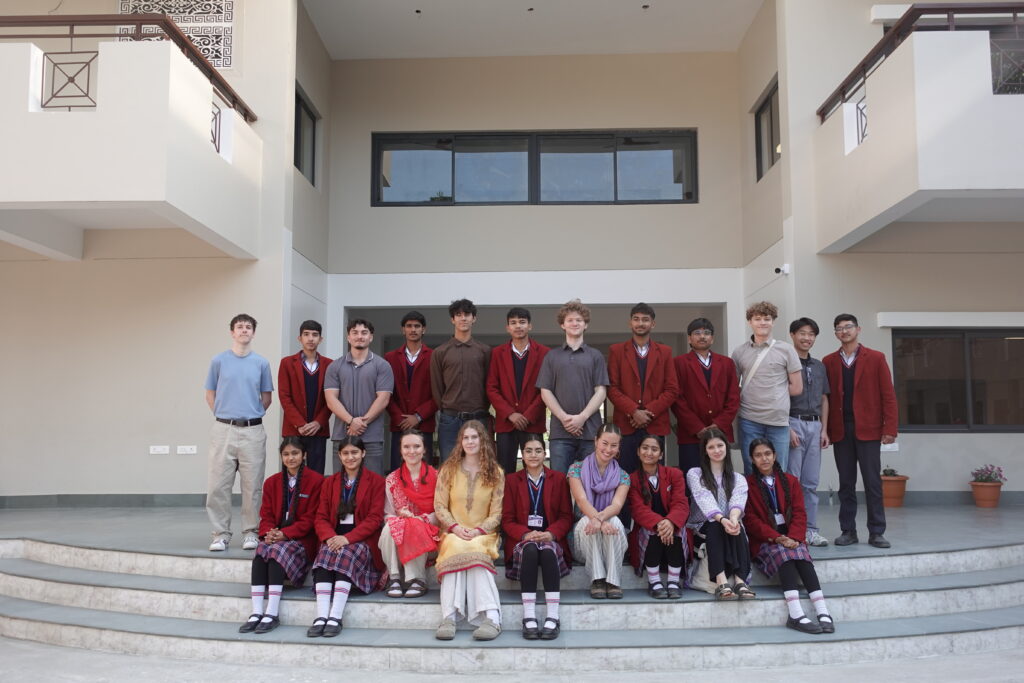
Before arriving at Sri Ram Vidya Mandir (the school associated with the Sri Ram Ashram), I expected there to be a disconnect between cultures. When I arrived, however, the first thing I saw was a united assembly. Everyone stood in lines organized by grade level and by the length of their arms. After they lined up, someone on the speaker gave commands like “Attention” and “At ease.” Those commands seemed to unite them. The students had a lot of discipline. By implementing discipline and wearing uniforms, they created a sense of unity. This made things less about where you come from and more about shared similarities. When fewer things separate people, there is more acceptance in friendships.
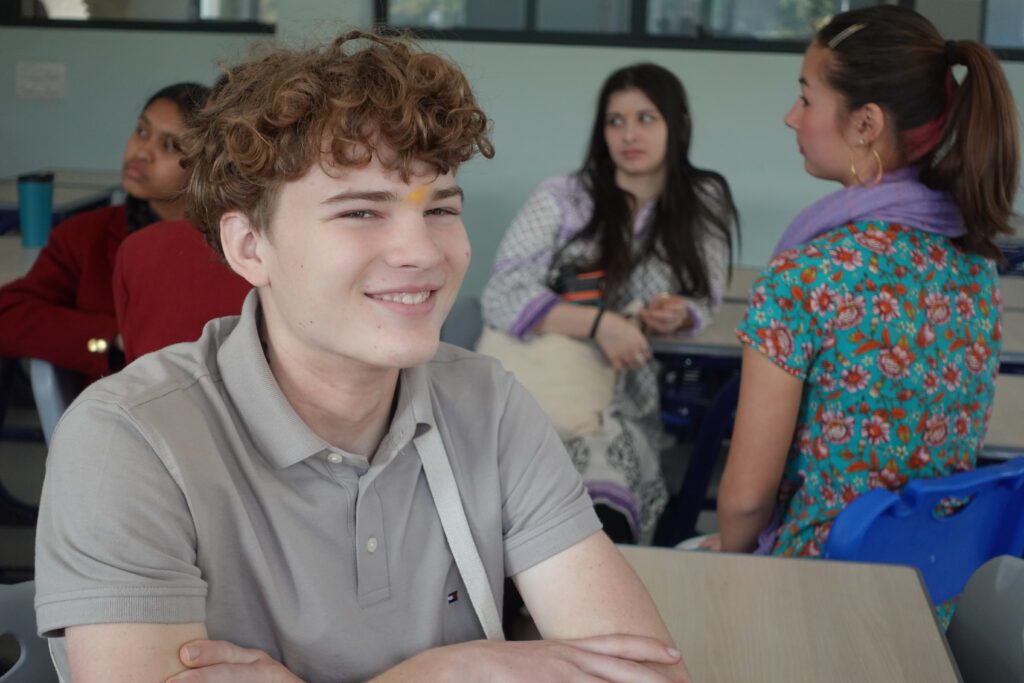
I ended up talking a lot with students in 11th grade. There wasn’t as much disconnect as I had expected. Kyler and I started talking with them about music and different genres. One student mentioned that he enjoyed lo-fi and English songs. He even talked about a couple of songs that Kyler and I enjoy and know, which really surprised me.
Kyler and I talked with two Indian students about how we could give back to our communities. I spoke about keeping in touch with my family. My family has done so much for me that it is impossible to repay them fully, but I think the best way to give back is by giving them your time. They worked hard to help me succeed in life, so the best gift I can give in return is staying connected—calling them, visiting them, and making time for them even when I am busy.
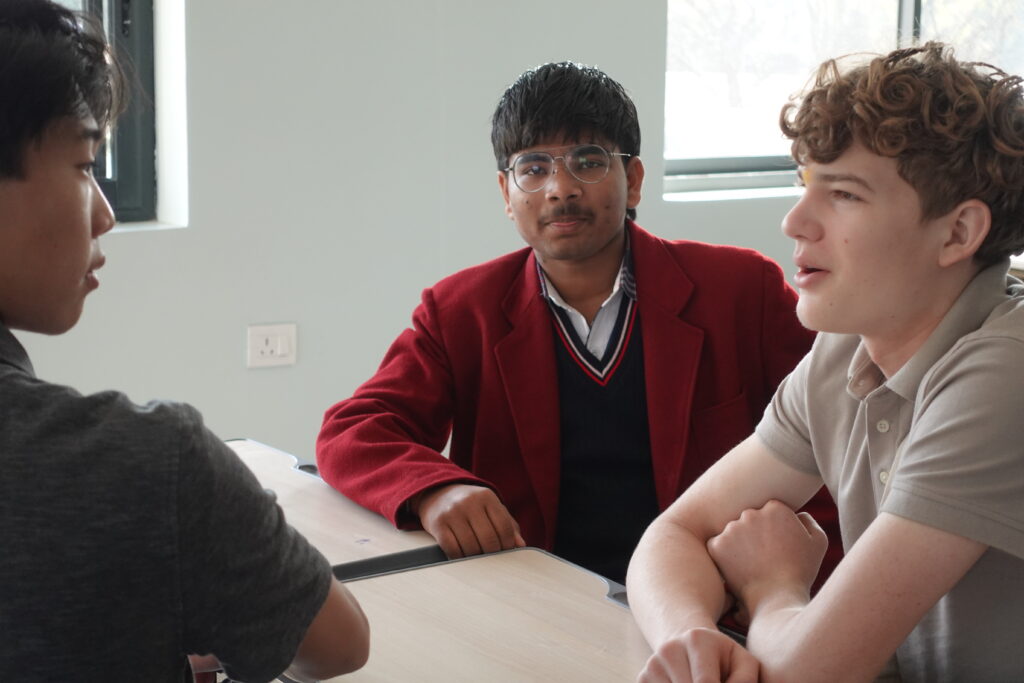
Kyler talked about careers that would allow him to help others. He mentioned that his uncle was a firefighter, which he respected, but he said he didn’t want to become one because his uncle developed lung problems from the job. Instead, Kyler talked about possibly becoming a police officer. His main point was that he wanted to serve and give back to the community. I also learned that one of the students wanted to join his family business as an electrician.
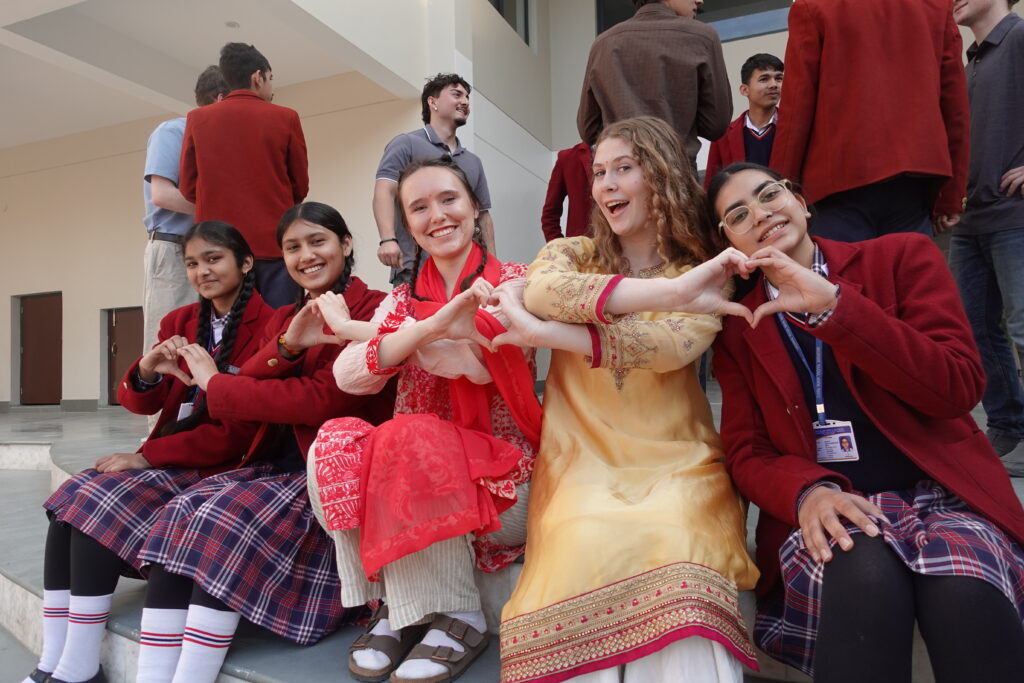
The students I spoke with ended up bonding over music, math, and games. I didn’t expect that we would connect so much. I thought there would be a large cultural disconnect between us, but that wasn’t the case.
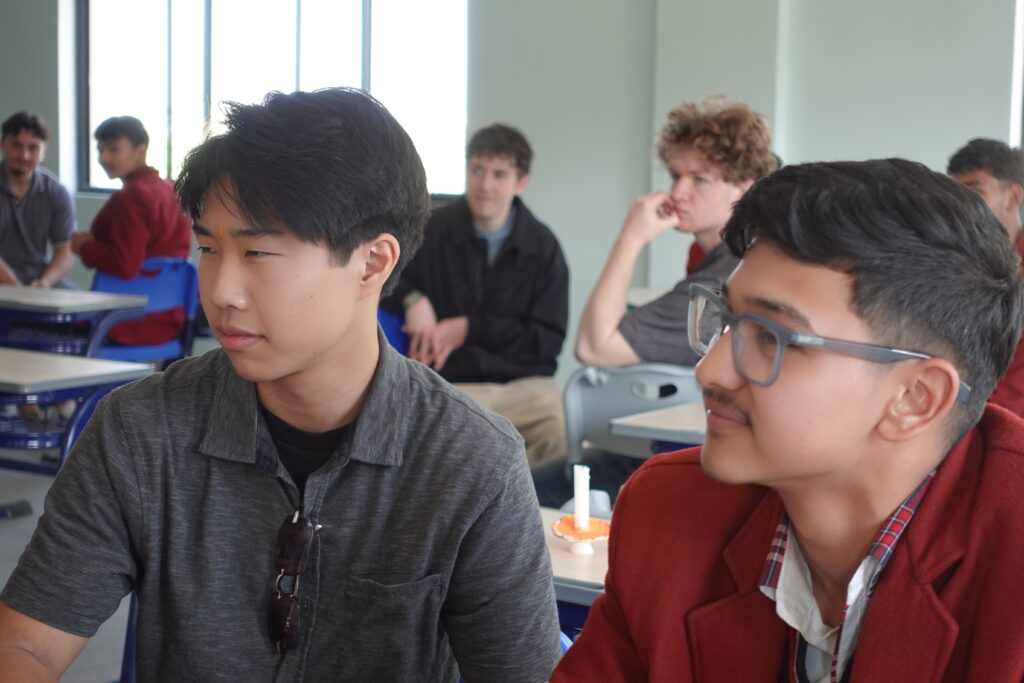
Now, I can see myself keeping in touch with some of these students. Because of this experience, I realized that there are many people in India with whom I can connect through shared interests and similarities in our cultures. This was not a huge realization, but I did wonder beforehand whether they would be as interested in other cultures we are. For example, I enjoy anime, which comes from Japan, and I wondered if they would also be open to art forms and music from other cultures, or if they mainly focused on their own.
It turns out they may be more open to other cultures than I expected. This experience has helped me develop a broader understanding of the world and a clearer idea of how connected people can be, even across different countries.
Global Perspective on Open-Air Markets
Shopping in Dilly Haat was not what I imagined it would be. I expected to be overwhelmed and feel completely out of my comfort zone. The first thing that surprised me was how formal everyone around me looked. Everyone was dressed nicely. There were many foreigners, and there were no stampedes of people to navigate. Dilli Haat is unique in that it is run by the government and the Delhi tourism and transportation development corporation. So it showcases artisan goods from all over India representing their areas’ wares and crafts. There was lots of cashmere from Kashmere, perfumes, handmade puppets, etc. The place is clearly for tourists as it is an amalgamation of goods from all of India. Despite this, it had a very honest feel to it.
Sellers were, in general, honest and seemed to enjoy participating in bargaining. The stalls were well organized, clean, and friendly. I was with Carson and Shannon who are Dilli Haat cashmere buying champions. This helped me discover the best goods and bargain for the best prices.
I have been to other open air markets in Thailand, Taiwan, and Mexico, and all of them had more of an air of regency and demand from you as a customer. This market was the first one I have been to that felt playful. I also felt more trust in the sellers because it was government run, so I felt I could trust that no huge scams were happening right under my nose.
Another thing I noticed was how many of the shops were selling the same things. This I have found to be pretty true across the board when it comes to these kinds of markets. The Cashmere and certain wares are very high quality and specific to India, but other goods, charms and decor I have found in every open air market I’ve been to. For example, I found the exact same elephant charms I bought for myself in Thailand two years ago. I wonder where they are sourced, what items are really region specific, and what is worth bringing home.