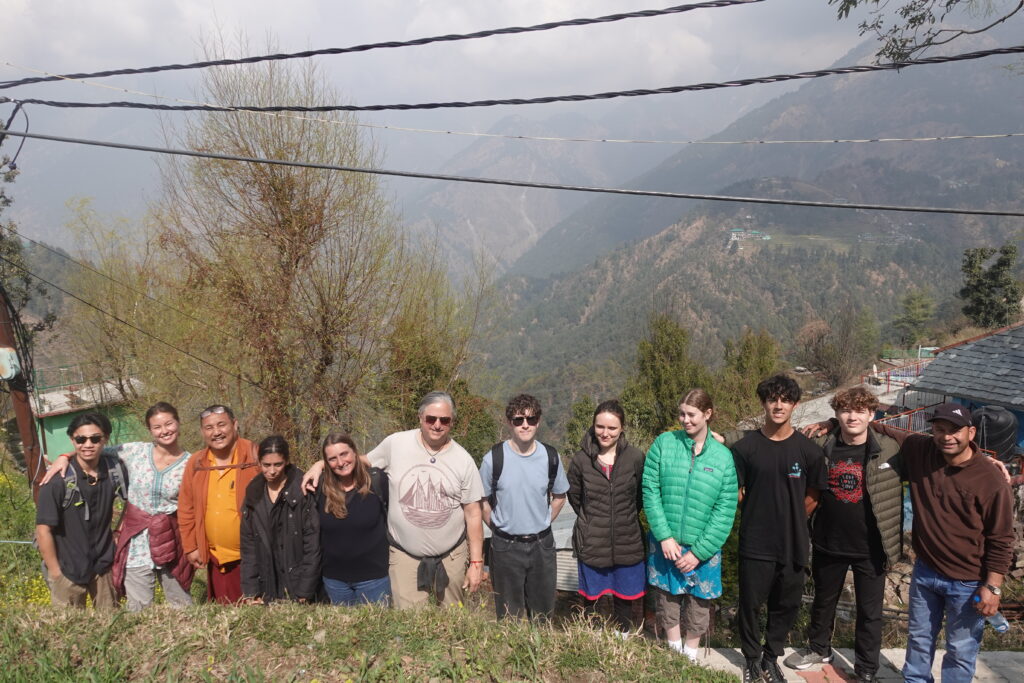
A Moment of Revelation
Growing up, I knew about the Dalai Lama. He was always somewhat of a mystery. I pictured a mystical figure, and I knew he was the leader of Tibet. When preparing for this trip, we found out we were meeting the Dalai Lama, and it sounded cool but I didn’t really understand the significance until we got here.
I only realized how important he is after arriving in India and seeing the people’s dedication. I always thought he was powerful because he is the reincarnation of Avalokiteshvara (the bodhisattva of compassion), but what I have learned from being here is that his power comes from belief. I have never seen a leader with more devoted followers in my life. After seeing all of these people I was very excited to meet him and see for myself what’s so special about him.
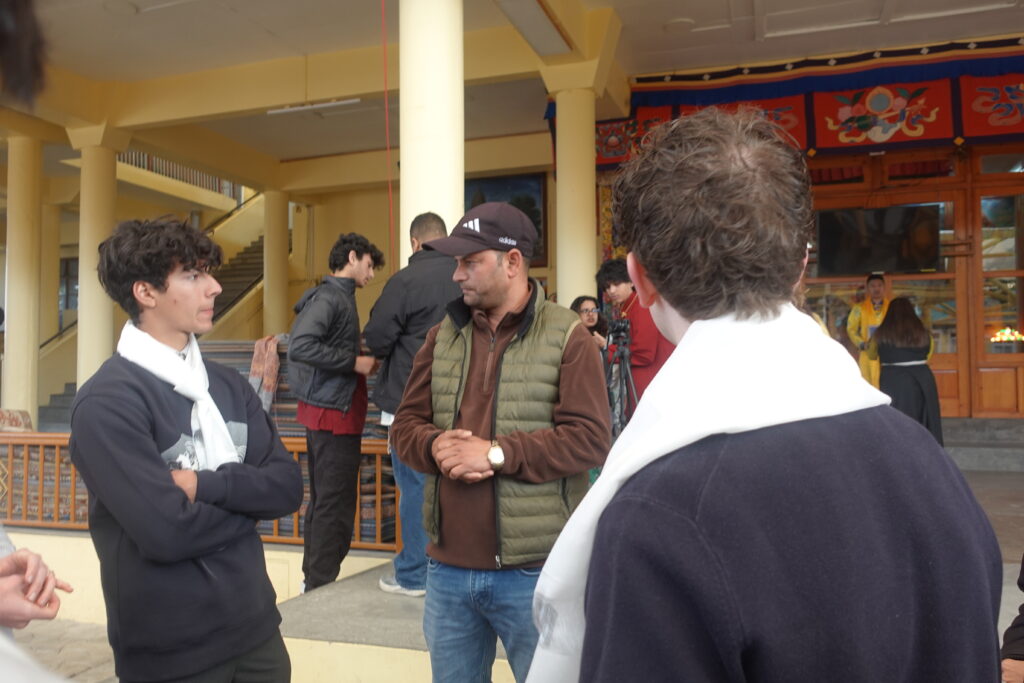
When we got there, I was excited and also incredibly nervous. We waited in the waiting room for a while before he walked in. When he finally did, everyone stood up and you could feel the reverence and respect that everyone in that room had for him. I was even more excited, but I was questioning what he was going to do that would be so impactful in the mere seconds that each person is allowed to be with him.
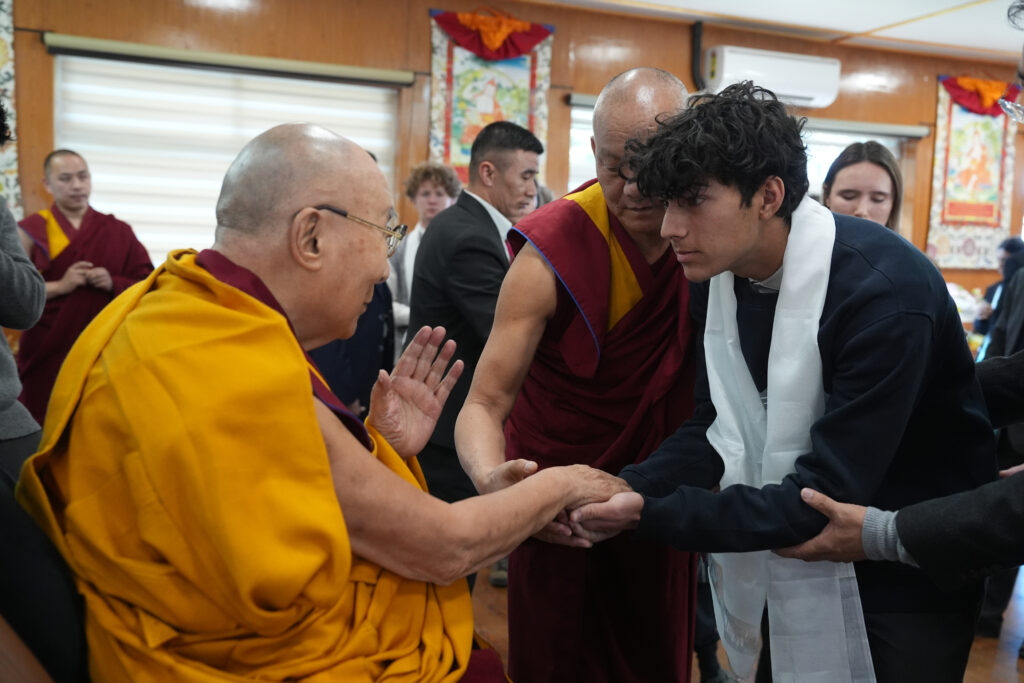
I finally made my way to the front of the line and I held out my hands to be blessed. This was one of the most simple gestures possible, but it still came across so powerfully. All he did was reach out and hold my hand and look me in the eyes for about two seconds. In those two seconds (I don’t really know how to explain it), I felt like he truly saw me. He just looked at me so calmly and intently that I felt like he really saw me in a way that I don’t think many people on this earth could ever see me.
This experience was something unlike anything I have ever been through, even though it was so simple. The feeling of his stare, his touch, and his obvious compassion and love is incredibly hard to explain. There is definitely more to my experience that I can not put into words.
Meeting the Dalai Lama showed me the true power that he holds and how all of the devotion that people have for His Holiness is fully deserved. I am truly grateful to be given this opportunity to understand a different culture.
An Exciting Morning
I have always had an appreciation for a great view, but after seeing the view from the top of the hotel we were staying at, I knew I would never be happy with any other view. While I could compare Delhi to a larger Los Angeles, and the countryside to Sacramento, the view at Dharamshala was unlike anything else I have seen before or am likely to see after. The closest thing I could compare to it is Grouse Mountain in Canada, but that does not seem even half as impressive. At Grouse Mountain, once you reach the high point, you are finished with the journey. Here in the Himalayas, the mountains seem to never end. When one stops, another begins, and there is an endless wall of snow capped peaks. Still, I was happy to head downhill from our high hotel today, even though the time was very early.
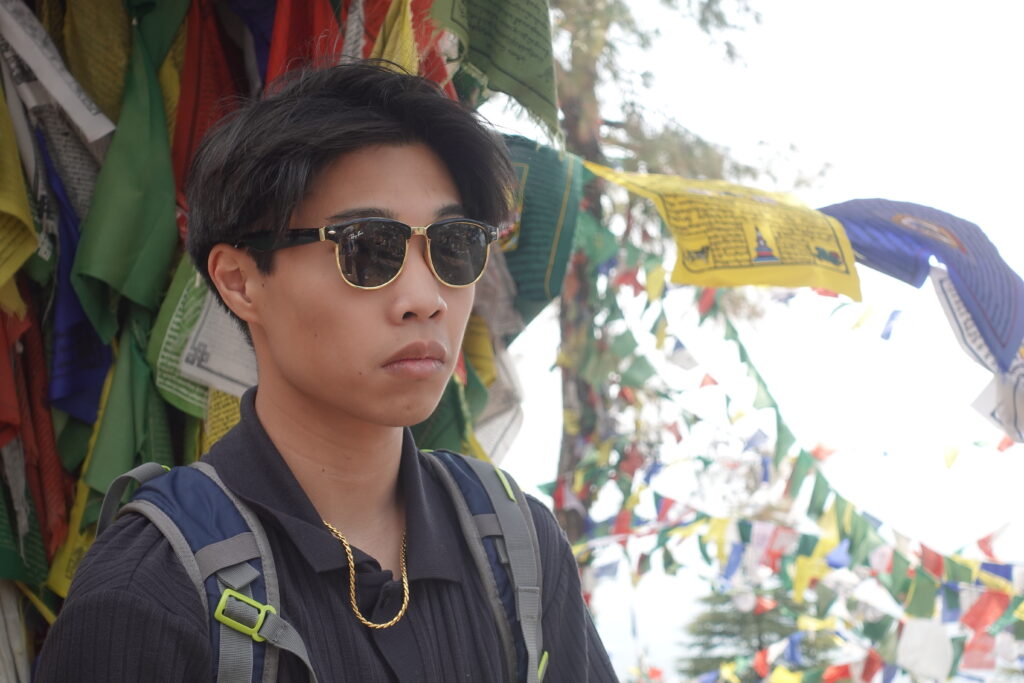
Today we would be meeting the Dalai Lama. I could not wait to see what would happen. This was because I was excited and nervous at the same time, and even now, I have the same reservations. The Dalai Lama is a very famous and revered person.
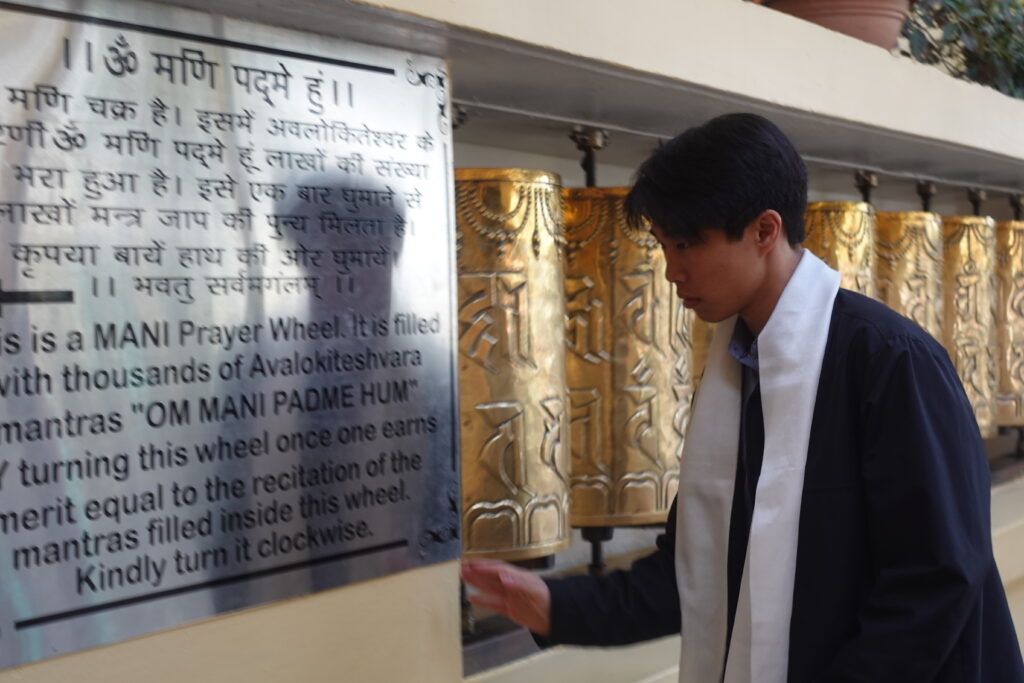
The walk was quick, and soon enough, we arrived at the Dalai Lama’s compound. The wait began. The wait was long, and at times I felt it would take hours, but I was surprised about one thing. I was still paying attention. I am, by nature, a person who is always thinking, and normally this takes the form of telling stories and remembering facts. This time, however, I was thinking only about the current situation I was in. I thought about who was next to me, who was in front, and how far I was from the Dalai Lama.
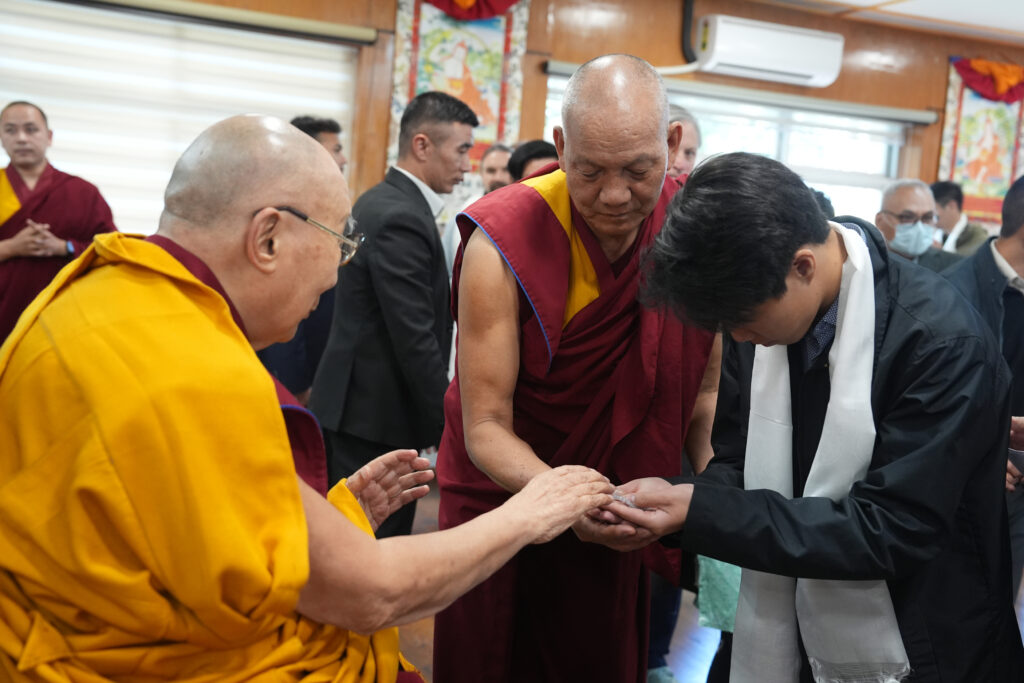
But soon, another concern hit me. I had not brought an object for the Dalai Lama to bless. Of course I had the scarf hanging around my neck, but everyone was getting their scarf blessed. I wanted something unique. Then I remembered that I had a friendship bracelet of beads that I got from a girl at the Ashram, and I knew that it was the object I needed. I quickly slipped it off my wrist, and my breathing soon returned to normal.
As I waited in line, two of the monks talked to me, and I was surprised by what they asked me about. One asked where I was from, and another asked about the bruises on my wrists, and I told him it was from a punching bag and not from a fight. He smiled at me and I continued on in line. Finally, the person in front of me moved, and it was my turn to be blessed. I extended my hands out with the bracelet inside of them, and I said “blessing”, so he knew that it wasn’t an offering. Then he closed his hands around mine, and just like that, it was over.
Overall, I’m happy with my blessing. Although I do not feel a major change in my life from the blessing directly, it has finalized my commitment to learning more about Buddhism, how to be a good Buddhist, and how to honor Buddha in my own life.
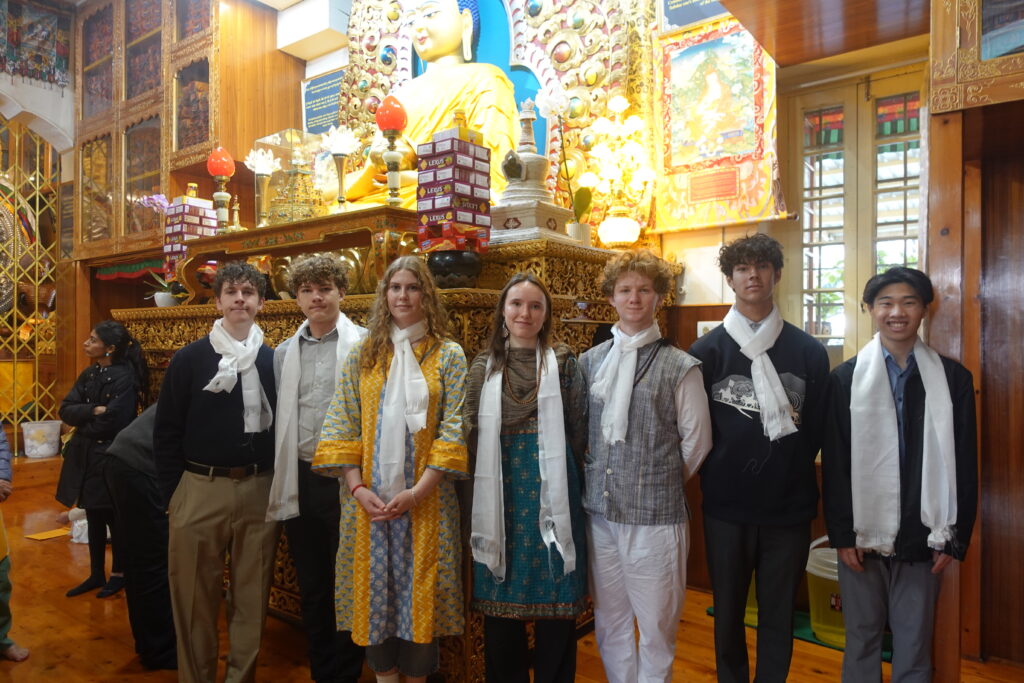

Encountering Holiness
“When you have nothing, you have nothing to lose.” — Bob Dylan
Easy for us to say. We have so much. Piles of things—more things. When something breaks, we toss it in the trash (perhaps after a few YouTube tutorials on how to fix it) and buy another. Convenience: a lifestyle that revolves around the purchasing of enhancements. That vacuum—while incredibly satisfying when it chooses to work—does not provide lasting contentment. It is temporary. It is fleeting. It is conditional: dependent on having a dirty floor, which is itself conditioned on having more things to dirty it.
Layer upon layer, our Western lifestyles amass these sediments. Layer after layer, they contribute to the mountain of “things,” of “stuff.” But what else is there? Another receipt? Another bill? Another metric to measure up to? To what end?
Our friends—brothers and sisters in humanity—fled through the night. They hid during the day, avoiding treacherous persecution from the “other.” They escaped with only the clothes on their backs, some prostrating for twenty-one days straight, callousing their foreheads and bruising their knees. Tomorrow was never guaranteed. Freedom existed only beyond the Himalayan range, in the haven of India. They carried nothing but an indomitable spirit, exalted by a generational heritage of faith in the interconnectedness of all beings. Faith that when they arrived—tired, cold, hungry, and alone—they would be received with kindness and make a home, albeit on foreign soil.
India welcomed these sisters and brothers from the land of Tibet, granting them refuge, supporting their autonomy, celebrating their vibrancy, honoring their religious ceremoniousness, donning their colors, and sharing in their devotional fervor.
How can a people persist in such joy as refugees? Perhaps the lesson is obvious, waiting to be received. Great teachers remind us that inner peace begins within. Maybe in extreme discomfort and material instability, the virtuous and resilient people of Tibet discovered an invitation to turn inward—to find their true home, their enduring happiness. Perhaps the less we have to pull our attention outward, the more direct the path to our compassionate hearts becomes.
When we sat in the waiting room this morning, awaiting His Holiness the Dalai Lama, everything felt ordained. A chaos so poised, regal, and beautiful embraced us like a warm hug. We waited together in tantalizing anticipation, hoping to be graced by his presence. He entered, ushered in by monks and devoted attendants. Group by group, we formed a winding, snake-like line. Each group was announced by its association and offered a brief but penetrating moment of his attention. His face—playful yet profoundly serene—lifted the fog from the sky.
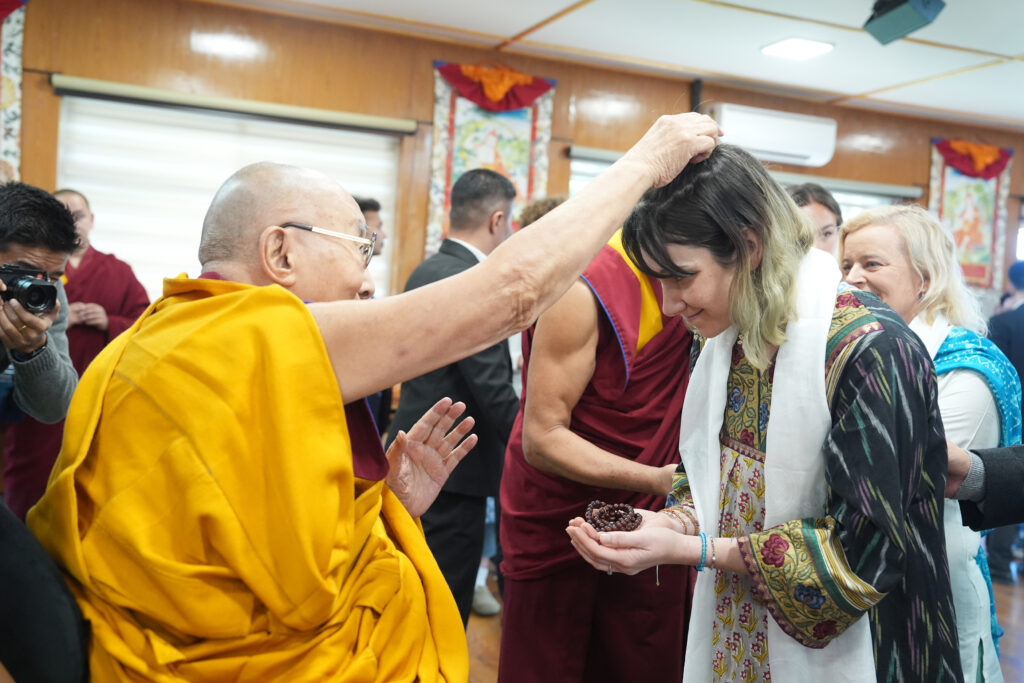
Thank you, India, for sharing your mountains, your fields, your soil with the people of Tibet. Thank you, Tibetans, for persevering with utmost joy, color, and spirit. Thank you to the nations that cooperate so powerfully and publicly, showing us that peace between peoples can endure—that difference can be embraced, and that it makes us stronger and more compassionate as a species.
May our faith not rest in material things that fade, break, and clutter our sacred attention. May we look instead to these living examples of deep peace—of reliance on the intangible yet profoundly real force that binds us together in love.
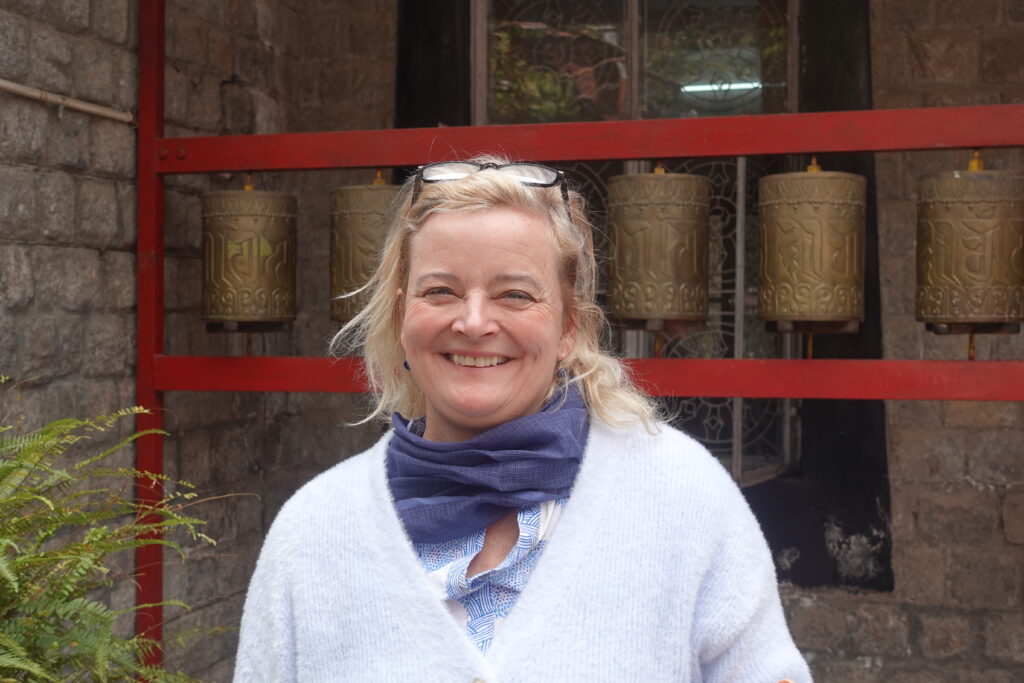
I was standing in a colorful, sunny courtyard rippling with people in all kinds of costumes and regalia, bright woven fabric and sleek embroidered silks, flowing robes of monastic and other traditions, well tailored western suiting and other outfits I can’t describe because they have no place in my experience of the world. There was a crowd of anxious people, all in their personal and cultural best, waiting at a small doorway to be called into the next step on the path to be blessed by Jetsun Jamphel Ngawant Lobsang Yeshe Tenzin Gyatso, His Holiness the Fourteenth Dalai Lama.
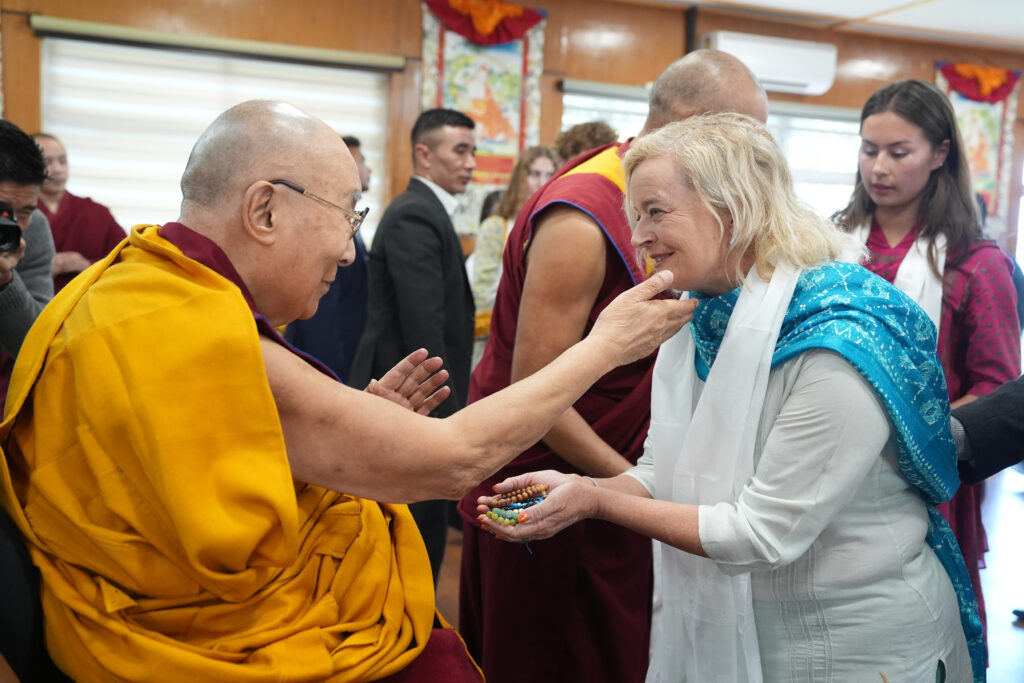
Buddhist believers think that the Dalai Lama’s are reincarnations of Avalokiteshvara, the bodhisattva (Demi-god) of compassion. In the two times I have been in the presence of his holiness, I have, indeed, found him to be the most compassionate person I’ve ever met. Fifteen years ago, in a long conversation, he taught me to love my enemies and to accept them as teachers. Today, as he looked deeply into my eyes and gently touched my face, I had the overwhelming feeling that he somehow understood the toil I endured this year, and in a way, the load I carried was instantly lighter.
I do not like organized religion. I do not believe in higher powers that can manipulate the minutiae of human experience. I deeply distrust the hierarchy and structures of major religions, knowing too much about their history. I do, however, firmly believe that there is much magic, and myth, that exists beyond the current explanations of science. We will explain it someday; we haven’t yet, but we can feel and describe and know it in the present. I believe that His Holiness has magic about him. Perhaps it originates in the difficult circumstances he has faced in his life, or in the years and years of meditation, dedication to others, and study that are required of him. Or perhaps it has arrived in the probability field between gluons or in the travel of the undiscovered particles at the vertices of E8, or perhaps Tibetan Buddhists are correct. In any case, his magic is as real to me as the chana masala I had for breakfast.
High Lamas in this area are beginning, I hear, to have visions about the birth of the next human body that will carry the bodhisattva of compassion. They have indicated that the fifteenth Dalai Lama is likely to be a westerner, and she will be born in a female body. I wonder, if she accepts the honor, how she might change the world.
While I stared at a giant painting of the Potala in Lhasa (the palace that has been the residence of the 5th-14th Dalai Lama’s, and was so until the Chinese conquered Tibet), I could not help but wonder how the structure of a religion convinced people to build such an enormous palace. Did they toil in the sun for little or no pay, promised that this was a path towards enlightenment? Weren’t Mecca, the Vatican, the Golden Temple, and other centralized religious seats much the same? I looked it up. While not slave labor, the building of these places does not, entirely, fit the doctrines dictated within. I am fascinated by the active ritual held in these places when they seem like they should be museums.
The thoughts I wrestle with are rampant in the modern world. The Dalai Lama was interested in Mount Madonna’s Values in World Thought program and first invited us for a conversation 17 years ago because he believes that secular schools hold the future of moral and ethical teaching. New generations are turning away from organized religion in record numbers. Schools will have to take up the teaching of ethics, in his opinion, and our Values program is a shining example of this. The program asks students to explore and define their own morals and ethics without dictating or indoctrination. The juniors and seniors read, discuss, sample, and question thought leaders from around the world as part of the process.

Compassionate Presence
Being in the presence of such a revered, practiced, and wise spiritual leader was both impossible to wrap my head around, and simple at the same time. There was a deep sense of humanity in the room; dozens of people making their way towards the Dalai Lama, in tears, humility, joy, gratitude, and other deeply human emotions. The Dalai Lama blesses around 600 people every day, so I almost felt guilty for being there. I wondered if he would be tired of doing this. Somehow, the opposite was the case. This was not a celebrity overrun with fans and tired of giving autographs. This was a joyful being, living a life of compassion and service, and choosing to connect with others in a beautiful way each day.
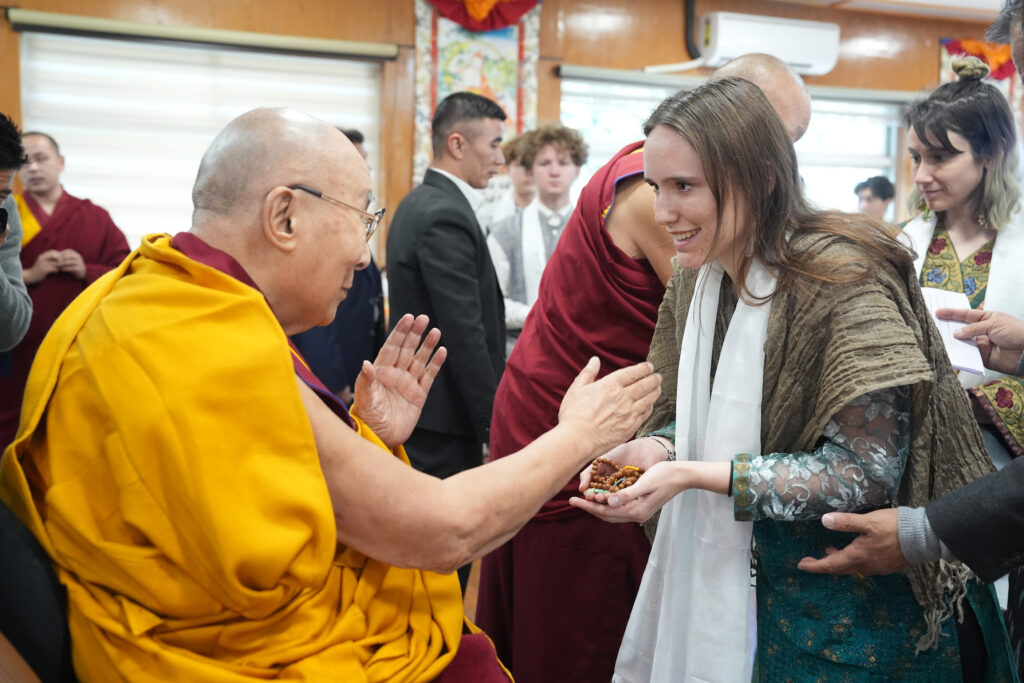
I didn’t know what to expect from my moment with the Dalai Lama. I tried to watch his interactions with the people in front of me, but somehow, even in this crowded room, he still seemed to have a personal, private, present moment with each individual. He is 90 years old and blesses so many people every day, and yet I gathered after the experience that he had blessed each member of our group in slightly different ways, making us all feel truly seen individually. The experinece was amazing. He made us feel like we were not just another face in the crowd.
The word that struck me about my meeting with him was gentleness. His gentleness removed all signs of aging, worry, or anything else apart from the moment we shared and the simplicity of it. We looked into each other’s eyes and I felt humbled by the gentleness in the lines of his face, his smile, his sparkling eyes.
I continue to be struck by the Dalai Lama’s health and kindness after living through a life full of hardship. He truly practices what he preaches in the sense that happiness can come from within and from service to others, regardless of the circumstances and the suffering we go through. The Dalai Lama is so inspiring, not because so many people follow him, but because he is a living embodiment of a beautiful ethical system that brings out the best of human nature. The themes of compassion, connection, and happiness despite suffering, have been prevalent throughout the trip, and meeting the Dalai Lama solidified all of these experiences into one awe-striking, moving moment.

An Entourage of Gratitude
The hotel where we were staying was very close to the Dalai Lama’s palace, which made everything feel more immediate. When we finally got to visit this palace, there were many other foreigners nearby. Clearly, people had traveled far just for the chance to see him, even briefly.
The security was much stronger than I had expected and envisioned. We were told to bring almost nothing. No phones or cameras. The restrictions felt intense, stricter than when we once visited the Pentagon. Every entrance was monitored; we saw armed security on the balconies. Every movement felt very controlled by the Dalai Lama’s assistance. At first it seemed excessive. The level of respect surrounding him explained it. He received many gifts.
There were so many people who simply wanted to see him in person. I was surprised; before, I had not fully realized how respected and important he is within Indian culture and across the world. The admiration was visible in the careful preparation that took place before his arrival. The Dalai Lama is very well cared-for. The attendants spent a noticeable amount of time preparing his space. They positioned his chair carefully so he could sit with ease. Many minor and small adjustments were made for his comfort. This experience taught me the importance of cultivating, and earning, respect.