Each year, during the preparatory stage of the learning journey to India, I ask the seniors to reflect on what they hope to gain from the experience, individually and collectively. Together, we consider a series of guiding questions so that they can tease out their thinking and be purposeful in their intention setting. As part of this process, the senior class selects a word that will serve as a compass on their journey; something that can anchor them to their purpose.
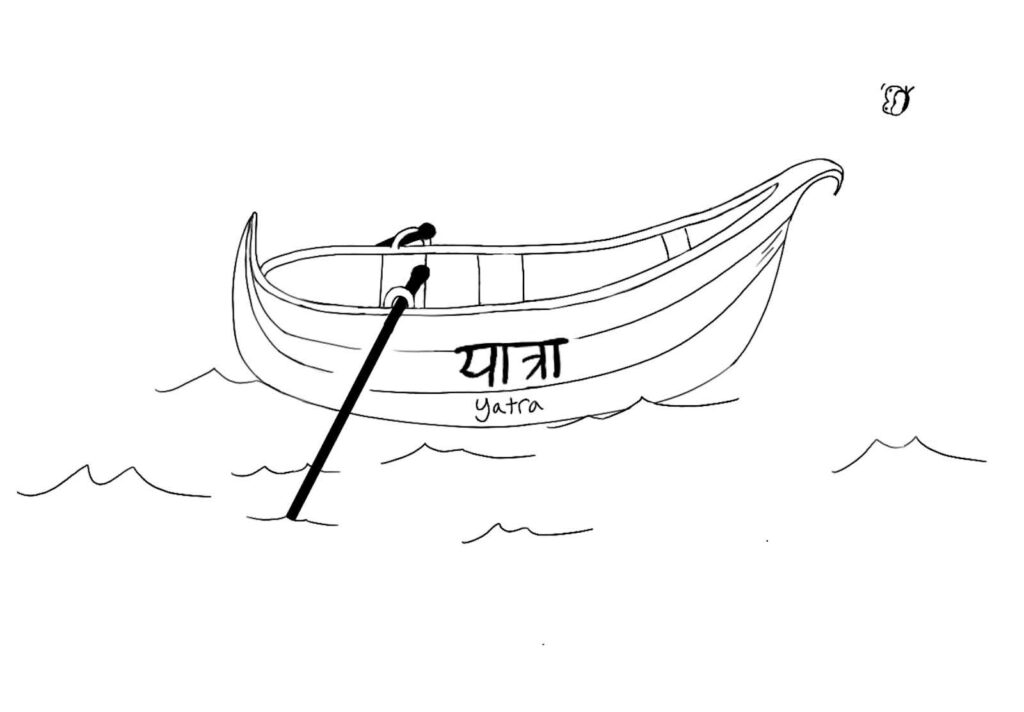
Language is fascinating. Entire concepts and complex ideas can be captured in one single word, and at times the complexity contained within that word is almost impossible to fully translate. The word the seniors selected this year is one such word: Yatra.
Roughly translated, Yatra is a journey that helps free us from mental and physical conditioning. It is a journey of rediscovery of self. This single word, in its complexity, perfectly encapsulates what the senior class hopes to gain from their learning journey.
We invite you to follow along as we embark on this journey of rediscovery of self.
The 2026 journey to India will take place February 13 – March 1.
On April 20 the Mount Madonna School (MMS) junior class, along with their teachers Chelsea Otterness, Greg Shirley and Claire Otterness, will travel to Washington, D.C. Their week will be filled with tours and interviews with an array of interesting individuals. Unfortunately, I am unable to join them due to an injury. While I am sorry to miss this opportunity, I am confident that the trip will be a success.
The Government in Action program was started in 1989 by Sadanand Ward Mailliard. Over the years, Mount Madonna School students have been fortunate to meet and interview some of our nation’s finest public servants. The Washington, D.C. learning journey is an integral part of the “Values in World Thought” program at Mount Madonna School. This unique trip to Washington, D.C. provides MMS juniors with a direct personal experience of those who devote their lives to public service.
We are motivated by a sincere desire to inquire into the values and experiences of those who serve our nation in all branches of government and beyond. We interview individuals who are committed to improving the quality of life in our nation and around the world, and who have the values and character that we wish to instill in our students.
In a time of division, the Government in Action program provides our students the opportunity to actively listen with open minds and hearts. It is our belief that we can positively impact the world by engaging in conversations of meaning, being curious, and being open to learning from people with different perspectives and lived experiences.
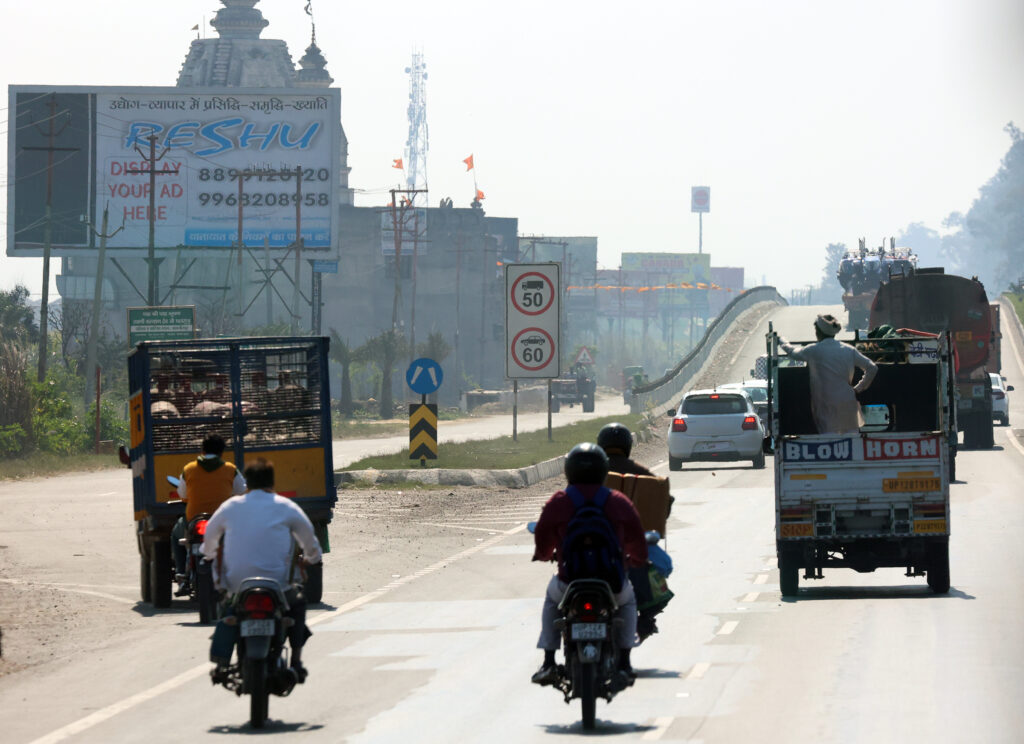
Today, in our more than eight hour drive to Agra from Haridwar, I found myself looking outside the window to the passing Indian freeway. I imagine anyone reading this who has traveled eight hours in one sitting before would know, you get bored. Then the question arises, how do you keep yourself entertained when time seems to come to a halt? I had attempted to solve this problem before, on our initial five hour drive to Haridwar, by trying to spot the moped scooter with the most people on it. This kept me enthralled for a solid 15 minutes, as I observed the number of persons on these scooters slowly increase, until I finally reached my India all time record of seven persons per one scooter! Far from the Guinness world record of 58 people on a moving motorcycle, but still quite an impressive feat on a motorbike only made to seat two.
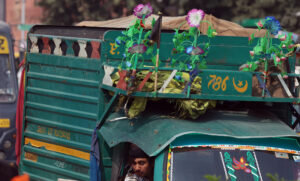
So, as I observed out the window on this eight hour ride, looking upon wooden cart fruit shops, with my eyes halfway open, and my back sore from hours of travel; suddenly a spark of an idea floated into my brain, that would soon turn into a full blown inferno. This spark came from a seemingly innocuous object we had seen everywhere we drove this entire trip, the beauty and opulence of Indian delivery trucks.
With my interest peaked, questions started to flood my head with the power of a monsoon, why decorate these trucks? Does the style of illustration and decoration differ from state to state or driver to driver? Does the art serve a purpose beyond decoration? Are there professional truck Picasso’s? But most importantly, what can we take away and bring into our own daily lives from these humble trucks and drivers? These were questions that, in my opinion, must be answered! So with nothing but a phone, notebook and a burning desire to learn more, I began my curiosity driven exploration into the wold of Indian trucking
So how did this all start?
It all started in the 1920s in British occupied India, with the importation of British military trucks. These trucks carried a variety of cargo, from weapons to people, but the cargo essential to the beginning of truck painting is kerosene. These trucks carrying highly flammable substances would have the words “Horn Please” written on the back, graciously asking whoever was driving behind them to sound their horn while passing the truck. Soon phrases from origins in driver safety, such as “Horn Please” and “Use Dipper At Night” became commonplace on trucks in India, and are still seen today. In the 1940s, companies began to paint trucks with company iconography, and logos, as an attempt to advertise their business. Shantanu Suman, a graphic designer and filmmaker who created the 2013 film “Horn Please”, in a interview with CNN travel had this to say about the state of advertisement on Indian trucks: “Imagine the truck is like a moving billboard. It travels from one side of the country to the other, carrying the message of the truck driver and owner.” And, “A better looking truck attracts more business.”
How does the art vary from region to region?
Each state of India has its own unique truck art scene. For instance, there is a style divide between Northern and Southern India, the South keeping a more conservative approach to motorized mosaics by maintaining minimalism, keeping plain interiors and exteriors. Opposed to the Northern Indian scene which embraces the opulence with large hand painted scenes and hanging tassels from the front of each truck. For example, the truck that flicked the metaphorical “light switch” in my head, had a cartoon painted rendition of the Taj Mahal on the rear gate of the truck, from the maximalist design and myself, being in Northern India.
All creeds and colors drive these trucks, so a large range of religious iconography is often painted by drivers to emphasize who is behind the wheel, symbols such as the mother and calf, star and sickle, cross, Om and many more! These small accoutrements can help drivers who spend 10 months out of the year working away from their loved ones feel like they are home away from home..
What can we take away from these motorized Michelangelo’s and Michelangela’s? Besides curing my boredom, and giving me design inspiration for my car back at home, these drivers and their noble motorized steeds serve as a reminder that we can add color and joy to the seemly mundane parts of our lives and just because you have to work doesn’t mean that you can’t make every moment your own. That artistic self expression is not limited to “Creative careers” and that everyone, no matter the occupation can benefit and express joy by showing who they are.
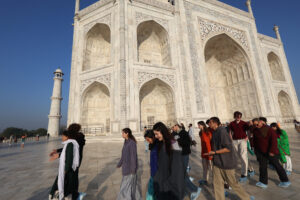
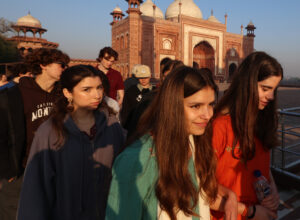
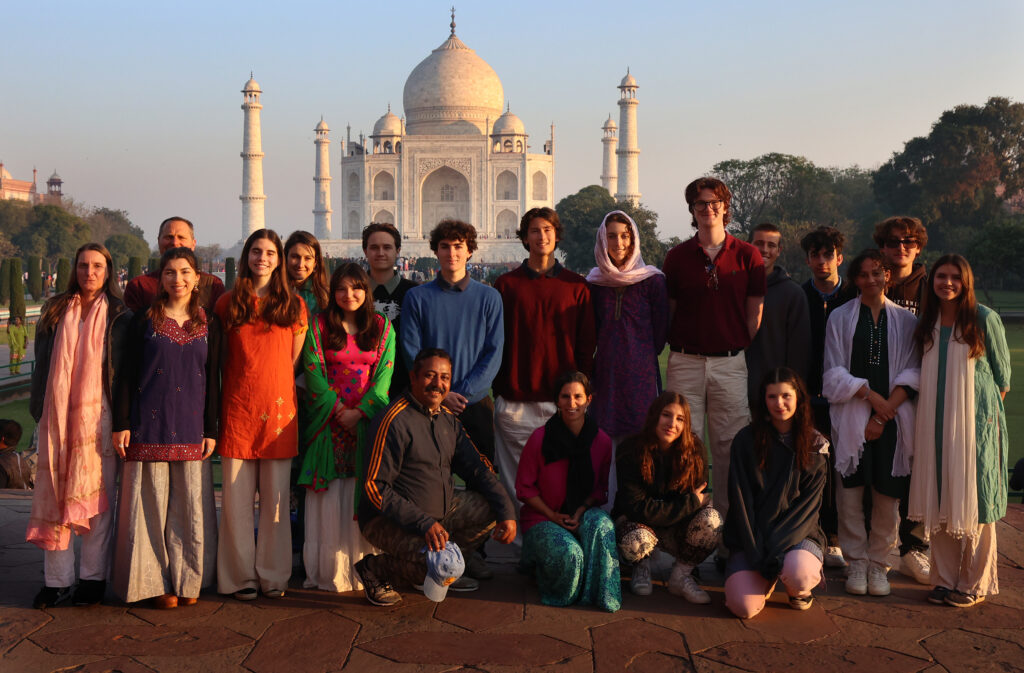
Today we had the opportunity to visit the Taj Mahal in the early morning. My classmate Peter and I woke up at 5:15am in order to meet with the group in the lobby at 5:25am. Once we arrived at the Taj Mahal, we got off our bus and onto other vehicles that were like extended golf carts. These extended golf carts took us to the entrance to the Taj Mahal, where we then had to wait in line for roughly 40 minutes. The cause for the long wait was partly because it was not open yet and also because the security checkpoint was slow. By the time we all made it through security it was around 7:30am.
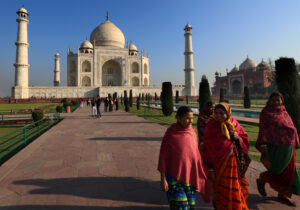
Before getting to the actual Taj Mahal, you get to the Taj Mahal Courtyard which is a large square shaped area that has a huge gate that leads to the Taj Mahal. Up until that point, you could only see the very top of the Taj Mahal, so there is a lot of built up anticipation as you walk through the gate. Normally, I am not easily impressed by architecture and buildings, but the Taj Mahal was one of the few buildings that did impress me. Not only is it massive and so much to take in from afar, but when you get closer you see all the fine details that were put into the building and it is even more spectacular. Not only are the paint patterns all along the walls and ceilings eye-catching and captivating, there are also hand carved shapes in the marble all around the Taj Mahal which are even more impressive.
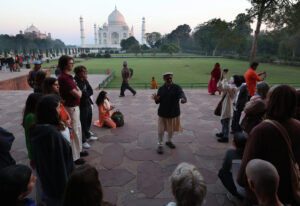
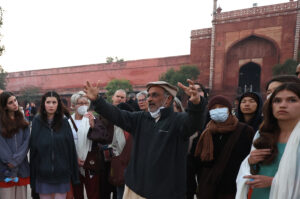
During our visit our guide, Shantum, gave us some history on the Taj Mahal and there were a few things that I found intriguing. First, he explained that the Taj Mahal actually isn’t solid marble, but that it is instead built out of bricks and then was covered with a marble coating. The place from which the workers got the marble was roughly 300 kilometers away, so the fifth Mughal emperor, Shah Jahan who built the Taj Mahal for this third and favorite wife, also had to have roads built to the quarry. In total, about 22,000 people helped build the Taj Mahal and it took them 22 years to do so. The actual building was done after a little less than a decade, but all the decorations and the gardens took a lot more time to build. It is quite an impressive building to entomb and profess his undying love to his wife. As the story goes, as she was dying giving birth to their 14th child, she asked him to build something as beautiful as their love.
Ona Musoll-Buendia
At 5:00 am, our alarm sounded, waking me up for what I didn’t know was going to be the most awe-inspiring day of the trip. The Taj Mahal has been an icon representing India for me, all of my life. I have seen it everywhere, on posters in my elementary school classroom as well as in books, but I had never once thought that I would be looking at it in person, let alone standing inside of this amazing work of art. Before we could see the Taj Mahal, we had to go through the impressive main gate. It has gorgeous detailing within the red sandstone from which it is made, with flowers made of 60 pieces of semi-precious stones each lining the gate, creating a beautiful frame. Around this, a calligraphic inscription is engraved. It reads, “O soul, you are at rest. Return to the Lord in peace with him, and he at peace with you.” Shantum, our leader for the day, explained that as we walk through the gate, we leave everything in the world behind and enter, focusing only on the present. Walking through the gate was an incredible experience. The shape of it perfectly framed the Taj Mahal, which was a long distance away, but it seemed closer than it appeared. Shantum had mentioned that there were some optical illusions that the gate created; for example, if you started walking backward in the gate, it would look like the Taj Mahal was moving toward you. Outside the gate, beautiful gardens were waiting for us in the dim morning light. A long strip of water ran through the middle of the area, leading up to the Taj Mahal. I took a moment to center myself and listened to the morning birds singing. Looking out at the Taj Mahal, I could not believe that it was real. A breathtaking ombré of colors created the perfect backdrop for the stunning Taj Mahal.
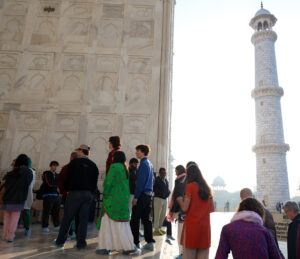
Shantum had wanted us to go early in the morning so that we could see how the sunrise changed the whole aura of the place, and he was correct. As the sun rose, light reflected off of the marble dome of the Taj Mahal. The sky turned blue and more people came filing in. Here, I learned a few of the architectural decisions that were made. Shantum explained to us how the sun frames the Taj Mahal, which faces south. Looking at it from the front, the sun goes around the building each day, changing its appearance every hour of the day. I also learned from my teacher Chelsea that the two closest columns on the side of the main building were slightly tilted out on purpose to look more straight and so that if there were an earthquake, they would fall out and not destroy the building. The inside of the Taj Mahal was just as beautiful as the outside. There were flower engravings everywhere, as well as the same flowers that were on the main gate. In the middle of the room, two marble caskets with beautiful detailing were surrounded by a marble gate. One side was open so I could see through. The one in the middle was for a man’s wife, which is who he designed it for. The second casket was off to the side because it belonged to him. The acoustics inside were amazing. Although speaking was not allowed, many people were talking and I could hear the riveting echoes throughout the building.
I now understand why the Taj Mahal is considered one of the wonders of the world. Its beauty surpasses many places that I have been to, and the feelings you get when you are there are indescribable.
Irulan Cockrum
On Wednesday night, our class arrived at a hotel in Agra, where we were greeted by Shantum, one of our tour guides. As we gathered before dinner, Shantum outlined the plans for the following day, including an early morning visit to the Taj Mahal.
The next morning, my roommate Sophia and I rose early, meeting the group in the lobby at 5:30 AM as planned. Walking to the bus while it was still dark out had a sort of auspicious feeling, amplified by our teacher Shannon’s encouraging words: “the early bird gets the worm.”
Upon arriving at the Taj Mahal, I felt extremely tired having woken up at 4:30 AM to see the sunrise. Standing in the long line for security increased the anticipation of laying eyes on a marvelous sight that everyone speaks so highly of.
Guided by Shantum, a man of spiritual insight, we were encouraged to pause as we walked through the entrance that framed the Taj Mahal and take a few steps back. He explained that by stepping back, we could imagine the Taj Mahal coming to us rather than us coming to it. This spiritual approach heightened my appreciation as I beheld the majestic beauty of the Taj Mahal.
Shantum’s explanation of the Taj Mahal’s architecture, crafted from pristine white marble adorned with intricately carved and inlaid flowers, was mesmerizing. Learning that the designs were not painted but precisely fashioned from colored stones like sapphire and malachite made me feel even more astonished.
Venturing inside, I marveled at the intricate floral patterns, each petal made with around 60 individual crystal pieces. This attention to detail left me in absolute awe.
My visit to the Taj Mahal deepened my fascination with architecture and design. Its sheer dedication and expression of love through architecture left a huge impression, reaffirming its status as a timeless masterpiece. There was a mystical allure that captivated me in a way that surprised me. Its history, dating back to 1631 when the Mughal emperor Shah Jahan built it for his beloved wife Mumtaz Mahal, feels like a plot from a movie script. I was intrigued. There are no words to describe how I felt when I saw the Taj Mahal. My fascination with it runs deeper than I thought it would. The Taj Mahal, made from intense dedication and love, is unique and magical.
Talks with a Monk
Cooper Padilla
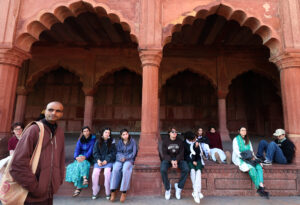
Today, we went very early in the morning to visit the Taj Mahal in Agra. My class and I were accompanied by a friend of Shannon (my teacher), whose name is Shantum Seth. Shantum was in Agra to meet with us but also to give a Buddhist tour of India to a group of people. The group was made up of people with many different backgrounds, some of whom were monks. As we walked around the Taj Mahal, taking in all its glory, I started to wonder why someone would decide to be a monk. So, I asked one of the monks from Shantum’s group what drew them to choose being a monk.
The man I talked to didn’t tell me his name; he asked me to just call him Brother. He was originally from the Netherlands but was now residing in Bordeaux, France. In response to my question, he told me that a big reason he was a monk was to serve others and to strive towards being a better person. This was a simple but wise answer. Serving something greater than yourself and performing work to accomplish enlightenment is a purpose that I find very noble. He then began explaining to me some Buddhist philosophies that he himself found very helpful and truthful. The first thing he taught me was the benefit of shedding all dogma. He explained that dogma is a preconceived idea about something. It is something that the mind uses to identify objects, beings, and concepts. But this is not taking things for how they really are. He used the example of a tree. When one encounters a tree, it is easy to look past it; it is just like any other tree. No, every tree holds a unique personality and artistic beauty. Letting what you are perceiving in the moment into your mind and affect your feelings can heighten your happiness. He told me to listen to the birds in the distance, which I had been hearing all morning but had tuned them out until then. This practice brought me into the moment, finding happiness by making the little things bigger than they seem.
He also talked to me about how returning to the simplest, purest form of yourself is the ultimate goal of bliss in Buddhism. He spoke about how many people are concerned about what they can gain by obtaining material things and other satisfactions. However, the true self has been within you all along, in your soul. It is a matter of stripping yourself of your dogma, what you believe yourself to be. He taught me how simple life should be, but also how vast a moment is. The way in which our mind views life around and within us is a changeable thing. When we practice patience and perception, the concept of happiness can change altogether.
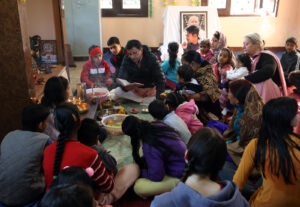
During our time at Sri Ram Ashram, we were introduced to a prayer tradition called Arati. Arati is performed and celebrated by the Ashram kids every night before dinner, but it extends beyond just the Sri Ram Ashram; it’s a part of Hindu culture. Arati entails a ritual of devotional singing and prayer towards Hindu deities. It is a time of passionate praise and worship, vastly different from what I have witnessed in Western culture. Observing the kids treat Arati with such respect and focus was inspiring. Children ranging from around ages three to eighteen come together selflessly to devote themselves to a higher purpose. Despite my expectations based on experiences in the West, I was mistaken in anticipating misbehavior and distractions among the children.
Arati is performed before a shrine holding various Hindu statues and pictures, along with a flame lit in praise of the deities. However, it’s the rhythm and melody of the Arati songs that moved me the most. I was taken aback when the drumming for Arati began. Initially, I had seen very young children holding drums, and I hadn’t expected much rhythmic competence. I anticipated a simple four-beat rhythm, similar to clapping along with a song. However, the young musicians demonstrated a unique rhythm with specific emphasis, transitioning from a four-beat to a seven-beat time signature seamlessly. This amazed me, as Western music rarely incorporates such exotic time signatures. Even very experienced musicians I have met would struggle with this concept. To the children, however, it was second nature. The drummers interacted with each other, playing separate parts at times, thus creating a more diverse rhythmic structure. Then, in unison, they would completely change the rhythm as required by the Arati song. As I attended Arati more frequently, I noticed that most of the kids could participate in the drumming with a sufficient level of understanding. Initially surprising, I later realized that since they had Arati every day, this proficiency was understandable. It was beautiful to see how the children absorbed this rhythmic feel at such a young age, much like learning a language through immersion.
Another aspect that amazed me was their patience, particularly during a call-and-response section of the song led by one of the older kids. The phrase was sung, and then it was up to everybody else to repeat it rhythmically. Initially, my classmates and I rushed the beat, a common issue among American musicians, especially younger ones. However, the children from the ashram repeated back slowly and meticulously, without any sense of urgency, perfectly in time with one another and relaxed in their execution. While I’m uncertain why they possess this rhythmic acuity, I’m inclined to attribute it to their presence in the moment, something that the United States is known to lack.
These experiences have altered my perspective on music and how I intend to conduct myself as a musician in the future. Patience and presence are key.
Beatrice Miller
Once a year, a group of bright-eyed seniors spend a brief week at Sri Ram Ashram. It’s a week of close-knit meals, friendly playtime competition, and comforting Aarti evenings. The memories made at the ashram impact these twelfth graders lives forever, marking their time in India with joyful energy, and then they leave.
Now, as it is my turn to experience this journey to Sri Ram, I try to remember the reality of the people who live at this orphanage. They grow up in the magical world that I only have the privilege to visit. They have not one, but three mothers. Each woman who is dedicated to loving these children and ensuring they know they are cared for. They have a village of friends, siblings even, with whom they grow up. The ashram is more than just a week out of my India trip; it’s the chance to meet a whole family. A chance for me to make connections so that I may bond with girls my age, a few days to learn about their interests, habits, and games, and to become their Didi (which means older sister in Hindi) and hold their hand all day long. I don’t have any sisters, yet now I have so many little ones. Little sisters, even brothers, who have come from all walks of life. They have written me letters and woven beautiful little bracelets for me to wear, tokens of their love and appreciation for how much my time means to them. I wish I could stay longer at my home away from home.
As a 17-year-old high school student, embarking on a two-week learning journey to India, I find myself overwhelmed with a sense of privilege and gratitude. In a world where opportunities are not equally possible to all, I recognize the immense fortune that has been placed in front of me with the chance to explore the beautiful tapestry of India’s culture, music, religions, and vast diversity. Day by day, as I dive deeper into the intricacies of Indian culture, my journey extends beyond mere sightseeing; it delves deep into my heart and soul of learning and understanding someone else’s culture.
Every single person we interview, shopkeeper I bargain with, and every namaste I speak with a bowed head, shows me that I am privileged to interact with individuals whose lives are filled with a richness that surpasses material wealth. Their warmth, hospitality, and unwaveringness are a touching reminder of the inherent dignity and humanity that unites us all. Though, even as I celebrate the richness of my experiences, I keep mindful of the complexities that accompany privilege. In this world, where inequality and injustice are persistent, it is incumbent upon me to recognize my privilege not as a badge of superiority, but as a platform for empathy, understanding, and meaningful action. On Saturday, as I bid farewell to the beautiful land of India, I carry with me not only memories of its breathtaking landscapes and vibrant cultures, but a renewed sense of purpose and responsibility.
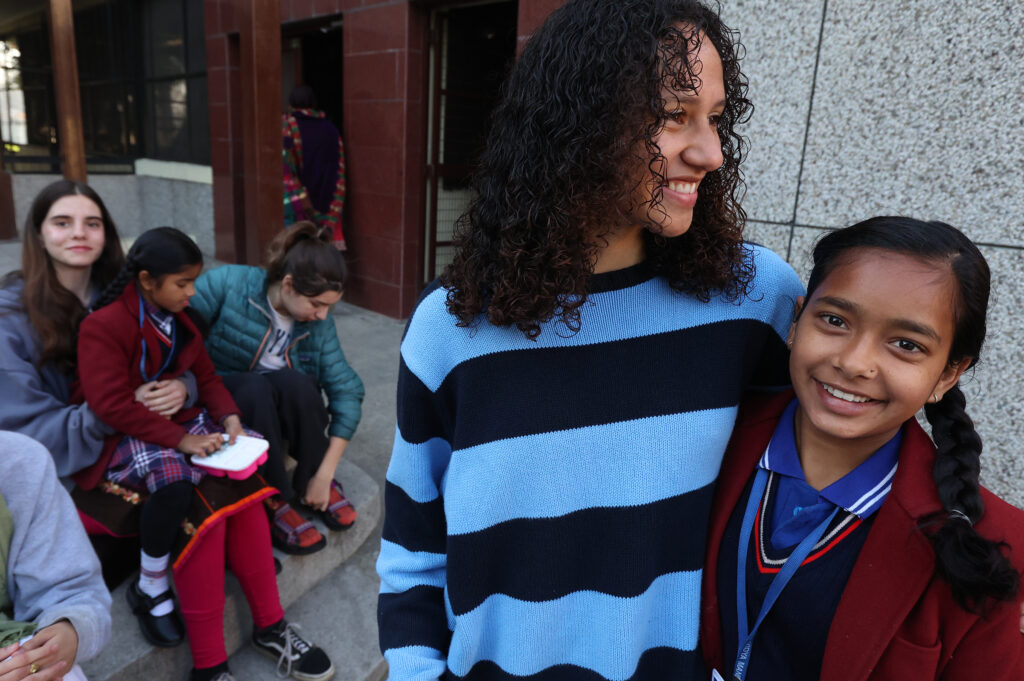
Today, our visit to Woodstock School in Mussoorie proved incredibly inspiring for me. This boarding school is distinguished by its commitment to various core values, one of the main ones being service. We discussed the historical roots of service, traditionally associated with religion, and considered its evolution into something sought after by colleges, often devoid of its original altruistic essence. This transformation reduces acts of service to nothing more than checkboxes on applications, devoid of genuine intent to help others. Woodstock tries to preserve the purity of service for its intrinsic value by encouraging students to start clubs and projects only with genuine interest in them, and to avoid creating these things simply to boost a resume. The teachers work closely with students, and since I plan to become a teacher, I felt that was something I would like to remember when working with students.
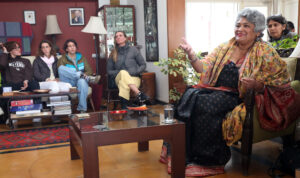
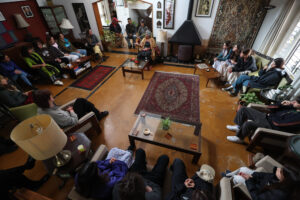
Later, over tea, we had the privilege of conversing with journalist Ranjona Banerji, who highlighted a similar loss of authenticity in journalism. While the United States remains a “North Star” of authentic journalism, much of the industry has become solely for entertainment rather than delivering substantial news. Banerji emphasized the importance of confronting controversial topics and discussed the current trend of media catering solely to personal, preconceived beliefs, thereby stifling meaningful dialogue among diverse perspectives. Our society has become isolated, and we avoid contentious topics crucial for progress. Acknowledging and embracing our differences is incredibly important to prevent further fragmentation and foster genuine understanding. Banerji poignantly reminded us that despite our differences, fundamental human emotions remain universal. She urged each generation to appreciate the nuances of individual experiences, encouraging empathy and dialogue. She said, “Remember what you were like when you were young so you don’t lose that part of you.”I feel that was a strong theme today, not just as a person, but as a society.
In conclusion, our experience at Woodstock School and the insightful conversation with Ranjona Banerji emphasized the critical need for preserving authenticity in service and journalism, fostering dialogue, and embracing diversity to navigate the complexities of our ever-evolving society. These lessons resonate deeply, serving as guiding principles for personal and collective growth.
Bella Sol Padilla
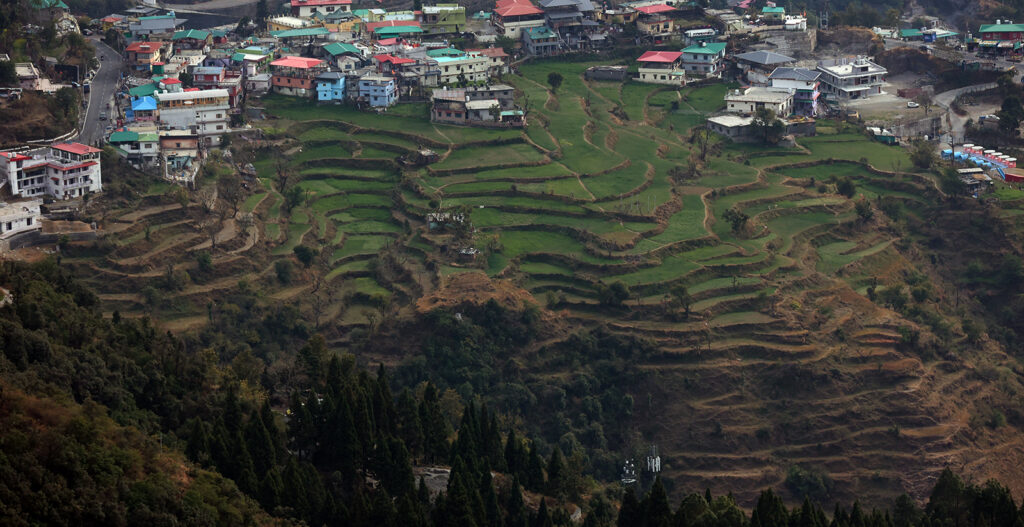
Towards the end of our India trip, while up on the mountain of Mussoorie, we had the opportunity to have a tour of a school called Woodstock. Similar to Mount Madonna, Woodstock is surrounded by mountains and picturesque scenery. Although the weather is usually mild and sunny, we visited on a cold and foggy day. As the mist of the fog blew, my classmates and I hiked up the mountain to the school. The school itself is well maintained, which I found interesting because Woodstock is one of the oldest international boarding schools in India. I would assume the students attending Woodstock would get their mountain legs quickly as our day was filled with climbing steps and trekking through woods.
The leader of the tour, Jamie, who is the Director of the Center for Imagination, walked us through the beautiful campus. She spoke to Woodstock’s diverse community. India is well known for being a melting pot of diverse cultures and religions. Naturally, I wasn’t surprised when Jamie told the group that Woodstock fosters students from 36 different countries. It took me a minute to process as my classmates and I all come from the same state.
Beatrice, one of my classmates, asked Jamie how Woodstock managed to fulfill the needs of students with different language barriers. Jamie explained that there is actually a project in the works that is about native languages and translation. The three main languages taught at Woodstock are English, Hindi, and French. However, it seems that this project will help create more space for students who speak specific languages. Jamie pointed out that through the process of translation, meaning can get lost, so students who participate in the project will have the opportunity to write a piece in their mother tongue, and translate it into English. The purpose is to observe translation and allow the students to express themselves in the language most comfortable to them.
One of Woodstock’s main principles is service. Woodstock has historical roots as a Christian school, however, students of all backgrounds and religions are welcomed. Something I noticed is that the act of service or giving back to the community plays a large role in any religion, not just Christianity. Students are given the time and space to invent new ways to give back to the community. Whether through their annual fundraisers to raise charity, or through volunteering at local hospitals, students are surrounded by this culture of giving.
It made me reflect on a community service project my class is involved in. At our school we have pioneered a project that will help restore the lake on campus, called the Lotus Project. This culture is not just prevalent in the school but in all of India as well. I hope to take this culture of giving back home with me and incorporate it into my own work.
Sophia Manzur
For the longest time, I have found it difficult to feel empathetic towards individuals with opposing opinions. I think my family can attest to this, especially when I feel passionately about certain social issues. As humans, we crave, yearn, and fight for our individuality. That being said, it is easier to categorize ourselves with others who feel similarly, rather than finding a middle ground and coming to the realization that we are all human beings. People (especially politicians) have taken advantage of this and have used it for their own political agendas. We get so concerned with our own views that we don’t realize that sometimes, we are fighting for the same exact thing.
Today my class had the honor of having a conversation with Ranjona Banerji. Banerji is an Indian journalist who is best known for her insightful and analytical writing. In her time as a journalist, she has contributed to prominent publications, giving them a unique perspective on various social, political, and cultural issues. Banerji’s thought-provoking pieces have set her apart from other journalists in the industry, establishing her as a respected voice in the realm of journalism.
What I find most inspiring about her work is she tries to breathe humanity into the piece. When reading pieces about certain controversial topics, it is easy to lose the humanity within them. Although I think it is important to have pieces that have a sense of neutrality to them, I find it innovative of her to incorporate her own personality into the piece.
Ranjona Banerji
Banerji also spoke on understanding the different generations. Younger people, like myself, have been trying to change certain customs that have been embedded into our society for hundreds of years. Banerji said that when she was young, her generation was trying to do the exact same thing that my generation is trying to achieve so she tries to remember her own perspective from when she was young to further understand ours. I found this quite beautiful because there can be a notion that you need to shed your old self to become something new. I also see that many people are ashamed or embarrassed of their younger self, which they shouldn’t be.
Through this conversation, I gathered that even if the opposing opinion is hard to hear, you should still listen, ask questions, and try to understand it. You don’t necessarily have to agree, but it is a step further to finding our common ground. When I grow older, I hope to carry my younger self with me so I am able to understand others and hopefully bridge the gaps within our society.