Interview with Charlotte Clymer
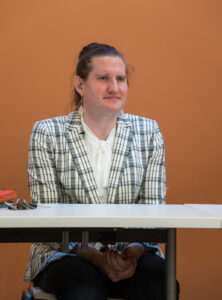
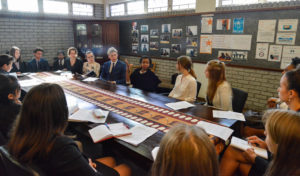
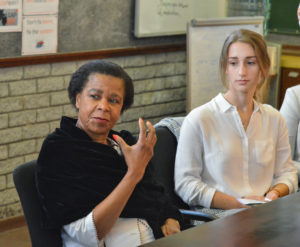
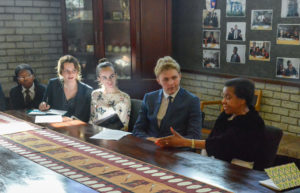
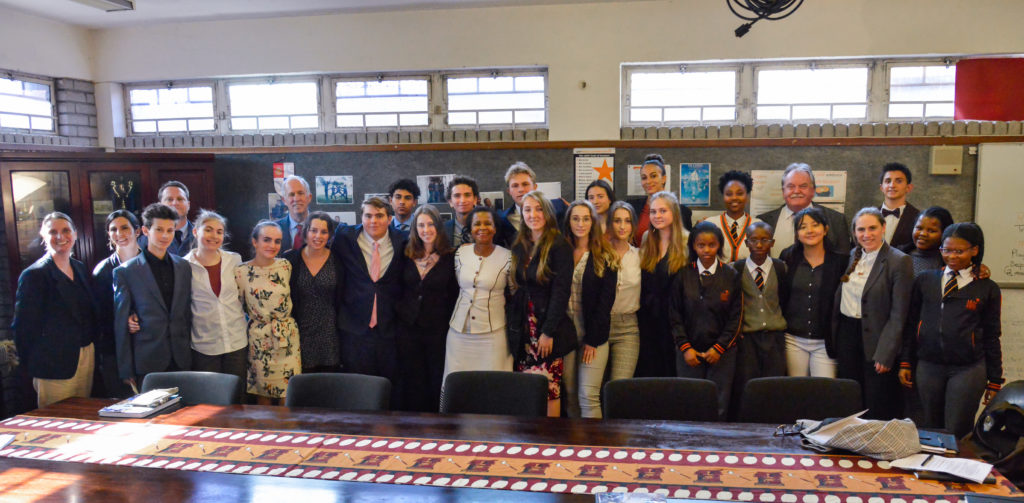
Today, after a scheduling mixup, we finally interviewed Charlotte Clymer. An ally to the LGBTQIA+ community, she was by far my favorite interviewee. I found her diverse and, some might say, contradictory background incredibly fascinating, and the opportunity to speak with her is something I will always value. She began by talking about her military experience and her belief in the importance of public service, whether it is in the military, Peace Corps, health care or any other area that requires service to others. She had a lot of advice related to politics and social issues, the most significant of which to me was the issue of gender inequality. We discussed how both women and men are infantilized and how the only way to overcome this is to maintain high standards for others and ourselves. She stated that the “boys will be boys” attitude is the most offensive thing that can be said about boys or men. Society has a low standard for men. They are expected to be masculine, violent, and in control. When men don’t display these traits, they aren’t seen as men. However, when they do demonstrate these traits and their actions become extreme, we make excuses for them and say, “boys will be boys.” She wants us to raise our standards and show greater respect for men and women alike. Holding a high standard for ourselves makes us good people and encourages those around us to be better as well.
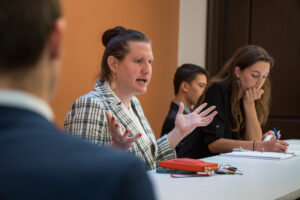
She also spoke on our shortcomings as a country – not to demoralize us but to motivate us. We as a society need to act on the opportunities that are presented to us. A great example is how countries around the world responded after the attacks on 9/11. Countries around the world, including “enemies” such as Iran, reached out in peace to pay their respects. Unfortunately, we did nothing to foster those potential relationships. On the topic of gun laws, she said that the fact that some states regulate gun purchases responsibly while others do not is ridiculous. The result is that a person can purchase a gun in one state and then travel to another state and use that gun to wreak havoc, and everything up to the point that the gun is used is perfectly legal. This situation results in distrust of our government and our fellow citizens. More effort needs to be put into the fight to change gun laws, international relations, gender inequality, LGBTQIA+ rights – and so much more – but we can do it.
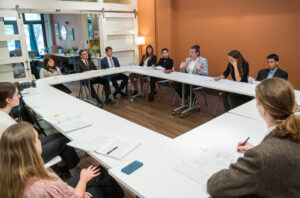
On our final morning in DC, I was excited to interview our last interviewee, Charlotte Clymer. Charlotte is a transgender activist and serves on the DC Commission for Persons with Disabilities. She works to educate, advocate, and create equity and equality in our country.
I had been very interested to hear from her, specifically on her views of the new generation as we come into positions of power. Something interesting that she said is that only those who have no power understand power. In other words, those who face racial, gender, or other forms of discrimination best understand the effects that decisions by people in power have. Officials who have never had the experience of feeling dehumanized or weak do not really understand the power that they wield. I found her perspective very illuminating, as I had never thought about the effects the decisions of unprepared leaders can have on others, especially when those leaders have no connection to the people affected by their decisions.
Charlotte has made me think about how I should see others. I should assume that everyone has their own experience with pain in their lives. By not immediately assuming that people are bad just because they think or act differently than I do, I can avoid projecting my own ideas onto them, and I can see them better as real human beings.
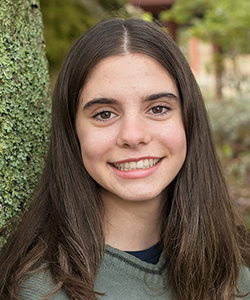
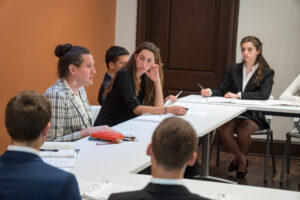
Charlotte Clymer gave me the most unique perspective on my own outlook on our world. She spoke about many different topics, from her connection with God and her faith to controversial topics like gun laws. One of the topics she spoke about that really resonated with me is understanding people from different communities.
She stated that you can only understand other people that have different backgrounds if you interact with them and hang around them. You have to get a sense of the community that they are a part of, such as—LGBTQ+ communities in this case. This statement opened my eyes to see how isolated we can be and how much we really don’t understand one another. We have to wake up and realize that for our world to be the peaceful sanctuary that we strive for, we need to come together as one by respecting each other’s views and developing the capability to understand each other.
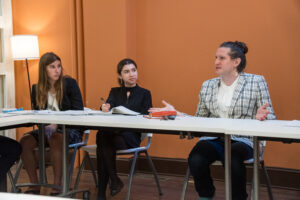
A little later in the interview, she expressed how our task as the future of our nation is to create conversations that lead to consensus, and consensus can only be created if we listen to others. In this day and age, we are focused on what’s right in front of us in the present moment, which can keep us from thinking about the future. An example of this that I see that Charlotte discussed as well is the crisis regarding gun ownership. I see posts on social media platforms that have been expressing their concerns for many years, but no real action has been taken to prevent the abuse of gun rights. In order for us to accomplish the task, we have to be able to push beyond what we know and not only listen but understand.
Our interview with Charlotte was the most mind-altering experience that I have had since coming to DC. I really learned a lot from her regarding what we have to do in order for our country and our world to be the place that we want it to be.
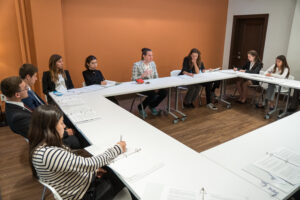
Our last day in DC was wonderful. We had the honor of speaking with LGBTQIA+ activist Charlotte Clymer. She is one of the sweetest and most down to earth people I’ve met. It was incredible the way she carried herself with grace and spoke knowledgeably. This interview was the perfect way to wrap up our trip.
One of my favorite things she said to us is that it’s up to our generation to make a difference. She mentioned that her generation won’t have to deal with the full effects of certain things like climate change, whereas our generation will, and it’s up to us to make a difference. She talked about how hard work can get us anywhere, an idea that all the interviewees this week discussed. I’ll keep that in mind when I’m back home. Another thing she said that’s “coming home with me” is that “hurt people hurt people.” Related to this idea is the idea that the most dangerous person is someone who doesn’t feel heard, and I think it’s our job as a generation to help change that by working to give a voice to everybody.