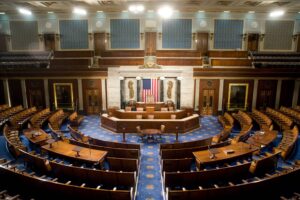
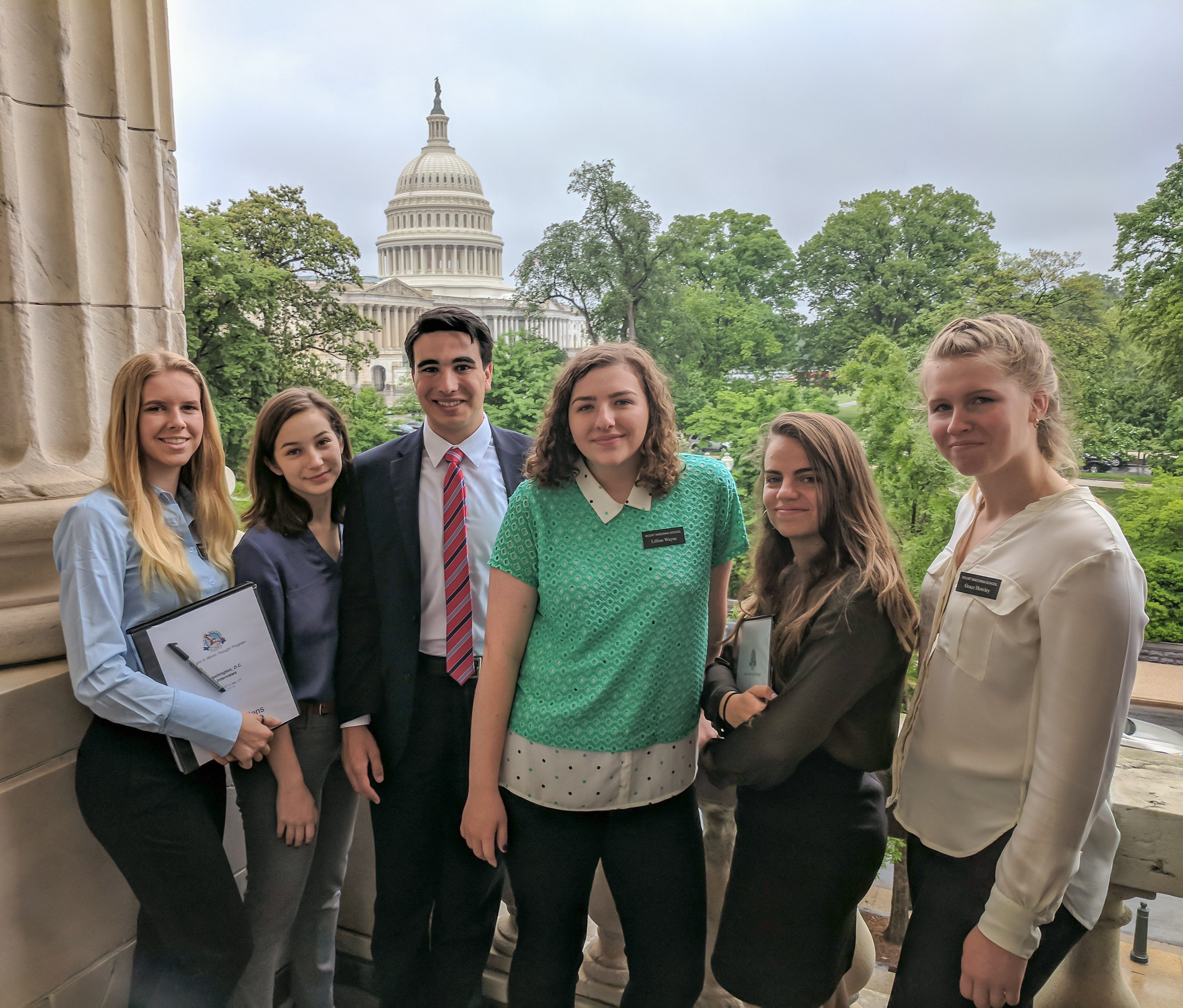
This morning we took a twenty minute walk back to the Capitol to look at the Senate and the House of Representatives galleries.
We visited the House of Representatives first. We walked down a hallway to where we could see the old windows of the Capitol before it was expanded. Once at the House of Representatives, we sat at the top of the level and looked down at the House floor. Looking up, we saw a glass eagle on the ceiling. The walls at the top are covered with portraits of famous representatives. On the bottom level are the 435 seats of the members of the House.
We then visited the Senate. The Senate room also has an eagle on the ceiling. We sat down on the top level, where we watched people working on the audio system in the room. The chief spokesperson told us that on Tuesday there will be a session. A security guard informed us that the chief spokesperson and assistants take turns talking to visitors every hour. On the top level there were statues of various senators from the past. Each of the fifty states has two seats, one for each senator. Behind the podium is the chair of the Vice President, who is the President of the Senate.
The architecture in the Capitol is amazing. There are statues and paintings in almost every room. In one room I saw a painting of a senator with a Lion. Viewing the House and Senate galleries was very interesting, but I imagine it would be very tiring to sit there for long stretches of time while Congress is in session.
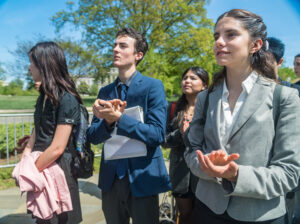
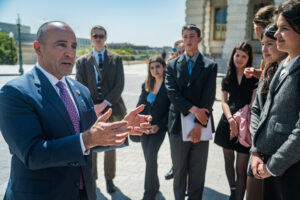
You never know what or who you’ll encounter in this town. We were scheduled to do a meet and greet with Rep. Panetta, but when we arrived at the Capitol to meet him he was speaking in a press briefing about the International Criminal Court’s charges against Vladimir Putin. However, the event turned out to be a great learning opportunity. Rep. Panetta’s scheduler, Alexa, let us through so that we could stand with the press. Rep. Panetta was joined by Rep. Don Bacon, Sen. Amy Klobuchar, and Ukrainian Ambassador to the US Oksana Markarova.
The purpose of the press briefing was to bring attention to Russia’s taking Ukrainian children back to Russia. Oksana Markarova described how by taking away Ukraine’s children, Putin is taking away part of their country, because a nation without its youth has no future. This idea particularly affected me, as it is horribly cruel to take children from their families, especially since Putin is trying to take back a country that rightfully gained its independence in 1991. Ukraine has a rich culture, and I’m hopeful that Russia does not succeed in destroying it.
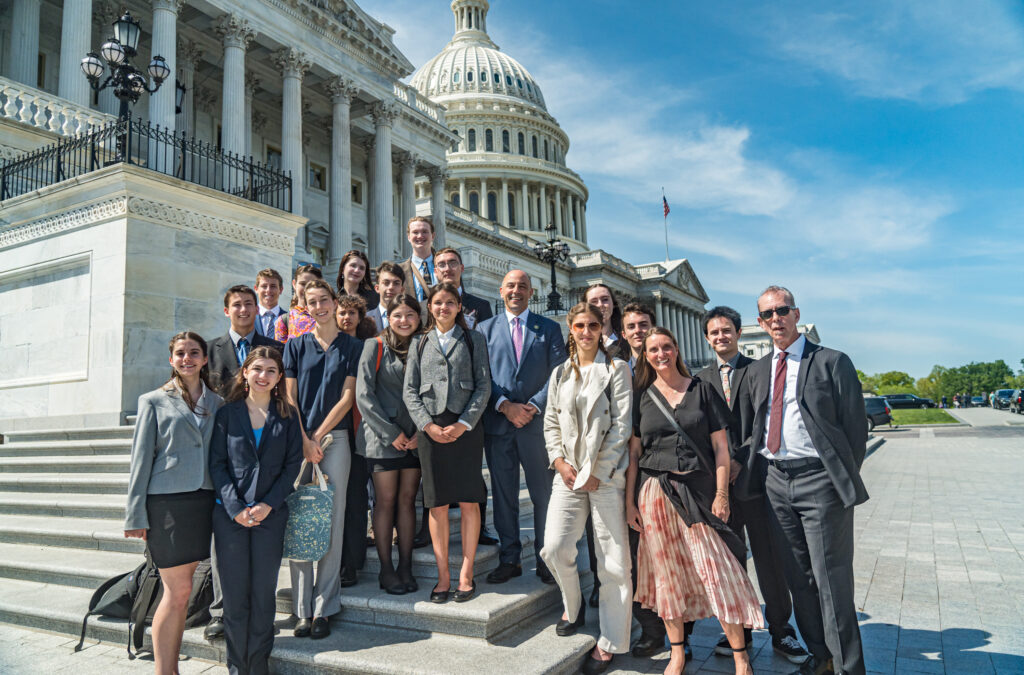
As the press briefing ended, we made our way to the steps of the Capitol, where Shannon explained that this is the first time in history that the ICC has issued an arrest warrant for the leader of such a large country and that this is a very big deal. Not only were we fortunate to witness such a historic moment, but we were fortunate to stumble upon such a great learning opportunity.
Anya Gonzalez
Before our meet and greet with Rep. Jimmy Panetta today, we were fortunate to attend a press brief on the Ukraine War. With the Capitol in the background, Rep. Panetta, Rep. Bacon, Sen. Klobuchar, and Oksana Markarova, the Ukrainian ambassador to the U.S, discussed the International Criminal Court’s charges against Vladimir Putin for his kidnapping of Ukrainian children, as well as Panetta and Bacon’s House resolution in support of the ICC.
As they spoke, I felt sorrow and anger. Prior to the press conference, I had been aware of the invasion of Ukraine, but I was unaware of Putin’s atrocious scheme to take children from Ukraine to bring them to Russia. Throughout the brief, I learned that only 306 out of the 16,000 Ukrainian children who have been taken from their families have been returned to their homes. Rep. Bacon accused Putin of “ripping them from their sunflowers, from their culture, and from their blue and yellow flag.” Later, after our short conversation with Rep. Panetta, I learned that by taking these children from their families and indoctrinating them into Russian culture, Russia is attempting to strip them of their Ukrainian identity, thus “breaking apart the Ukrainian country.”
Reflecting on this experience, I came to an epiphany. While it is easy to focus on issues relating directly to me and my country, international issues are just as significant. Witnessing this press briefing first hand inspired me to learn more and work to solve issues on an international scale in general. More specifically, I want to advocate for issues that are important to me. As Judge Friedman told us earlier in the day, I may not yet have a vote, but I do have a voice that I can use to advocate for myself, my country, and my world.
Cooper Padilla
Congressman Jimmy Panetta met us on the stairs of the Capitol today so we could talk to him and ask him a few questions. He had just finished a press conference regarding the kidnapping of Ukrainian children by Russian forces. It was exciting to see him in real life because I have seen his face on signs and posters all over Santa Cruz. I could tell that he is an experienced politician by the confident way that he carries himself. Talking to him was very interesting, but I was disappointed that we didn’t get to interview him formally, because I have several questions I would love to hear him answer.
The first thing he spoke about was the importance of public service and why selfless work for the good of others is beneficial. I already knew that he had served in the military, so I asked him if that was his first job in public service. He impressed me with his response. He described the various public service jobs he held before and after the military, including working in restaurants as a waiter, doing maintenance work, doing cleaning work on a fishing ship off the coast of Alaska, and a number of other hard jobs.
Not only was I impressed and motivated by the things he had to say, but I learned a valuable lesson from him that applies to my life right now while I begin thinking about college and my future. He said it is all right not to know exactly what you want to do yet. There are many decisions and challenges that I will face in life, but they don’t all have to be faced at once, so there is no need to stress too much about the future. He emphasized the idea that the best way to decide what you truly want to do is to try everything and see what you like. He also emphasized the idea of becoming good at whatever you do as a way of building character: “Be the best at everything you do, no matter what.” Every job is important, and working hard is the best way to move up and succeed. I am determined to always remember what he said and put it into practice in my own life.
The Capitol Building and Interview with Congressman John Lewis
Carl Ward
Walking through the Capitol
I was hit with the reality of this trip today. After two days of interviews around DC, we were thrown into the heart of the city. We found ourselves in the Capitol Building, carefully walking through marbled hallways, seeing pictures, paintings, and statues of various legendary political figures with every step we took. We kept walking by signs that said, “No Tours Beyond This Point,” and I kept wondering where we were going that was so exclusive and how we were getting such access.
After walking through a few metal detectors and having my mind blown too many times to keep track, a security guard outfitted with the classic earpiece/extra-dark sunglasses look stopped me and gestured toward a large door. I used all my strength to open this door, and on the other side I saw the chamber of the House of Representatives. The actual one! Just like in all the videos and pictures I had seen before, except I actually got to be there. We sat up in a balcony, watching this famous room full of famous people voting on and debating a bill that addressed agriculture, veterans, and food stamps. In a way it reminded me of going to a Warriors game, seeing something I had seen many times, but never in person. Being there makes you realize how real it all is, in a way that a screen just can’t communicate. It hit me right then that all these people are really spending all day making decisions that can end up affecting an entire country. Sure, I knew that before, but now I was watching it with my own eyes.
Not long after, I was sitting across from one of the most prominent figures from the Civil Rights movement, John Lewis. I had that exact same realization while he was describing his experience of the Selma March. I began to wonder how different the world would be if this man had never existed, if he had never been an integral piece of one of the most important movements in US history. I was so enthralled that I forgot to take notes. I wish I could remember more of what he said, because it was all just as amazing as the experience of meeting him. Either way, I spent a day in a place I will likely never return after this trip, and I met someone that I will always remember meeting. Today? Not bad.
Lillian Wayne
Congressman John Lewis
Before leaving for Washington DC there was one interview I had been looking forward to and anticipating the most: Congressman John Lewis. With my mother as the History and US Government teacher at my high school, I’ve learned so much about him and how important he was throughout the Civil Rights Movement. When he walked into the room, everyone’s eyes lit up. When he sat near me my heart was pounding, seeing him up close, and I couldn’t believe he was real. He was such a warm and beautiful person whose words and voice soothed and inspired everyone in the room. When he shook my hand, he looked me in the eyes, and all I could think about was how much history and extraordinary experiences his eyes have seen. I will never forget the incredible stories and words of wisdom he told. I could not take my eyes off of him the entire interview, not even to take notes. I wanted to savor his presence because I’ll probably never get the chance to witness him again.
Earlier in the day we went to the chamber of the House of Representatives and got to watch members of Congress debate and vote. Seeing this was another unforgettable and incredible experience. The room where this is held is a room I’ve only seen in textbooks. I couldn’t believe I was really in there. The room was exciting and full of so much energy. Everyone was passionate as they debated their side of the issues. When the votes were being counted we were on the edge of our seats, waiting in excitement and nervousness for the outcome. We had become completely immersed into the world of politics and debate. Although we have many more days on this incredible journey, I know that this day in particular will be one of the most eye-opening and unforgettable.
Cyrus Kamkar
Today was by far my favorite day in DC and definitely one of the best days of my life. The day was arranged semi last minute, leaving room for many surprises. We started the day off by going inside the Capital Building, where we watched the voting process on a controversial bill called the Farm Bill.
It took a while to enter the chamber of the House of Representatives to witness the vote, and I didn’t know what to expect. We walked through the door, which I thought led to another room we had to go through, or another staircase. However, it was the voting gallery full of members of the House of Representatives. I walked in, my jaw hit the ground, and I froze. I have never felt that way before. I sat in the front row of the balcony and looked down, trying to spot any members of Congress I might recognize. It was absolutely amazing, and still is amazing, that I was in the same room that I’ve seen on television and in photographs, a room where so many big decisions are made. The debate of the Farm Bill began, and it was incredible. After the debate, we got to see the voting process live in action. This made my day.
After sitting through the debate, we went to interview Congressman John Lewis. John Lewis was in the middle of a meeting in the Ways and Means Committee, and we had the opportunity to sit in and watch for a brief five minutes. At this point, I was speechless. I had just been inside the House of Representatives to watch a live vote, and now I was watching the Ways and Means Committee in session, and I still had the Interview with John Lewis to look forward to. We assumed, based off of Lewis’s tight schedule, that we’d get no more than four questions in. Fortunately, we got to ask ten questions. Similar to our pre-trip interview with Secretary George Shultz, I had a difficult time fully realizing whom I was sitting across from and listening to. Lewis’s life experience differs from other Congressmen. He is a man dedicated to persistent service, no matter the cost, in the name of justice. I was looking at the same man who helped change US history, and who marched beside Dr. Martin Luther King Jr.
Lewis said that change comes with an interesting combination of “history and fate.” What I got from this was, we know deep down when it’s time to fight for something, and to act on that knowing means that you are leaving this country a better place than it was before. He also told us, along with everyone else we have interviewed, how important it is to vote. He said, “Why do you think people try to stop others from voting? Because it’s power.” People underestimate the power of an educated and engaged country that partakes in a democracy. We have all the tools; we just need to use them.
I will always remember today as one of the best days of my life. Politics is my main interest, and is definitely the field of occupation I want to enter. Today enriched my desire and passion for politics.
Elias Moreno
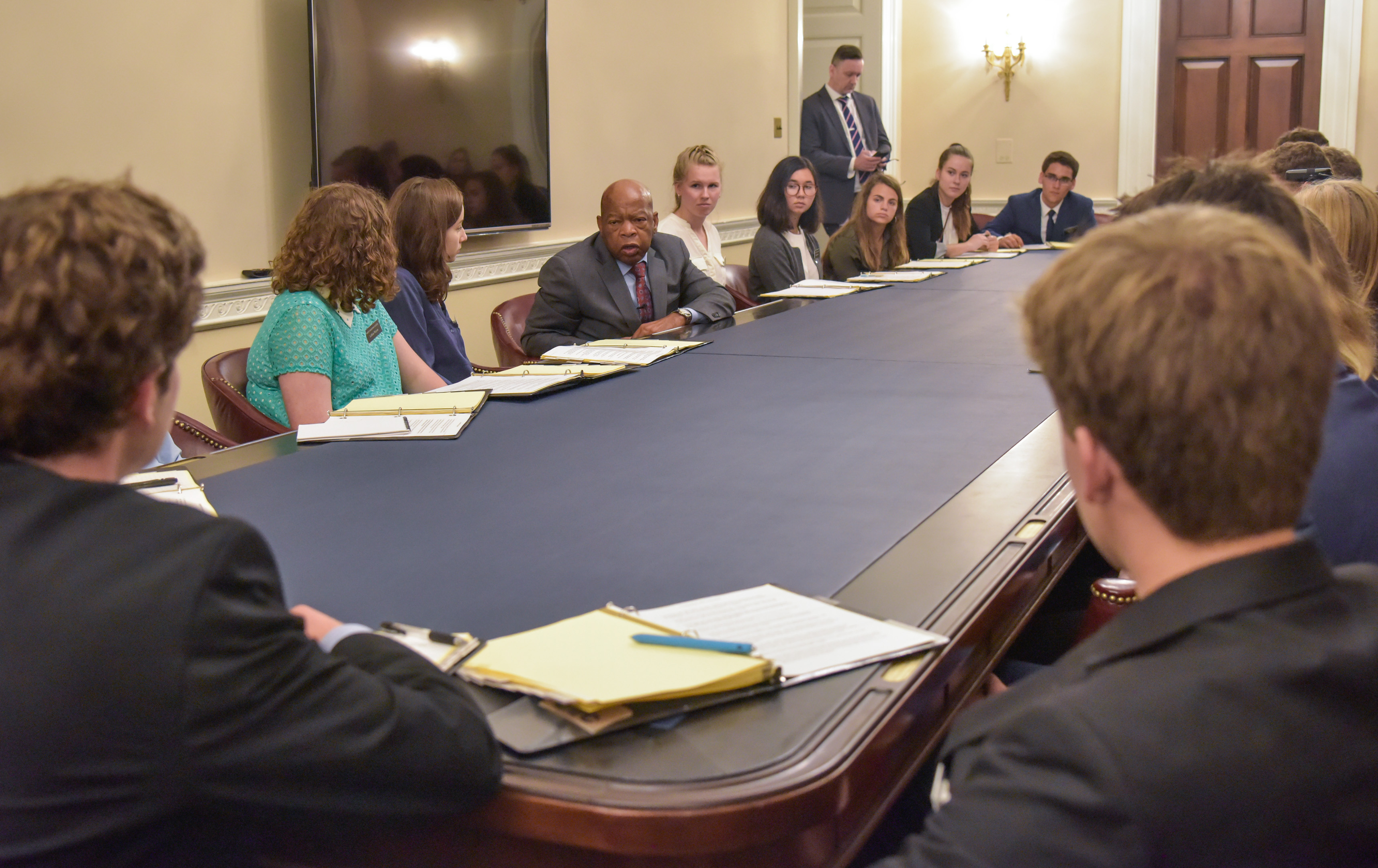
Walking through the Capitol Building today and seeing where the decisions are made that affect the whole nation was surreal. We walked into a room with a long table and waited for John Lewis to come in. We didn’t know what to expect or if he would even have time to answer our questions. Luckily, he was able to sit down with us and give us a glimpse of the knowledge that he has accumulated after 50+ years of activism. When I asked John Lewis my question about how we could keep our moral principles in times of crises, he looked me in the eyes the entire time he gave his answer, the same eyes that “saw the face of death” on Bloody Sunday in Selma, Alabama. He expressed how we as young people have the power to change the very fabric of our nation, but we must vote. If we truly believe in something we have to be unwavering in our dedication to the cause; we must always have the strength to keep fighting no matter how many obstacles we face. We have to elect people that represent us and the things we are fighting for; we must have diversity of views and perspectives. I could tell from his answer and eye contact that he thoroughly believed in every word he was saying. He wanted so desperately to pass on this message to the youth of the nation, the message of non-violence, love over hate, and importance of community. His answer struck a chord with me. As a young person newly able to vote, I cherish our democracy. We can truly impact our nation and its perception of our people and the world. We have the power to progress views and ideals to a place that comes from love, understanding, and open-mindedness.
Ruby Bracher
While we were guided through the gilded marble halls of the Capitol, I felt as though I might want to join the DC political scene for the architecture alone. High ceilings intricately adorned with stars, sky, and historical events; hand-painted tile floors; narrow, spiraling staircases. It would have been easy to get lost among the sculptures if there weren’t a long line of us, single-file, clinging to the white walls as we made our way towards the Ways and Means Committee where Congressman John Lewis was working.
Our guide led us to a conference room off to the side of a meeting. This was the first time we were allowed to situate ourselves without knowing where our interviewee would be seated, and I had the luck of sitting one chair away from Congressman Lewis.
One of the strangest feelings on the DC trip is recognizing someone’s face from research rather than having met them in person. It was especially strange seeing someone who had been the subject of so many books and documentaries, who had made such a large contribution to the progression of civil rights in our country. When Congressman Lewis first entered the room, my mind immediately went to a tweet I had seen, showing Lewis leading a sit-in during the 60’s next to a photo of him staging a sit-in at the White House two years ago.
Making prolonged eye-contact with him as he answered my question was also strange, along with trying to restrain my stomach from jumping into my throat as I eeped out a small “thank you” when he finished speaking.
One of the most powerful aspects of our time with Congressman Lewis was “with belief comes engagement.” He was only a little bit older than us when he was first arrested for his activism in the early 60’s, and has continued to fight since then, even as he is the last living of the “Big Six” of the Civil Rights Movement. He has managed to stay motivated by his optimism and hope in the good of people, particularly youth. As a young person given access to the right to vote in such a turbulent political climate (where at times it feels my voice doesn’t matter), hearing the emphasis on hope as a means of perseverance from someone who has changed so much in this country for the better against enormous odds is reinvigorating.
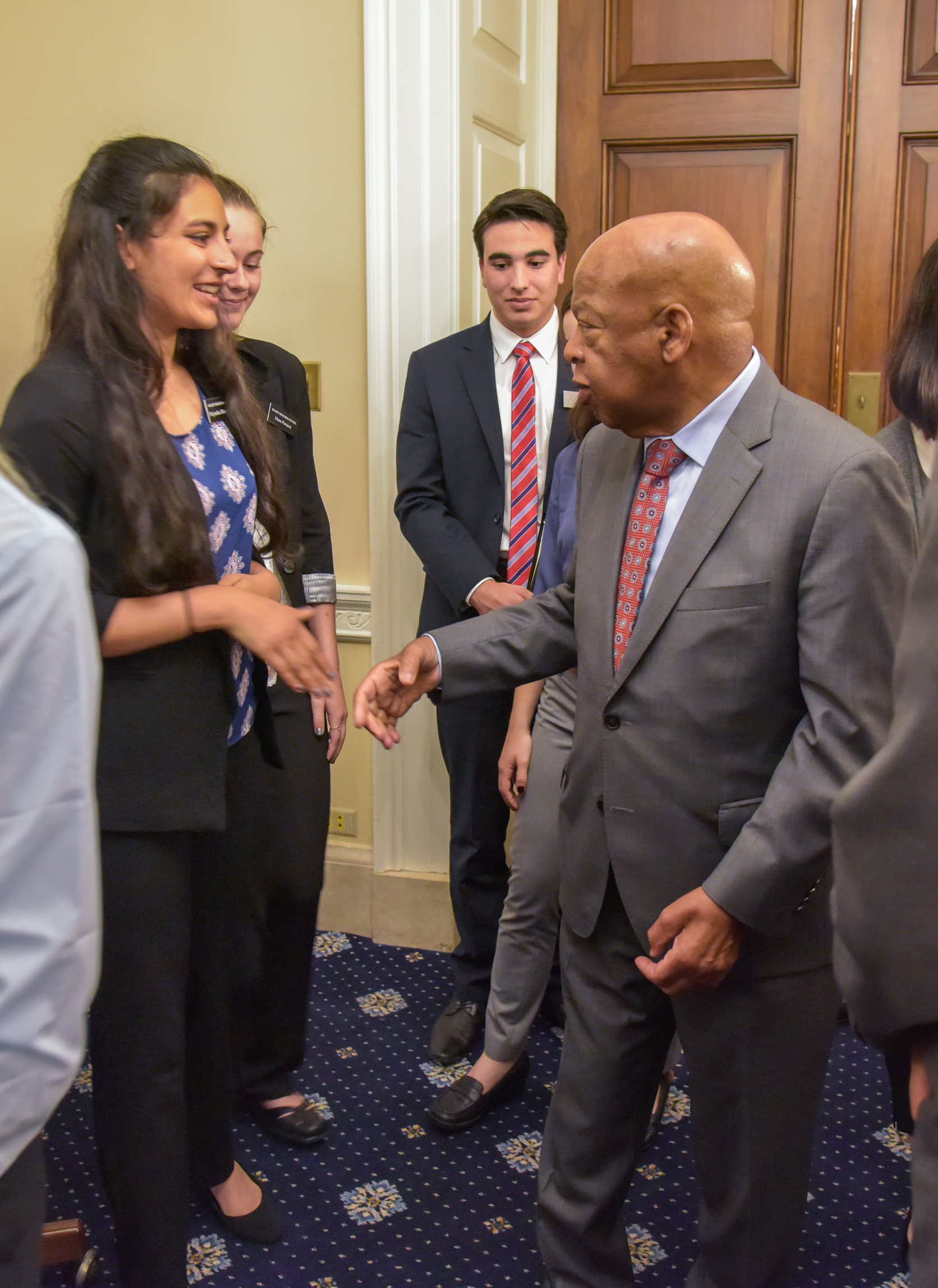
Mount Madonna students with Congressman John Lewis