Like Pop Rocks in Your Brain

Interview with Farar Elliot, Chief of the Office of Art and Archives, House of Reps.

Liana Kitchel

This morning we interviewed Farar Elliott, the Chief Office of Art and Archives at the House of Representatives, whom l was very excited to interview. In the last week or so, I have been researching her and what she does. I found out that a curator can do everything from finding pieces to display to figuring out and writing the narrative that the objects tell to figuring out where and how to organize the exhibits. After finding out what curating really entails I looked up colleges that had programs on different types of curating or related majors, even though I already know where I am going and what my major will be. I found out that curating is combining story telling, history, art, and sometimes even science. Needless to say, I was very intrigued to interview her. 

When we arrived at the Library of Congress to interview Elliott, we could hear protesters in front of the Supreme Court who were there to protest the possible overturning of Roe v. Wade. We then found out that the interview would be a little later than expected, so we wandered over to the group of people who were protesting. I was surprised to discover that the majority of people there were anti-abortion. We soon found a small group chanting, “My body, my choice!” and joined them. I have never been to a protest at which the opposing side was also present. It was very emotional to see people so passionately chanting on both sides. It was definitely a new experience for me to see and hear firsthand a group of people that believe so firmly in an opposing view. 

After attending the protest, we talked about what a protest really does and how it is a good way to show support, but we also talked about how there are other ways to be helpful and make a change that are more productive. We then walked over to meet Elliott. When she first showed up she was very personable, and immediately I became even more excited to talk with her. I wrote a few questions for this interview, but I ended up asking her what was the most challenging part of creating an exhibit, and what was her favorite part. In response to the first question, she stated that it is difficult to figure out which narrative to present and what to say about each object so that viewers are given the most important information without over-explaining, and the object “speaks for itself.”

In response to the second question, she said that she is always looking for and excited by creative “click” or Aha! moments that sometimes occur when you find the missing piece to a puzzle you have been trying to solve. Her response resonated with me. When I am making art or doing some creative project, it is the best feeling to experience that “click,” when everything seems to align and come into focus. I worried that since I am going into a design program at college I might burn out and lose that creative inspiration that I love so much—that being creative and artistic might become a “mere” job and a chore. However, hearing her talk about her continuing love for working in a creative field—that she still experiences those Aha! moments that feel like “pop rocks in your brain”—gives me hope that I will continue to love art and design even if it becomes a job.
Blythe Wilson

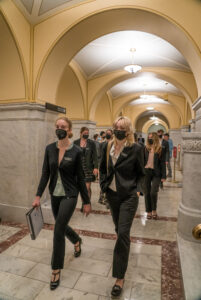
After a chaotic morning outside of the Supreme Court building, we met Farar Elliott at the Library of Congress, an absolutely gorgeous building. This is the interview I’ve most looked forward to because she has such an interesting job: Curator and Chief of the Office of Art and Archives for the House of Representatives. As soon as she greeted us the tone was conversational, and it was clear that she would be fun to talk to.

She talked about her work curating and the goal of having objects drive the exhibition. It was really interesting to hear about her process of collecting objects that tell stories, and how objects with human activity/damage are more valuable. 
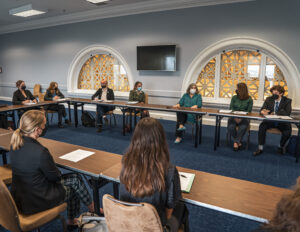
Zoey and I spent quite some time last night crafting a question for Farar Elliot, and the answer she gave us was very interesting. We asked about her thoughts on contextualizing, rather than removing, controversial monuments and art of historical figures.

She answered that we should contextualize old monuments and add additional monuments that reflect our current beliefs. However, she also recognizes that there are times when it’s good to take monuments down. She mentioned the statue of Robert E. Lee in Richmond, Virginia, onto which BLM protestors projected art prior to its removal, and how satisfying it was to witness the process of its eventual removal. 

She had a refreshing take on the permanence of history and the potential for change. She said that when things break you often see they are useless, so that they no longer serve their purpose. The idea that we can let go and move past parts of history/government is something I’ve never heard discussed in this way before, and it left me hopeful about all the changes that could eventually occur.

A Paleontologist Says to “Wing” It

Interview with Scott L. Wing

Summer Howley

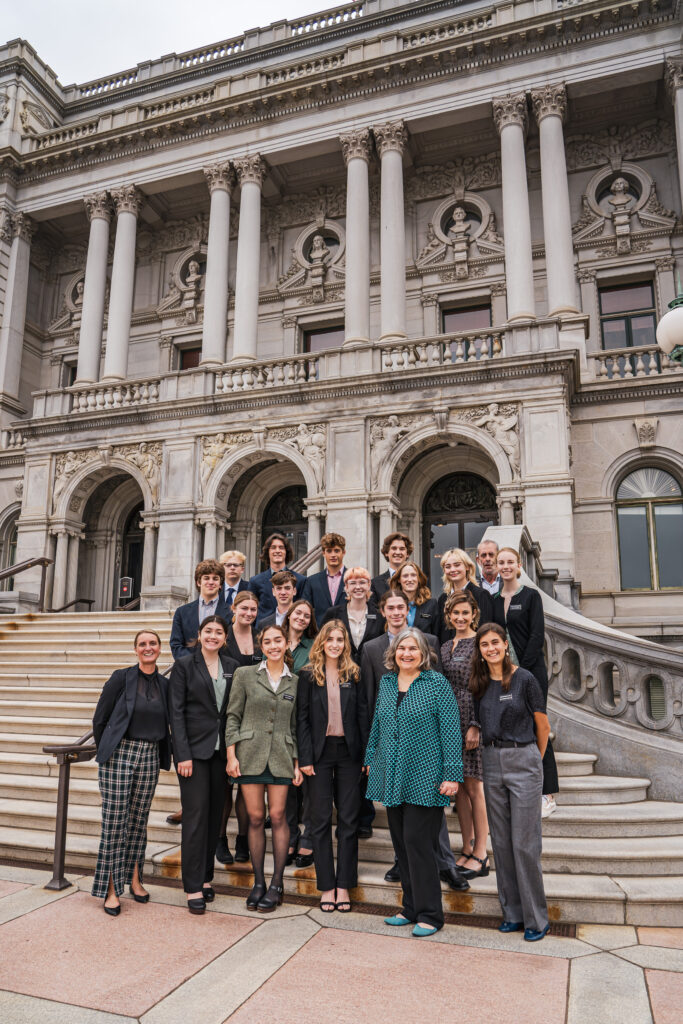
On our way to the room where we would conduct our interview with Scott L. Wing—a curator at the Smithsonian National Museum of Natural History—we passed row after row of black filing cabinets with aged handwritten labels on every drawer. The scene looked like something out of a science-fiction movie. We came to know later that the collection on that floor was dedicated to shells. The bones and plant collections also each had a floor. Wing said in total there are over 40 million fossils. If I had time and permission, I would have found it amazing to explore the collections for hours. 

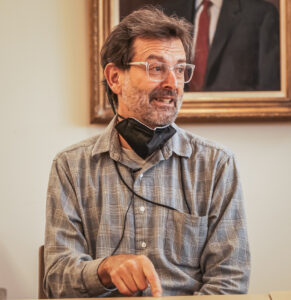
Once we began the interview, it was evident how intelligent and passionate Wing is about his work. When asked what ideas he thinks are most important for museum-goers to take away from their visit, he said that he hopes that people gain “some sense of awe at the age of the world and their connectedness to it.” His answer was a well-worded explanation of what museums have to offer. I also liked that he didn’t simply discuss the age of the world but also discussed how we too are part of the world and natural history. 

However, although we are a part of nature, we have a unique impact on it and thus a unique responsibility when it comes to our environment. A theme throughout our interview was climate change, a difficult and sensitive issue. He argued that finding a solution to the problem of climate change requires “a sense of urgency and hope at the same time.” Too often in the media, opinions are polarized, with some people denying the existence of climate change for irrational reasons and others thinking “apocalyptically” about the end of the world. Neither of these alone are the only possibility for the future, and neither of them alone are productive when trying to solve the problem of climate change.

When asked if he has advice for people who are entering adulthood during these tumultuous times, he stressed the importance of remaining flexible. It is not necessary or desirable to plan everything in too much detail. Instead, it is important to take advantage of arising situations and opportunities and be “willing to see a turn in direction” and embrace it. This was very validating to hear, as I have been telling myself recently that I need to be flexible about my future plans. Remaining flexible makes my future prospects appear all the more exciting as a result.


Mariah Cohen

Today we interviewed Scott L. Wing, a research biologist and Curator of Paleobotany at the Smithsonian National Museum of Natural History. I learned a lot about both his work and what my career path might be like in the future.

Wing spoke about the process of creating an exhibit and how challenging it is, which was very insightful. Before the interview, I had never really given much thought to what exactly goes on behind the scenes of the creation of an exhibit at a museum. However, hearing Wing talk about his work made me more excited for my future career, whatever it may be, and it opened my eyes to what many jobs actually entail. One thing he said about this process that stood out for me was how much debate/negotiation goes on in the process of creating an exhibit. I was extremely surprised to learn that when you see an exhibit at a museum, everything—right down to the specific words used to describe the exhibits—has been argued over extensively. Because curators are often scientists themselves, I assumed that whatever they think about an exhibit is perfect, and no one would object because scientists know what they are talking about. However, it is not the case that scientists always have a sense of what the general public at a museum can digest when viewing an exhibit, and it is often the case that exhibit developers have a better sense of what the general public wants to know. Knowing what I know now, I have a much greater appreciation for museums, and I continued contemplating what he said as we walked around the Smithsonian National Museum of Natural History.

Another thing I found valuable in this interview was Wing’s story about how he got to where he is now. Although Wing was always interested in fossils, his career began when he was invited to go on an expedition to dig for fossils when he was seventeen. Multiple times in the interview he stressed how important it has always been for him to have fun. Because the expedition sounded like it would be fun, he joined it and started down the path that led to where he is now. When asked what his favorite part of his job is, he stated that “driving around in his four-wheel-drive vehicle” is his favorite aspect of the job. Similarly, his advice to us as young people was not to get stuck having a set plan for our lives, because it’s important to have a good time and remain flexible so that you can take a different direction than you originally planned for if necessary.  This idea is reassuring for me, as I don’t know quite what I want to do with my life, and I’m worried that I will get stuck doing something I don’t enjoy. Having a successful person tell me that he is happy in life because he “went with the flow” was refreshing and inspiring to hear.