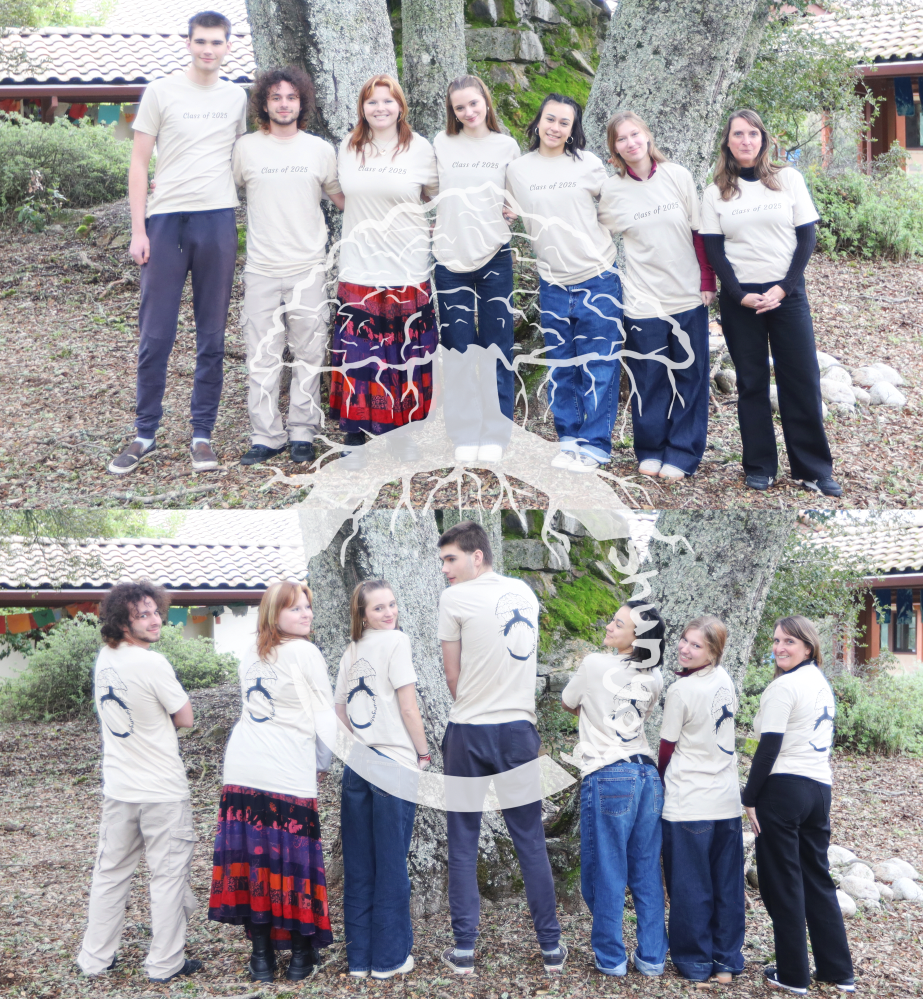
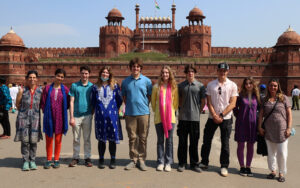
On February 14th, the Mount Madonna School senior class will embark on the 2025 Learning Journey to India as part of their Values in World Thought class. They chose to name their trip “Shunyata.” Shunyata means, “True nature of reality” or “emptiness.”
As part of their trip preparation, the seniors were asked to reflect on the purpose of their upcoming trip and to set intentions and goals. Here are excerpts from some of their writings. – Shannon
Shunyata is a Tibetan word that means “Emptiness.” More precisely, empty from an independent reality. In Buddhism, it is interpreted as the “true nature of reality.” We chose this name because we wanted the theme of the trip to be centered around being in the present, accepting change in perspective, and openness to the unknown. These are all aspects of traveling to a new country, especially one as vibrant and culturally diverse as India. We will be subject to new experiences and pushed out of our comfort zone in many ways.
Manumailagi Hunnicutt
“For me, this learning journey will be a test of my capability to be open to experiences, as well as a lesson and gift that will teach me things about myself. This is something that I will not take for granted or forget. I am excited for the journey ahead.” – Manumailagi Hunnicutt
Chloe Smith
“While on this trip, I hope to fully immerse myself in the culture. Everything is going to be different, but that’s what makes it exciting. The food, the places, the people, the clothes, the art, and such a rich history. The preparation for our interviews has been an amazing experience. I have learned so much about the organization CORD. Doing research on Dr. Metre and learning about her passion for doing good has been essential in grasping the intricacies of CORD’s mission and its effects on local communities. I’m particularly impressed by their approach to rural development, which tackles healthcare, disability rights, education, economic opportunities, social justice, and women’s empowerment. I’m eager to hear Dr. Metre’s stories and connect what we’ve learned in class with her real-world experiences.” – Chloe Smith
If we want to go back far enough, I guess you could say that the concepts and ideas that have contributed to my preparation for the trip have been told to me since I could understand words. Keeping an open mind, being present, listening to others, being kind, being prepared, and knowing yourself. That’s one reason why I resonate with “Shunyata.” All the things that have prepared me have been with me since the start. They’ve just been re-interpreted as I’ve grown and have taken on more complex meanings.
Mordecai Coleman
“I resonate with the name of our trip because it acknowledges that there is no single existence and that all things are connected and give each other meaning. This is something I hope to solidify in my mind with the added experiences of a new culture. Overall, I want to keep an open mind and try everything that is offered to me.” – Mordecai Coleman
In addition to visiting many sites, such as the Taj Mahal, and interviewing individuals such as Dr. Metre and Lama Chogyal, we will spend time at Sri Ram Ashram, and visit organizations, such as CORD, Aasraa Trust, and CED Society.
For more information about the organizations we will visit please follow these links:
The seniors are raising money to donate to organizations they will be visiting. You can support their efforts by donating directly and/or buying trip merchandise.
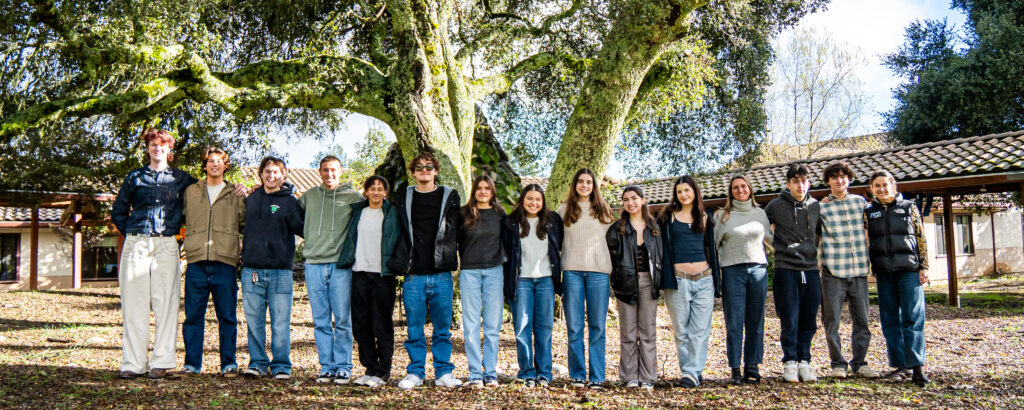
On April 20 the Mount Madonna School (MMS) junior class, along with their teachers Chelsea Otterness, Greg Shirley and Claire Otterness, will travel to Washington, D.C. Their week will be filled with tours and interviews with an array of interesting individuals. Unfortunately, I am unable to join them due to an injury. While I am sorry to miss this opportunity, I am confident that the trip will be a success.
The Government in Action program was started in 1989 by Sadanand Ward Mailliard. Over the years, Mount Madonna School students have been fortunate to meet and interview some of our nation’s finest public servants. The Washington, D.C. learning journey is an integral part of the “Values in World Thought” program at Mount Madonna School. This unique trip to Washington, D.C. provides MMS juniors with a direct personal experience of those who devote their lives to public service.
We are motivated by a sincere desire to inquire into the values and experiences of those who serve our nation in all branches of government and beyond. We interview individuals who are committed to improving the quality of life in our nation and around the world, and who have the values and character that we wish to instill in our students.
In a time of division, the Government in Action program provides our students the opportunity to actively listen with open minds and hearts. It is our belief that we can positively impact the world by engaging in conversations of meaning, being curious, and being open to learning from people with different perspectives and lived experiences.
The schedule for the 2024 Learning Journey to India by Mount Madonna School seniors. Click here to view the blog as we update it daily!
SCHEDULE:
Friday February 16: Departure from California
Saturday February 17: Arrival in India
Sunday February 18: Delhi Tour: Bangla Sahib Gurudwara, Bazaar, Market
Monday February 19: Travel to Sri Ram Ashram, Haridwar
Tuesday February 20: Sri Ram Ashram Ganga walk Visit Gujjar village
Wednesday February 21: Day Trip to Rishikesh: Beatles Ashram, Meeting with Sadvhi Bagawati, Aarti at Parmarth ashram, satsang, and dinner.
Thursday February 22: Day Trip to Dehradun: Aasraa Trust Visit Araghar Government Primary School Lunch time interview with Ms. Shaila Brijnath, Founder and Chair of Aasraa Visit Waste Warriors and meet their senior staff
Friday February 23: Sri Ram Ashram Visit Sri Ram Vidya Mandir school
Saturday February 24: Sri Ram Ashram Goodbye party!
Sunday February 25: Travel to Dharamsala
Monday February 26: Meet and interview Dr. Metre and visit CORD (Chinmaya Organization for Rural Development) Visit Dalai Lama Temple, visit McLeod Ganj
Tuesday February 27: Upper Dharamsala Village Meet and interview Rinchen Khando and visit Dolma Ling Nunnery
Wednesday February 28: Travel from Dharamsala to Agra
Thursday February 29: Taj Mahal, Agra Fort Meet with Shantum from Buddhapath Travel to Delhi
Friday March 1: Delhi Tour: Gandhi Smriti and Old Delhi Meet with social activist Laila Tyabji
Mount Madonna School seniors will embark on a learning journey to India on February 16, 2024. Check back soon for writings, photos, and videos from the trip, as we will be updating along the way.
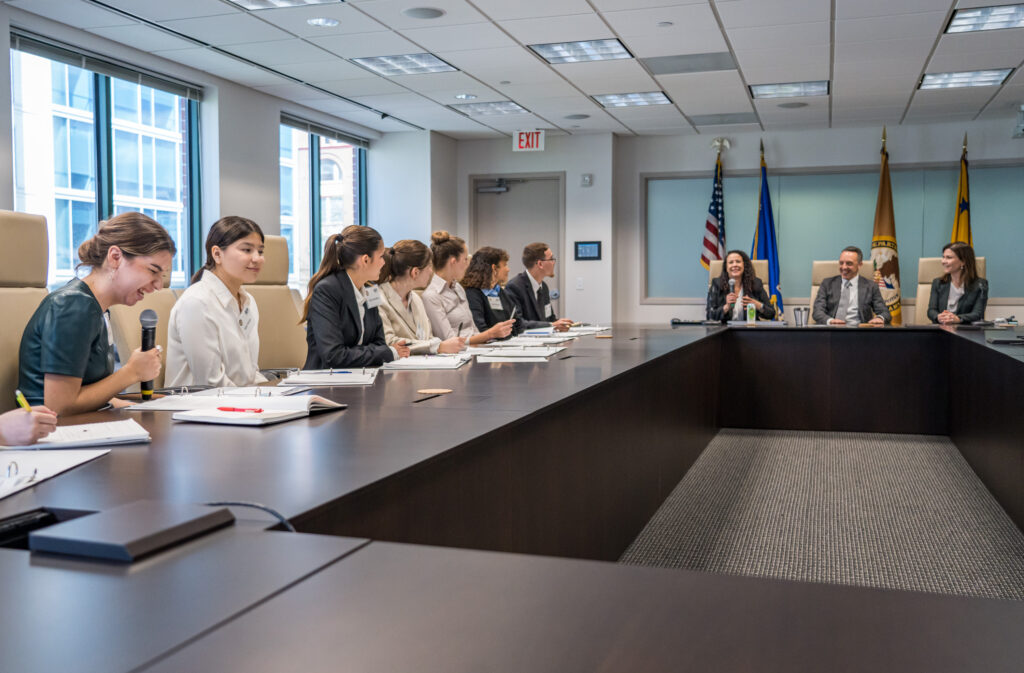
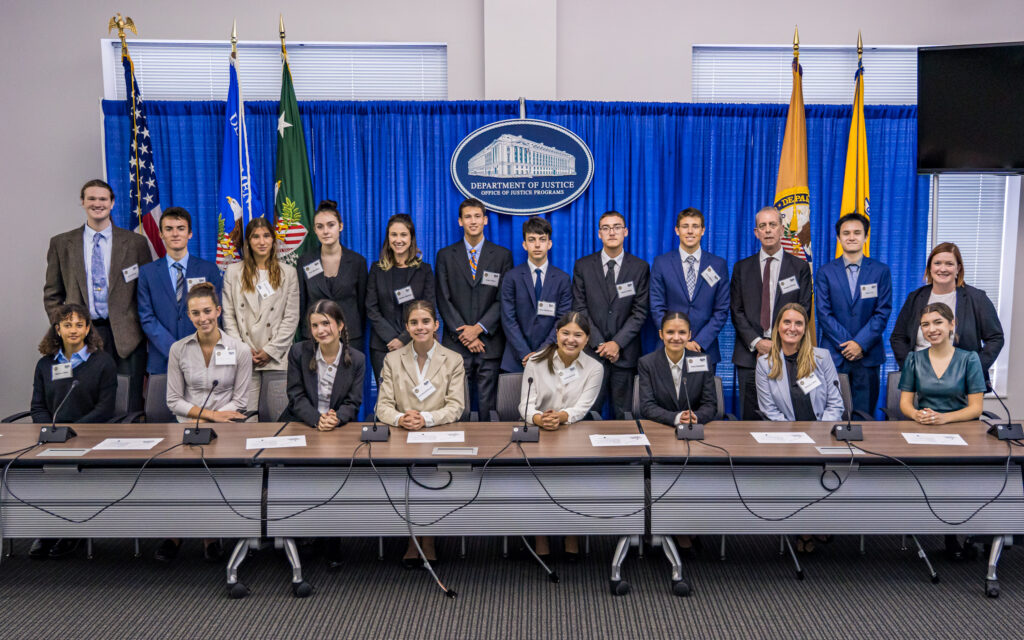
Panel Discussion at Office of Justice Programs (Department of Justice)
Cy Harris
Talking to the Department of Justice panelists today gave me a new perspective on government and public service. Before meeting with them, I was unaware of the struggles that government workers experience with balancing their own opinions with the interests of those in the public whose lives they affect. DOJ attorney Linda Seabrook said something that struck me when asked about an article she had written: “It’s hard not to take a pessimistic viewpoint … we need to … drown out this hate, deprive it of oxygen, knock it down from its platform.” Her response helped me understand better that as a society we put a great deal of pressure on our politicians and decision makers, and it’s difficult for them to get everything “right.” Furthermore, the decisions they make weigh heavily on them too. I came to realize that these are “real” people making difficult decisions that they know affect other “real” people.
I came to this same realization during our other interviews today. Earlier in the day, we had the opportunity to speak with a group of military personnel during our Pentagon tour. Josh Clemmens, a US Army pilot, stated that you have to stay true to your decisions even when they involve life and death. Learning that people who are responsible for the lives of others understand all too well the human consequences of their decisions helped to humanize those in positions of power. I came to realize that public servants understand the human consequences of their decisions and that it is a mistake to take the popular view that they are not “human” like the rest of us. In another interview, former Secretary of the Interior Bernhardt mentioned that when making decisions it’s important to stay true to the law despite one’s own ideology. Contradictions can arise, because you face the decision to sacrifice either your own beliefs or your oath to uphold the law. Public officials make difficult decisions that affect people every day. It is therefore important to humanize government workers and politicians. We have to “drown out [the] hate” that many in the public have towards public servants and come to see them as people whose jobs have them serving us.
Anya Gonzalez
Today we interviewed four officials from the Department of Justice: Chris Fisher, Mariel Lifshitz, Linda Seabrook, and Eddie Bocanegra. I was particularly excited to interview Eddie Bocanegra because of his unique background and his work helping those affected by violence. Beginning in his teenage years, Eddie was imprisoned for fourteen years for a gang-related homicide. He grew up in a poor neighborhood where the DOJ had a reputation for breaking apart families and making life difficult for his community. Despite his rough start in life, Eddie now works as senior adviser for community violence intervention in the Office of Justice Programs at the DOJ. Eddie explained that his focus is on “leveraging” resources to help law enforcement and underserved communities work together to solve problems in those communities.
Although the other DOJ panelists do not share Eddie’s background, they all share his passionate commitment to bridging the gap between underserved communities and the criminal justice system, focusing on racial justice, behavioral health, community violence intervention, and police reform. Before the interview, I felt a disconnect between government officials and myself as a citizen. I think I had lost a lot of faith in our government with respect to humanitarian issues such racial justice and violence intervention. However, after the interview, my faith in government officials and my hope for the future was to a great extent restored.
Sophia Manzur
Today we interviewed people from the Office of Juvenile Justice and Delinquency Prevention at the Department of Justice. The panelist I was most excited to interview is Linda Seabrook, who works in the Office of Justice Programs as Senior Counsel of Racial Justice and Equity, focusing on increasing outreach to underserved communities through government programs and initiatives. She began her legal career as an assistant solicitor or prosecutor, because she wanted to work for justice for women and girls of color.
I asked a question about an article she wrote in 2017, “A Love Letter to Charlottesville.” In the article, she examines the Unite the Right rally and her own personal connection to Charlottesville. Her words deeply affected me: “We have to learn from the actions of the people of Charlottesville and drown out this hate – deprive it of oxygen, knock it down from its platform.” Many in our country want people to forget the disturbing parts of our history, and the result is that we end up repeating myths instead of learning about and from the past.
I wanted to know if Seabrook sees any change in our country since the events of 2017 or if we have learned anything from them. Seabrook responded that she doesn’t want to be pessimistic, but she hasn’t seen improvement, and she thinks that things have even worsened. She recalled that in the past she and colleagues who held different political opinions still got along. However, now there is pressure on officials not to interact with those who hold different views. However, although things are bad right now, there is still reason for hope. We can deprive hate of “oxygen” by making the effort to create and maintain connections with others. Understanding the perspectives of those with different opinions humanizes both them and ourselves, and it is only through humanizing people that we can make all of our lives better.
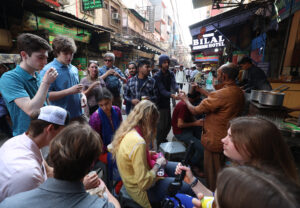
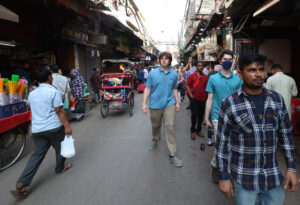
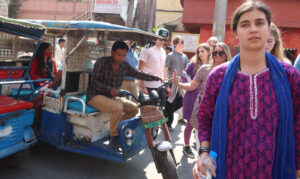
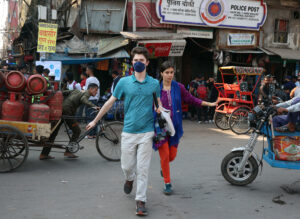
This morning a bus took us to Old Delhi, where we waited at the subway station for our guide. During the drive, it struck me as the most crowded place we had been to on the whole trip. The streets were packed with every kind of vehicle imaginable, many rickshaws, the occasional bus, and more motorcycles than could be counted. It also struck me how many people were just in the street, weaving through the traffic with little care for the chorus of honks from drivers they momentarily stopped. The electrical infrastructure was also fascinating. Each power pole was a rat’s nest of power lines going every which direction. It was genuinely surprising to me that the power grid was still functioning and stores and houses were still receiving electricity.
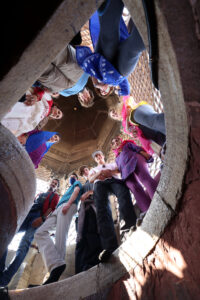
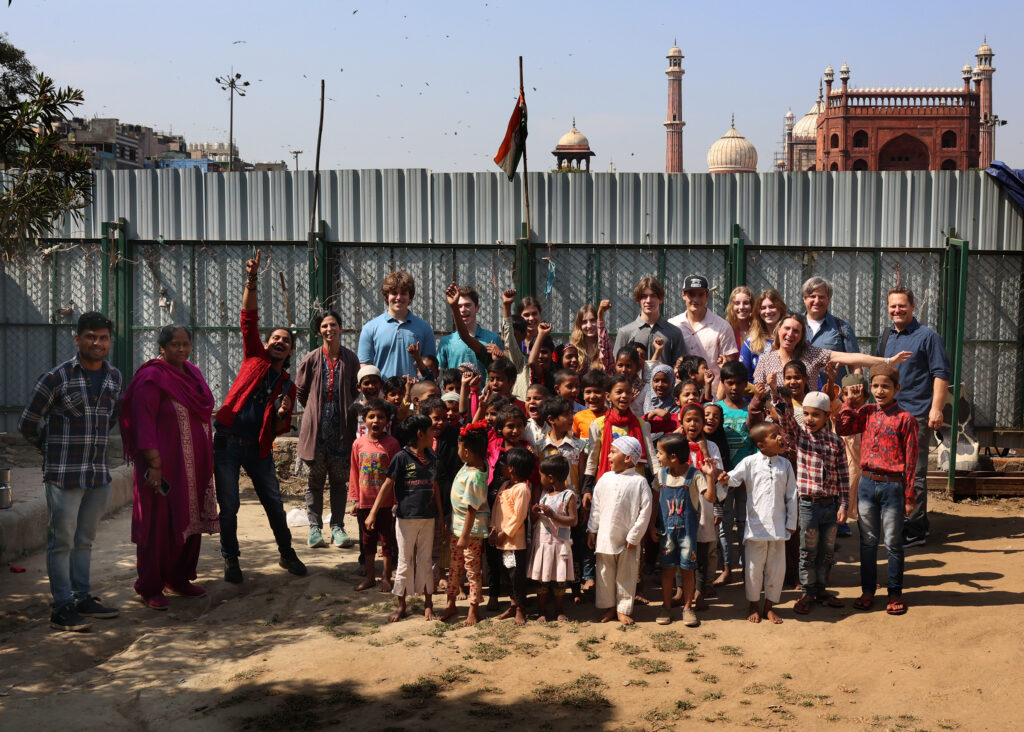
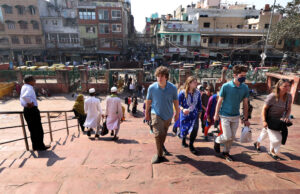
After a little while, our guide arrived. He was part of the Salaam Baalak Trust and took us on a walk all over the city. First, we walked down a packed street just off the main road that took us into the maze of houses and stores. He told us how the system of begging works, and we saw food stalls with beggars sitting next to them. Then we walked back to the main road, and towards the main mosque of Delhi. We saw the inside and climbed up a tower within the mosque which had an amazing bird’s eye view of the city. Then we walked through a big bazaar to get to one of the nine contact points that the Salaam Baalak Trust has established throughout the city, and met a group of children from the ages of two to thirteen. After some playing and a picture with the children, we headed to the last stop on our walk, a Jain Temple. The inside was beautiful and was covered in idols, sculptures, and paintings on crumbling plaster ceilings. After this, our city walk was over, and we headed off to lunch.
The Salaam Baalak Trust is an NGO specifically organized to support children all over India, the name directly translates to “Salute the Child.” They have nine “contact points” all over Delhi, one of which we were able to visit during our walking tour. Their goal is to provide opportunities to neglected and abused street children, as well as raise awareness and sensitize people who may not know about the issue. Recently, they have also teamed up with the Central Queensland University in Australia to provide some of their students with higher education.
The system of begging really struck me as a product of the extreme population growth of Delhi. The idea is that large groups of beggars will all gather near food stalls, and wait for someone to pay for their food. The cook has a cheap option that more fortunate people can pay for to feed one of the beggars which positively affects their karma. This and the rapid integration of technology, exemplified by the unorthodox electrical grid and building construction, all make me view rapid population growth differently.
Jacob Sirk-Traugh
Today we took a long walking tour of Old Delhi which was a very interesting experience for a multitude of reasons. Our tour guides were part of an organization that works with street children, called Salaam Baalak Trust. Both of our tour guides had lived on the streets as children and had been rescued from the streets by the organization they now work for.
The crowding, poverty, and pollution were the main things I noticed because they were so extreme. The streets were filled with beggars who would follow us and tap our shoulders and put their hands out. Many of them had disabilities, lost limbs, or looked like they were starving. Many of them were children. Our tour guide told us that many children on the streets start using hard drugs around the age of nine, and most are using by fourteen. Wherever we went, there were people packed in around us, and there was a constant risk of pickpocketing or getting hit by one of the drivers who were driving through crowds of people and barely yielding to pedestrians. The shop owners were constantly beckoning at us to come look at their goods. Many of those who have an entrepreneurial spirit were selling the same goods as at least four other people within ten yards of them.
One part of Old Delhi that gave me some hope was the restaurants where for thirty rupees you can buy a decent meal for one of the nearby beggars. The reason this exists is mainly religious, and it works, because as our tour guide told us, money donated directly to the beggars might not be used in the best way.
After we spent some time walking through the narrow streets, we traveled to one of the largest mosques in India, Jama Masjid. The architecture inside was very impressive and the marble artwork was beautiful. After walking around inside for a bit, we decided to climb a massive tower which overlooked Old Delhi. The view from the top was strangely beautiful. Though it was mostly smoke, run down buildings, and overall desolation, it made me think about how large the world is and how many people don’t get to just go home. It’s very eye opening to see and to try and understand to some extent the struggle which defines so many people’s lives.
Back in the streets of Old Delhi, we walked to an informal school run by the Salaam Baalak Trust. The organization has 9 centers located around Delhi, and the mission of these centers is to get children off the streets, off drugs, and to get them a decent education. When I got to meet some of these kids it was really inspiring to see them taking advantage of the small opportunity they have. It was also sweet to see how friendly and eager to meet us they were. At first, I thought we wouldn’t have much to say to each other, but yet again I was proved wrong. During our brief time together we were able to connect through a variety of hand games, which I have come to realize are a sort of universal language. Old Delhi was a difficult place to see, but there were pockets of hope.
Burning Flowers, Colored Smoke
Zoey Ocampo-Sobkoviak
Smoke in my lungs and then a different smoke and then a different smoke. Roti on the tawa, burning milk on the sides of a chai pot, bus exhaust, burning fields, burning flowers. Spicy smoke, sour smoke, cigarette smoke, turmeric smoke, the kind of smoke that seeps into my mask and my clothes.
Each alleyway and street that Junaid from the Salaam Baalak Trust led us through hit me in wafts. Even though Old Delhi was filled with all kinds of sensory experiences from hawkers, clothing shops, cabs, and hanging bells, the smells were what reached me first. Every step forward could either have been deliciously exuberant or an indubitably big mistake.
The day was bluer than our previous times in Delhi, but from the very top steps of the Jama Masjid mosque tower, I still smelled a breeze laced with the smog of twelve million people living in just one city. My dark-blue scarf blew off the top of my head as I looked outside at the great expanse of houses below. French tourist perfumes and Indian guide hair products wafted through the translucent fabric.
In the Bazaar near the mosque, I smelled dust and human waste. I smelled degrading garbage mixed with fragrant sweets. The red sandstone around me transported me to a different time, but the scents grounded me to the current, ever-changing moment.
Inside the classroom of the Salaam Balak contact point which lay outside the bazaar, I smelled musty clothing and my own sweat. I smelled the Sri Ram Ashram again, for a brief moment. Yet, this place was different in many ways. Many of the kids led lives I could only ever read about or imagine from a distance. Young children start collecting trash and selling it to make a bit of money in dense urban areas. I walk through the smells of smoke and garbage, but I do not live in it. Junaid told us that some children as young as 9 or 10 start sniffing glue or white-out. These contact points are meant to intervene and offer children on the streets of Delhi access to education, shelter, and food. Much like CORD, the organization works to help these children pick themselves up and nourish their dreams.
I probably smelled of privilege or at least something similar. Or maybe I smelled of ridiculousness due to the fact that I was dressed like a chicken with my bright orange leggings and my non-matching kurta. Whatever it was I smelled like to them, it didn’t matter in the moment. We sat and played together in an almost impossibly coincidental way. I asked a few questions in Hindi, and one child counted to me in English. We played hand clapping games and I smelled joy. Our time was simple, like the smell of the scribble-ridden newspaper on the ground. Underneath the joy, however, I sat in moral turmoil, taking in the tile and patched tin roof. I looked at one girl as we said goodbye, knowing I might never see her again. She smelled to me of hope in a city full of contrasts, but who am I to say who she is? I should wonder instead what she thought of me.
Later still, in the Jain temple and the sari shops of Chandni Chowk, I smelled rose incense, and old wooden fixtures. I smelled peeling paint and ancientness. I smelled muddled water under my shoe and I smelled bursts of color. At the Red Fort I smelled carnival ride grease and swaying trees.
I am not sure how else to convey the feelings that arise for me each time I visit a new place in India. It has gifted me, whether I asked for it or not: the ability to feel the color of each space seeping its way into my senses like smoke.
Smoke from the roti on the tawa, or burning milk on the sides of a chai pot, or bus exhaust, or burning fields, or burning flowers, or burning Tibet, or burning tongue. Colored smoke, spicy smoke, sour smoke, cigarette smoke, turmeric smoke, incense smoke rising up above the bustling cities and sprawling natural landscapes.
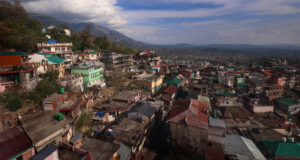
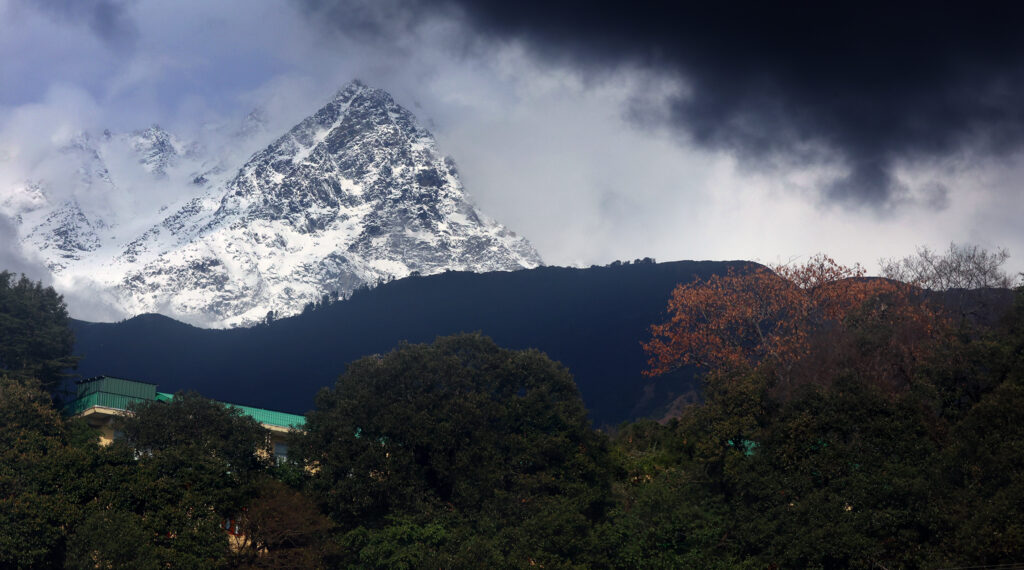
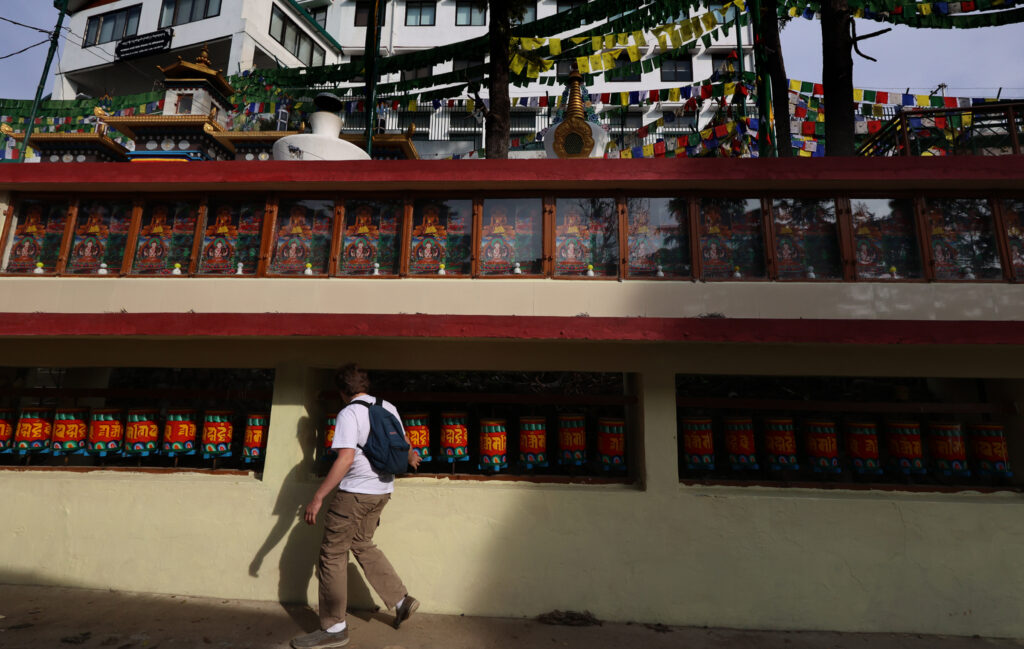
Dharamshala was definitely a highlight of the trip for me. The crisp mountain air was a nice change from the heat in Delhi, and I absolutely loved the scenery. The Himalayan foothills were beautiful on their own, but once the fog cleared and you could see the tops of the mountains with snow at the top, it was breathtaking. Aside from the scenery, Dharamshala was a very nice place to stay. I loved seeing the Tibetan culture sprinkled throughout the town. There were prayer wheels everywhere and we never got tired of spinning them. There were prayer flags hanging from trees and across the streets, which added some cheery color to our trip, and there were intricate paintings and carvings on the walls wherever you looked. I will definitely miss the undeniable beauty of Dharamshala.
One of my favorite parts of our visit, aside from the shopping, was the Norbulingka Institute. Norbulingka is committed to the preservation and continuation of Tibetan culture and arts. Our tour guide, Ravi, walked us all around and showed us different people working on traditional Tibetan crafts such as painting and woodworking. Of course, Norbulingka was just as well decorated as the heart of Dharamshala, where our hotel was located. There were prayer flags strung high above fish ponds made from stone, and luscious green plants that flanked stone steps leading to a Buddhist temple. The buildings were held up by amazing red columns with paintings that connected with the roof. We all took some amazing photographs, as one may have guessed. The temple was surreal. There was a 30+ foot tall Buddha statue at the center and Thangkas and tapestries depicting different stories of the Buddha.
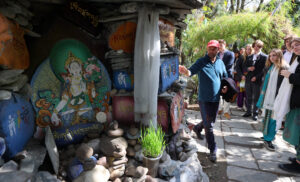
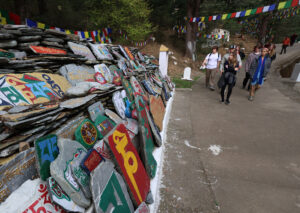
Before leaving for Delhi, our last activity in Dharamshala was the Kora walk. On this walk, we were silent and allowed ourselves to reflect on what we’ve experienced so far on this trip, all while admiring the neverending beauty our surroundings had to offer. The Kora walk had some of the prettiest decorations I have ever seen. There were thousands of prayer flags and painted stones throughout the path, and the Tibetan dogs didn’t shy away from here, which made it all the better. I really enjoyed the Kora walk because it gave me some time to just enjoy nature and process all that has happened in the past two weeks. I truly hope I can come back to Dharamshala some day.
Sam Kaplan
Today we left the Himalayan foothills to return to Delhi and ended our 3-ish day visit in the Tibetan-influenced city of Dharamshala. It was wonderful to stay and play at Sri Ram Ashram, and it was interesting to see the diversity and sites of Delhi, but when we arrived in Dharamshala I thought to myself, ‘This is a place I could easily live in.’
We stayed near the home of His Holiness the Dalai Lama in a town called McLeod Ganj, halfway up the mountain. Our hotel, the Serkong House, had balconies that simultaneously looked over the valley and looked up at the snow covered Himalayas. The foothills and mountains were jagged with long ridgelines and deep valleys in between them. But where the mountains were white and gray with snow and rocks, the foothills were green with splotches of color, populated by a dense layer of trees and broken by the occasional village or house. The air was cool and for the first time since arriving in India, clear. I was reminded of the high peaks in Yosemite National Park that gave way to rolling hills and a couple valleys. But unlike Yosemite, this was not just a park but the home of many Indian, Tibetan, and Himalayan tribal people.
McLeod Ganj is a rare kind of place and I still find myself thinking about its curious cultural position. It seems that at least a third of the people living there are monks who study at the temple adjacent to the Dalai Lama’s house. Many more Tibetan lay people also live there, drawn to the seat of the government in exile. Some are descendants of tribes who live in the mountains, and some are Indians from the surrounding state of Himachal Pradesh. On one hand McLeod Ganj is like the capital of Tibet. While China has taken over the Tibetan state, Dharamshala has acted as a beacon to many Tibetan’s searching to practice their religion freely and escape Chinese oppression. Dharamshala has become the home and archive of Tibetan things, people, culture, and religion. On the other hand Dharamshala is not part of Tibet, it is part of India. In a way all of the Tibetan refugees are visitors or guests in India. As Rinchen Khando, founder of the Tibetan Nun’s Project, talked to us about, Tibetans still yearn to reclaim their homeland. What does it mean to have a government and religious leader who people flock to, operating under the refuge of another government? What does it mean to have a culture carried on only by people and not by a specific place? What does it mean to watch as another government tries to strip your cultural home of its culture?
The situation in Tibet is horrible in many ways, but out of that situation a place like McLeod Ganj is born. Today we walked the Kora Circuit, a sacred trail that runs around the home of His Holiness The Dalai Lama. At one point the road branched off to a home for the elders and I saw many of them walking the loop, moving slowly but with resolve. I saw one sitting with two younger adults and talking, maybe even teaching them. I was struck by these elders; there seemed something resilient and encouraging about the walk they were taking. They were and are the custodians of Tibetan culture, it is possible that some of them had to escape Tibet themselves when China took over, and they are still walking their sacred trails.
I’m still not sure what all of this means, the resilient elders, the tragedy of Tibet, the cultural melting pot of McLeod Ganj, the Tibetan home away from home in Dharamshala, and the provided refuge, given by the Indian government. But I continue to think about it, and I continue to explore the situation in my mind with curiosity, sadness, and a touch of hope. I know there is something in all of that information, something to be learned, something to be changed about the world. In the meantime I present the pieces of observation to you.