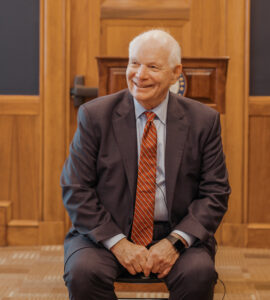
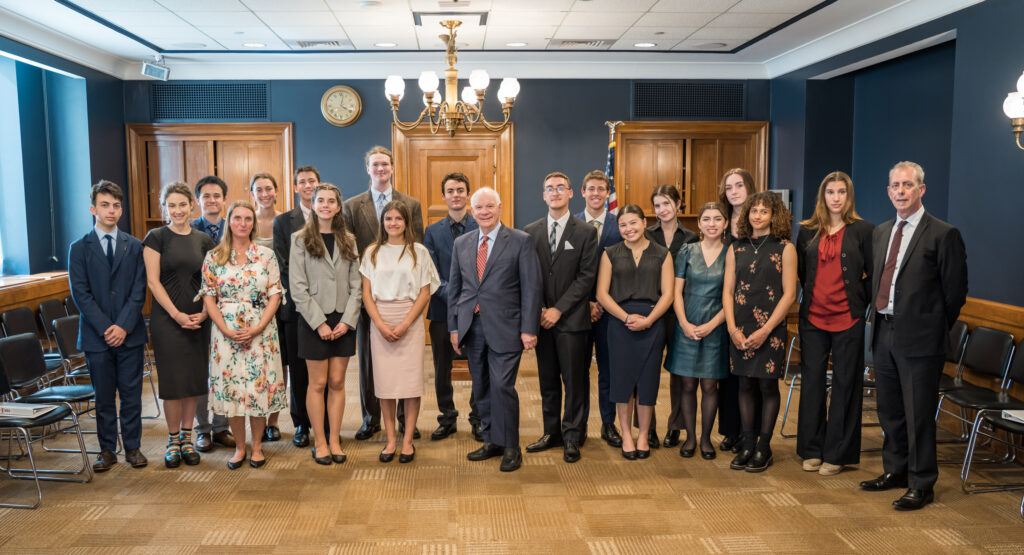
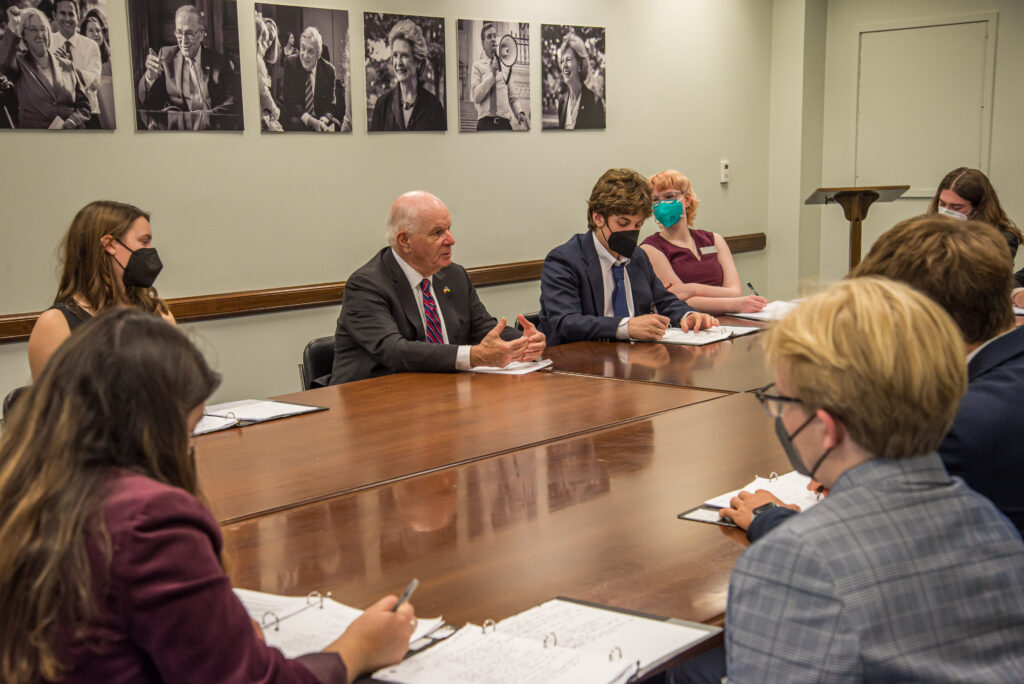
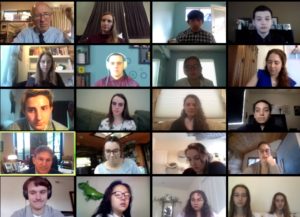
This afternoon we interviewed Senator Cardin, who has held his seat in the Senate since 2007. Our interview with him was short, only thirty minutes. Senator Cardin has been a chairman of the Helsinki Commission since 2006, and in 2015 he was named the Special Representative on Anti-Semitism, Racism, and Intolerance for the OSCE Parliamentary Assembly, a position he still holds. During our interview, Senator Cardin discussed a number of interesting topics, one of them being a bill that the state of Maryland just passed that allows people to work in public service for the government for a year as a way of getting into college.
When asked what he thinks the American Dream is and whether or not it’s achievable for our generation, he said that his idea of the American Dream is “personal” and comes largely from his grandfather. He told a story about his grandfather selling vegetables from a small cart that he would push down the street. Because of the war in Europe at the time, his grandfather had to decide whether to stay in Europe or move to America. He chose to start a new life in America and work hard to create opportunities for his children. Senator Cardin stated that wants everyone to obtain their own version of the American Dream. I asked him a question about our generation and the number of new and complex issues that affect our future. In his response, he said, “do jobs or engage in hobbies that will make you happy” and to “work hard to meet challenges.”
-Peter S.
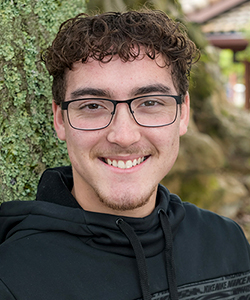
Isaiah Orozco
Today I had the pleasure of meeting and interviewing Senator Ben Cardin, a senior US senator from Maryland. I was extremely inspired by what he had to say to us. What stood out for me most was what he had to say about the American Dream: “I think the American Dream is personal, and it is achievable for everyone, but you must work for it.” I found Senator Cardin to be very easy going and open minded. An example of his open mindedness was the way he described working with Republicans in the Senate, many of whom hold very different views from his own. When discussing a recent gun bill that became law, he stated that although it was not everything he wanted, it was far better than nothing, and passing it required cooperation and compromise: “Did I think that was enough? No. Was it progress? Yes. Do I think more needs to be done? Yes, but progress is better than standing still.” I completely agree with his perspective, because we cannot wait around for the perfect gun law while horrible shootings continue to occur, and it is better to fix only part of the problem than to fix none of it.
Finally, Senator Cardin had plenty of advice for us in the interview: “Expect the unexpected,” “Find out what really satisfies your psyche,” and “You have a lot of time left, so focus on what makes you happy.”
Today we interviewed Maryland Senator Ben Cardin. While we only had a short, thirty-minute interview with him, he nevertheless had time to say some really interesting things. He spoke about immigration law, noting that in the US two of our foundational values are freedom and opportunity. America is, after all, the Land of Opportunity. However, we cannot claim this title if we cannot provide equal freedom and opportunity to those who come to this country to become Americans. Current immigration laws do not reflect American ideals: “America, in its actions, is not living up to its values.” Currently, we reject too many people who seek a better life and better opportunities, and we reject people who seek political asylum, including people who have fled their country to escape persecution and human rights violations.
I also appreciated Cardin’s view that political campaigns should be more transparent. He told us that he takes the time to go to rural areas of Maryland, talk to the people there, and work on their behalf, even though he knows that it is quite difficult to change people’s minds and that he most likely will not be getting their votes. Even though he doesn’t need those votes to get elected—as he receives enough votes from cities like Baltimore—he still makes an effort to work on behalf of all the people in his state.
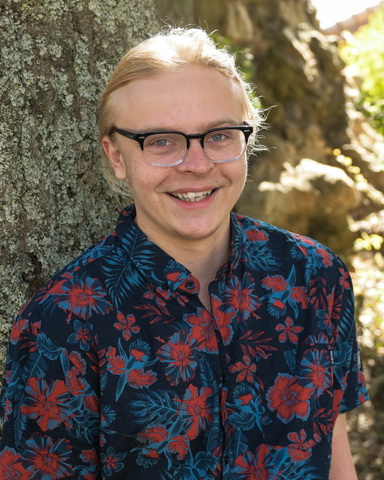
Sky Weir
Today we toured the Capitol and interviewed Sen. Ben Cardin (Maryland). The interview with Senator Cardin was for me the most interesting interview we have had on this trip. It seemed that everyone was looking forward to it. The tour of the Capitol prior to the interview was packed with information, such as the history of various statues and the story of the three artists who painted the dome of the Capitol. We all eagerly anticipated the interview as we ate lunch in the Senate cafeteria, one of the best meals of the trip so far. After Sen. Cardin entered the room, we all stood to greet him, and he made a funny remark that released some of the tension we all shared. We had originally planned for an hour with him, but we were informed that he could only stay for twenty-five minutes, forcing us to streamline our interview to six key questions, all of which provoked thoughtful answers on his part.
Throughout all of the interviews this week there has been a common theme of listening to the other side and coming to a compromise. Cardin too focused on the importance of this theme in several of his answers. We then asked questions about voter suppression, and Cardin responded with the claim that voter suppression negatively affects everyone. He also commented on the fact that we need to change the way we finance elections to make our democracy less partisan. He passionately argued that there needs to be more financial transparency in political campaigns, which seems to me to be necessary if we are to maintain and strengthen our democracy.
He made an important point about the need to be more loyal to our country than we are to our political parties, and he noted that, historically, “when we have a threat, we put the country first.” He then placed his hand on the desk and said in a very solemn tone, “we should do that more often.” This for me was a “wow” moment: I could see his genuine passion for what he does, and I could tell that his own sense of morality pushes him to be his best self in politics.
As the trip is wrapping up, I find myself looking back to our first day here and contrasting it with where we are now. I’ve had many profound experiences and been exposed to views I had not encountered before, making me think deeply about many aspects of my own life. This trip has deepened my understanding of how the US government works, which I know will be most important in the future.
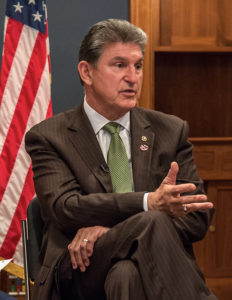
In
response to a question on bi-partisanship, Senator Joe Manchin said,
“Washington has become tribal.” Senator Manchin commented on how
you’re forced to pick a side, red or blue, and that his only answer
to that can be that he is red, white, and blue, an American citizen.
It’s a hard job walking the line between Republican and Democrat
and yet, for the Senator, it seems to be the only way to go about
things. From what we’ve gotten to see in our short time with him,
I’ve come to learn that he is not someone to be messed with.
Senator Manchin has a strong set of beliefs and is steadfast in not
letting others sway his decisions, even those from his own political
party. He showed a great passion for helping and getting the best for
the people of West Virginia. He often brought us back to his core
reasoning for the way he votes on certain decisions, and the premise
for that is if he cannot explain the importance or reasoning behind
the policy or program to his constituency with conviction then he
cannot support it.
Senator Manchin’s strength in his beliefs and his ability to ask for compromise and advice was something that greatly inspired me and caused me to question how I’ve been living my life. I may not be making the large life changing decisions that senators make on a regular basis, but I’d still like to go about my life with even half of the confidence in my decisions that Senator Joe Manchin displayed to us today.
Zoom meeting with Senator Manchin
Ronan Lee
Early
this morning, half the students wary with drowsiness, the other half
still in bed, we started to prepare for the day by going over
questions, making sure we could pronounce certain words, and that our
clothes were unwrinkled. Toward the end of this process, Senator
Manchin showed up.
I found Senator Manchin to be a man with integrity, honor, and a spokesperson for his state. He was also a man who made jokes, told us stories, gave us helpful tips for the future, and answered our questions with a smile. Not knowing what to expect, I was thoroughly surprised by the positions of the senator.
Something I would say is very prominent within our nation is the belief that there is a definite right and the definite wrong answer to most issues. The nation is split in two, and there is no side that one can blame. We as humans are often closed off to opinions we deem as wrong. We have this pack mentality, where you are either with us or you are against us. Yet Senator Manchin is out there, not choosing a specific side, voting for what he believes is right. I found that truly honorable and inspiring.
Maverick Mettencourt
Today
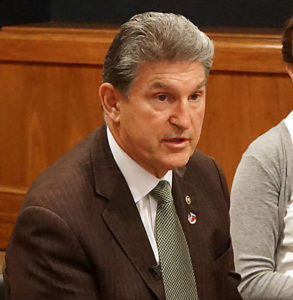
we interviewed a Senator from West Virginia, Joe Manchin. My
family has a personal connection to him, and that is how we got the
interview with him this year. Right at the start of the interview, I
got singled out to say hi to Senator Manchin. This allowed me to
create a personal connection with him and I was able to ask the first
question. I really liked interviewing Senator Manchin because of how
bipartisan he is. I also liked how he defined bipartisanship. Senator
Manchin spoke to us about how you need to vote for what you believe
in, not for your party. He strongly believes that if you truly think
the other party is correct, and their ideas are right, vote for them.
He is also a man that cares about his constituents. He shared a story with us about a time when he was at McDonald’s during his Governorship and he met a woman that worked there. She asked him, “Hey aren’t you the governor?” She then went on to tell him that she had missing teeth and could not afford to have them replaced. In response he said, “You know what, let’s get you some new teeth.” He proceeded to call up a friend that was a dentist and he sent her over to get her teeth fixed for free. I think this really shows how much Senator Manchin wants to promote the common good.
Connor Murphy
It is always a good idea to speak with people who have different opinions from you. That’s a good rule of life and downright necessary for you to grow as a person. But many people think that people with different opinions from you tend to be well, wrong. It was with these conflicting thoughts that I entered the interview with Senator Joe Manchin.
Senator Manchin is a Democrat with a voting record that throws that idea into conflict with reality. I knew that we would be disagreeing on policy before the interview started, and as we all know if I disagree with someone they must be wrong and illogical. So, you can imagine my shock when he wasn’t; every opinion he put before us, whether I agreed with it or not was grounded in sound logic.
Group Zoom call
In the interview, we touched on a lot of themes that have been recurring on the journey so far. He spoke about the importance of listening to a multitude of opinions just like Laura Liswood had said, but here he took it a step further. Senator Manchin pointed out something that has never occurred to me: other people with other opinions have those opinions for a reason and when you listen to that reason, what they think might make sense. The one thing he said that stood out the most to me was, “Talk to people not through people.” All sarcasm aside, the world needs more of this. Too often people get sucked up into their side of the argument and everything else falls by the wayside. When what you know becomes more important than the conversation, you are no longer talking to people, you are talking through them. He highlighted the importance of speaking openly and honestly, and more importantly listening and making sure that people know you are listening.
The other thing Senator Manchin exemplified in this interview was his humility. He spoke about the test of character that he uses, which is just brilliant. The test is simple. When introducing himself he will say something like, “My name is Joe Manchin.” Then if the other person responds with something like, “I am Senator blank”, he can see that this person puts their job as more important than themselves. They have no humility; they see themselves as a role before a human.
Overall, I was struck by the air with which he carried himself. To me he represents the ideal that, “It’s not a vote for the Democratic party or Republican party. It’s a vote for West Virginia.”
Fiona Burgess
Our
interview with Senator Joe Manchin is one that I have eagerly
awaited. He is the only Senator we are interviewing this week and I
was excited to hear everything he had to say. I was not disappointed.
As he spoke it became clear how dedicated he is to his constituents
and state. My admiration only grew as we learned that he doesn’t
allow party affiliation to define his policy decisions. His respect
for bipartisanship is inspiring. Personally, I find the slander that
both parties throw towards each other to be one of the hardest things
to witness. Senator Manchin’s commitment to people over party is a
breath of fresh air from the current political polarization.
One
of my favorite parts of the interview was when Senator Manchin shared
how his grandmother influenced his values. As he explained it, she
was an extremely compassionate woman who always looked out for
others. He described a distinct memory of his childhood during
Christmas when his grandmother received three coats from his cousins
and him. She loved the coats but told them immediately that she would
have to give two of them away as others could use them and she only
needed one. Senator Manchin has been molded by the lessons he learned
from grandmother: attend to the needs of others, err on the side of
generosity, and do not use more than you need.
The influence of Senator Manchin’s family on his priorities was notable to me as I too have drawn a great deal of my values from my family, and in particular my grandfather. First a Republican and then a Democrat, my grandfather always voted in a non-partisan way for what he saw as best for his community and country. As a major figure in my life growing up, he taught me the importance of helping others and listening to others’ opinions even if I don’t agree. In regard to the current party divide in the U.S., Senator Manchin said, “We as a society can come together, we must come together.” As a result of my own values and motivational leaders such as Senator Manchin, I remain hopeful that our country can become less divisive and more open to the exchange of ideas.