A Day of Leisure at the Smithsonian

Erik Howley

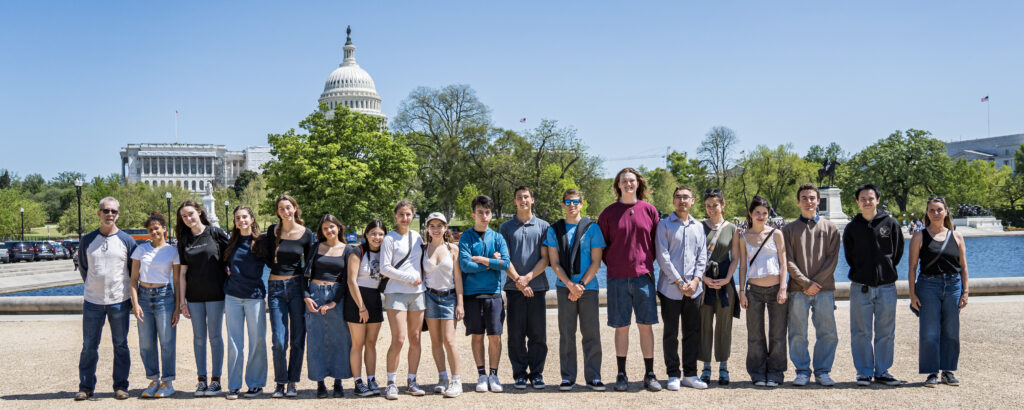
Today we decided to take advantage of the beautiful spring weather and explore the city. We left around noon in our city style fits and walked to the National Mall. My group decided to rent bikes and get some exercise. We rode around the Mall, enjoying the fresh air and stunning views of the Capitol and the Washington Monument. We came upon an ice cream truck and decided to treat ourselves.
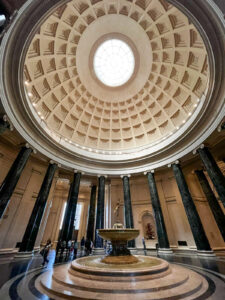
After biking some more, we headed over to the National Gallery of Art, and after consulting our maps we made our way to the modern art exhibit. On the way we rode in an elevator that was so big we were able to play a small game of tag in it. Inside the exhibit, we paused briefly to view Barnett Newman’s “Stations of the Cross,” but then the vibrant colors of the Mark Rothko exhibit caught our eye. One painting in particular, “Orange and Tan”, impressed us. Our art teacher, Angela, had talked about this painting in class and said that she was so moved by it that she cried. Rothko’s use of color and space is mesmerizing, and the sheer magnitude of the walls of color left us spellbound.

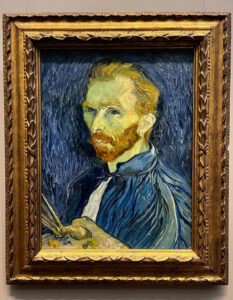
We continued our way through the rest of the exhibit, which included paintings by Picasso, Max Urnst, and other artists. Next up was the French impressionist exhibit, where we viewed works by some of the greatest artists of the nineteenth century. I marveled at Renoir’s skill and the beauty of his paintings, which featured dreamy, romantic scenes and figures from everyday life. We finished our visit with a trip through the Vincent Van Gogh exhibit, where we were all amazed at the intensity of emotion in his paintings.

It was a great day of biking, eating ice cream, and viewing art. We got a little exercise, ate a sweet treat, viewed some great art, and enjoyed a nice break from the rigors of interviewing public figures.


Erin Kavitsky

Today we visited several of the Smithsonian museums. My first impression of them is that they are much bigger than I imagined they would be. I have heard stories about how large the museums are and how many there are, but, as is the case with the memorials and monuments, their enormous scale took me by surprise. The shining glass dome of the Botanical Gardens caught my eye, and I was happy to wander over towards it with a group of friends. Walking through the huge first set of doors, I was surprised by how warm and humid it is inside. The fragrance of the beautiful flowers, combined with the warmth and humidity, gave the sensation of being wrapped in a blanket.

We walked through a second set of doors to enter the botanical garden itself, which features a little path running through the different sections of the garden. I appreciated that the garden doesn’t just feature plants from one region but from a number of different regions around the world, with each section sealed off by automatic sliding glass doors. If you are ever in DC and are wanting to visit the Smithsonian museums, I highly recommend including the botanical gardens as part of your visit. Even if, like me, you aren’t especially interested in plants, a trip to the gardens is an amazing experience.

Wyatt Adams

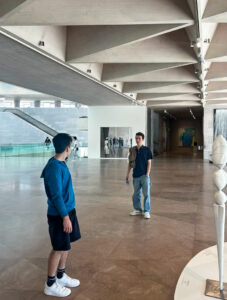
Today, a group of us visited the National Gallery of Art. Until today, I had not been a big fan of art, and what little art I do enjoy typically involves “real life” images of people, places, or objects. I’ve never enjoyed looking at abstract art. However, after visiting the museum today, my outlook on art has changed. 

The first exhibit we visited was the modern art exhibit. The exhibit included works by many famous artists, but the only artist I knew was Pablo Picasso. He was one of the founders of cubism, a form of art that uses geometric shapes to form broken and oddly figured images. Before going to the museum, I was not a fan of Picasso or cubism, but there was something about seeing the actual paintings that made me stop and say to myself, “Wow, I don’t understand this at all, but it’s kinda cool.” After viewing other cubist works, I decided that although I don’t particularly care for cubism, I do respect the artists and admire the complexity of the art.

We then looked at paintings from the Renaissance. Prior to visiting the museum, I thought that Renaissance art was cool looking, but I didn’t like that they all have a similar “feel.” Much of the art is religious in nature, so it gets a little repetitive for me. However, when I saw the paintings in person I was genuinely impressed. I didn’t realize until I viewed them that the canvases were anywhere from three to ten feet tall. I was amazed to think about how someone could paint something that big without a photo to look at while painting. Despite the religious themes of the paintings, I really enjoyed looking at their impressive detail and vivid colors.

A Paleontologist Says to “Wing” It

Interview with Scott L. Wing

Summer Howley

On our way to the room where we would conduct our interview with Scott L. Wing—a curator at the Smithsonian National Museum of Natural History—we passed row after row of black filing cabinets with aged handwritten labels on every drawer. The scene looked like something out of a science-fiction movie. We came to know later that the collection on that floor was dedicated to shells. The bones and plant collections also each had a floor. Wing said in total there are over 40 million fossils. If I had time and permission, I would have found it amazing to explore the collections for hours. 

Once we began the interview, it was evident how intelligent and passionate Wing is about his work. When asked what ideas he thinks are most important for museum-goers to take away from their visit, he said that he hopes that people gain “some sense of awe at the age of the world and their connectedness to it.” His answer was a well-worded explanation of what museums have to offer. I also liked that he didn’t simply discuss the age of the world but also discussed how we too are part of the world and natural history. 

However, although we are a part of nature, we have a unique impact on it and thus a unique responsibility when it comes to our environment. A theme throughout our interview was climate change, a difficult and sensitive issue. He argued that finding a solution to the problem of climate change requires “a sense of urgency and hope at the same time.” Too often in the media, opinions are polarized, with some people denying the existence of climate change for irrational reasons and others thinking “apocalyptically” about the end of the world. Neither of these alone are the only possibility for the future, and neither of them alone are productive when trying to solve the problem of climate change.

When asked if he has advice for people who are entering adulthood during these tumultuous times, he stressed the importance of remaining flexible. It is not necessary or desirable to plan everything in too much detail. Instead, it is important to take advantage of arising situations and opportunities and be “willing to see a turn in direction” and embrace it. This was very validating to hear, as I have been telling myself recently that I need to be flexible about my future plans. Remaining flexible makes my future prospects appear all the more exciting as a result.


Mariah Cohen

Today we interviewed Scott L. Wing, a research biologist and Curator of Paleobotany at the Smithsonian National Museum of Natural History. I learned a lot about both his work and what my career path might be like in the future.

Wing spoke about the process of creating an exhibit and how challenging it is, which was very insightful. Before the interview, I had never really given much thought to what exactly goes on behind the scenes of the creation of an exhibit at a museum. However, hearing Wing talk about his work made me more excited for my future career, whatever it may be, and it opened my eyes to what many jobs actually entail. One thing he said about this process that stood out for me was how much debate/negotiation goes on in the process of creating an exhibit. I was extremely surprised to learn that when you see an exhibit at a museum, everything—right down to the specific words used to describe the exhibits—has been argued over extensively. Because curators are often scientists themselves, I assumed that whatever they think about an exhibit is perfect, and no one would object because scientists know what they are talking about. However, it is not the case that scientists always have a sense of what the general public at a museum can digest when viewing an exhibit, and it is often the case that exhibit developers have a better sense of what the general public wants to know. Knowing what I know now, I have a much greater appreciation for museums, and I continued contemplating what he said as we walked around the Smithsonian National Museum of Natural History.

Another thing I found valuable in this interview was Wing’s story about how he got to where he is now. Although Wing was always interested in fossils, his career began when he was invited to go on an expedition to dig for fossils when he was seventeen. Multiple times in the interview he stressed how important it has always been for him to have fun. Because the expedition sounded like it would be fun, he joined it and started down the path that led to where he is now. When asked what his favorite part of his job is, he stated that “driving around in his four-wheel-drive vehicle” is his favorite aspect of the job. Similarly, his advice to us as young people was not to get stuck having a set plan for our lives, because it’s important to have a good time and remain flexible so that you can take a different direction than you originally planned for if necessary.  This idea is reassuring for me, as I don’t know quite what I want to do with my life, and I’m worried that I will get stuck doing something I don’t enjoy. Having a successful person tell me that he is happy in life because he “went with the flow” was refreshing and inspiring to hear.