Democracy is a Responsibility

Zoey Ocampo-Sobkoviak

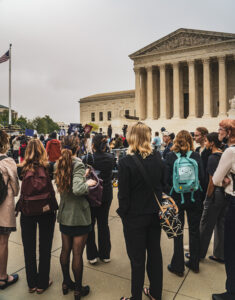
This morning, from the steps of the Library of Congress, we could hear chanting and shouts coming from outside the Supreme Court. We were about to meet the Chief of the Office of Art and Archives of the House of Representatives, Farar Elliott. We were excited to meet her and speak to her about her intriguing job. At the same time, the recent leaking of the draft opinion from the Supreme Court regarding the possible overturning of Roe v. Wade was on our minds. We were intrigued by the protest and wanted to be a part of this important event. 

As it happened, our interview with Ms. Elliott was moved to a couple of hours later, so our entire group crossed the street to observe the action. I was excited but a little unsure of what to expect, given that the topic of abortion has been long debated, contested, and is a key issue in the fight for women’s rights.

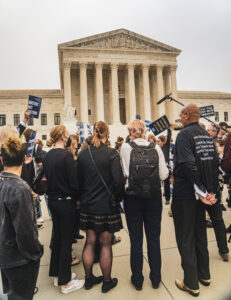
When we arrived at the stairs of the Supreme Court building, we found a gathering of both supporters and opponents of Roe v. Wade. However, the opponents outnumbered the supporters, which I found alarming. Nevertheless, as our chaperone Chelsea told us afterward when talking about our experience, it is important to hold space for all sides to have their beliefs and to think critically about what it is we believe and will fight for. It was fascinating to see how certain groups that are stereotypically liberal or progressive were waving banners supporting the ban on abortion, while certain groups that are typically seen as more conservative were shouting chants to protect women’s choice. Everywhere I turned it was hard to discern who was arguing what, and people who looked like me did not necessarily hold the same beliefs at that moment as other people who had vastly different backgrounds from mine. 

I joined in with the girls in our group, and eventually I felt the courage to chant and participate. I felt the support of women and others I had never met, and they let us know that they were inspired by our group. I felt gratitude towards the boys in our group who joined us in the protest because I believe that feminism is not just for women. Even though I am passionate about activism and protecting human rights around the world, my introversion initially held me back from letting my voice be heard. After giving myself the space to watch and observe, I joined the protest. I gave thought to the arguments at that moment—as I had done many times before today—so I did not feel that I was blindly rushing into conflict. I chose to follow what I felt was right, to call attention to the serious damage that a ban on abortion would have. Overturning Roe v. Wade could have serious implications not only for women but for anyone who can become pregnant or has to handle an unwanted pregnancy. According to the Center for Disease Control, these implications disproportionately affect people of color and those with fewer economic/ healthcare resources, as Black and Indigenous women are up to three times more likely to die from pregnancy-related issues than white women.

With some guidance from our chaperones, we reflected on the high emotions of the moment. An important thing we talked about is that protesting is just one step in making the changes we want to see. Protesting is absolutely essential, and it does well to rally people for a cause, and it has been pivotal in plenty of social, political, and environmental movements. However, protesting needs to be backed up by community organization, changing or creating legislation, and investing resources in active solutions. I am glad to have been a part of this protest because this SCOTUS decision will directly impact my and future generations, and I feel fortunate that I had the space to think critically about the experience.


Cecily Kelly

Waking up this morning on the second day of our interviews in Washington, DC, we were met with a dull, gray, overcast morning, the weather reflecting the dismal mood that women across the country were feeling after the upsetting events of the previous night. The preemptive leak of the monumental decision to overturn Roe vs Wade left women around the country feeling betrayed, heartbroken, and angry.
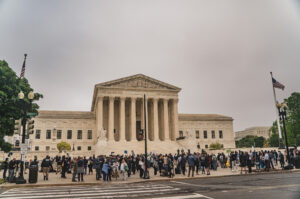
Some of us thought little of this decision at first. It was just another morning in DC, as we rushed to get out the door, clad in fancy clothes, ready to interview important people. As we made the trek to our first interview at the Library of Congress, we began hearing the faint noises of protesting at the Supreme Court of the United States, located next to the Jefferson Building. When we arrived at the Library, it was apparent that there had been a little mix-up, and Farar Elliott, the curator of the House of Representatives, would not be arriving for at least another hour.

On any other day, this would have been disappointing: the thought of having to sit around in cold weather for another hour would have upset most of us, but today was different. We immediately knew that we wanted to go get involved, to protest in support of our beliefs, and exhibit our First Amendment rights. When I walked over to the protest, I was stunned. I was expecting to see and hear women protesting this abhorrent ruling, screaming chants for their right to choose. Instead, I was met with the opposite: women cheering at the overturning of Roe vs. Wade. I was disgusted. How could these women be excited to lose their rights? How could they be protesting their own right to choose?

After a few moments of taking in this sight, I regrouped with my peers and watched from afar as people cheered over the robbery of my choice. Eventually, a woman from the other side of the protest made her way to us and we followed to join her. We began chanting, “Keep your hands off my body” and “Hey Hey, Ho Ho, your backwards views have got to go.” We chanted in the face of oppression as “progressive Catholics” screamed back at us. This lasted for a while, as we protested for our rights and pro-life protestors inched towards us, forcing us to move backward.

We used our voices to express our beliefs and fight for those who will be more affected by this ruling than we might. When it was time to head to our interview, we were fired up and apprehensive about leaving. We turned away from the crowd, and walked away on the promise that we would be back. 

Grace Timan

I was sitting in the hostel bedroom with all of my friends when I found out about the leaked SCOTUS decision. We were all immediately outraged. Being a group of teenage girls, we felt this on a personal level, this decision being something that has the potential to affect us all individually.

The next day we went to the Supreme Court to protest, one of the most surreal experiences I have ever had. I have been involved in protests in the past, as I planned a Black Lives Matter Protest in June 2020. However, the difference between protesting in Santa Cruz and DC was stark. In Santa Cruz, everyone around you is on the same side, but there in front of the Supreme Court building, it was a mix of opinions. Everyone is passionate, but not everyone agrees with you. It’s hard not to become aggravated by other opinions, but it was important for us to focus on supporting one another and the others around us.
MMS Students on Front page of the New York Times

The scene was really emotional. I saw my best friend crying, and I broke down myself. The precedent that the overturning of Roe v. Wade sets has the potential to take away more than just our rights to abortion, but could also result in bans on birth control and gay marriage. It feels like we are moving backward. These are my rights, this is my body. While protesting, I felt pure desperation. 

On a more positive note, I could feel so much support around me. Many women in the crowd made sure that I and my friends were safe. They were motherly, and they demonstrated the community that fighting for a common cause creates. Being able to look behind me to see my male friends passionately yelling for my right to choose was also touching. Knowing that people care even when an issue doesn’t directly affect their lives added to the feeling of community. 

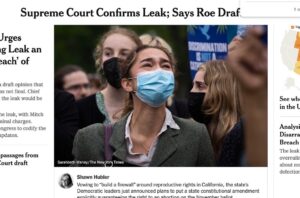
It felt like I was a part of history today. We were nervous when participating in a DC protest, especially in such a momentous location like today. We only realized the magnitude of what we had experienced until later in the day, when we checked the New York Times and saw our picture on the cover. We then realized just how much impact we as individuals can have. I’m proud to say that I am fighting for this cause.

Democracy and Solving Problems Together

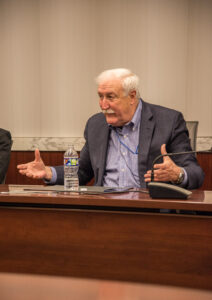
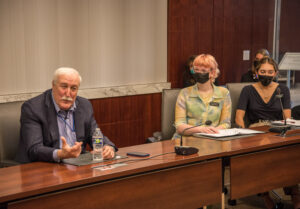
Interview with Sean O’Keefe

Jimmy Bregman

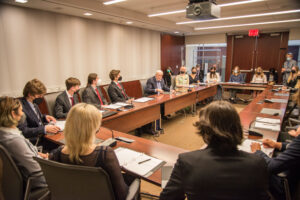
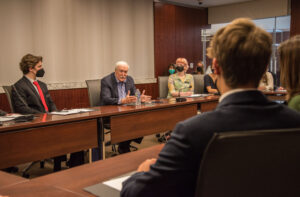
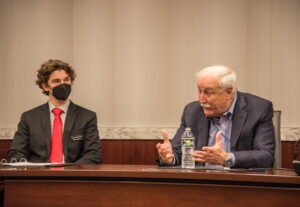
So far our DC trip has been a great success, and I have had an amazing time with my classmates. Today we did our first formal interview as a group at the Center for Strategic and International Studies (CSIS) with Sean O’Keefe. I was very excited leading up to this interview because I found from my research that he is a very interesting and insightful person. I think that both of my questions landed very well, and I was super satisfied with the answers that I received. It was very insightful talking to someone who has so much experience working in non-profit, commercial, and government organizations, and who is known for being a problem solver.

Kayla asked a very eloquent question about how he dealt with regret and the past. O’Keefe’s personal philosophy on this was beautifully concise and it deeply resonated with me. He reminded us that, although it is paramount to be reflective and mindful of our past, we can’t move forward if we’re constantly looking behind us. This philosophy, he told us, is admittedly difficult. O’Keefe revealed that as a human he too struggles with implementing this thought in practice, although he also reminded us that our best is all we can do.

I spent a lot of time thinking about what question I wanted to ask. For the longest time, I couldn’t come up with any question that I felt had enough substance, and I really wanted to impress O’Keefe with my question. I eventually found a very niche panelist discussion that he participated in over Zoom in which he discussed unique challenges such as our space littering problem and space policy. Although he didn’t expound much on the latter, I felt he would have some interesting things to say. I ended up asking:

“In an online interview in March, you talked about the challenges of expanding into outer space and the need to convince all active parties to cooperate in a manner similar to maritime law. Do you think that different governments will be able to apply these logic-based rules as we expand in space exploration and travel?”

He gave us a lot of his knowledge about why space regulation can be so very hard to implement and how it concerns our innate nature as humans and how we must transcend that nature to work towards larger goals.


Sky Weir

Today, we had our first interview. Leading up to it, people didn’t seem very excited, probably because we are still jet-lagged. However, as we got closer to the interview, everyone seemed more enthusiastic about what was to come. When we got to the interview, we were surprised with a small layout of fruits and desserts that in my opinion raised morale considerably. The interview began, and what followed were many well-worded questions. O’Keefe’s responses gave us valuable insight into his thoughts and feelings. 

The first question that really interested me was Jimmy’s question: “What are some key lessons or concepts you’ve taken away from your varied positions, and what helped you put your best effort into each job?” His response was a well-rounded summary of what his personal values are when it comes to this part of his work. He commented that people skills are essential in public service as well as in life. Knowing how to work with people and how to get a large group to come together and figure out a solution that integrates everyone’s opinions has helped him in all of his jobs and in becoming the person he is today. I found one story he told to be very thought-provoking. He shared a quote that a college professor of his wrote on the board that continues to be meaningful for him: “PEOPLE IS HARD.” I gained some understanding of how complex people are and why it is important to take this complexity into account when working in public service. 

After several questions that explored his personal morals and work experience, Ben asked a question relating to his opinion on how soon large-scale commercial space travel will be available. He brought up the example of air travel and how it first started. When commercial airlines were first introduced, they catered towards the rich, as air travel was expensive, intense, and took a lot of skill on the pilots’ part. Now, however, air travel is highly commercialized, and almost anyone anywhere can partake in what used to be an extremely exclusive mode of travel: “Technology, once devised, reduces in cost at the same time it’s expanded in application.” For this reason, he thinks that space travel will eventually become routine.

As the interview came to a conclusion, he imparted a few thoughts about the importance of being able to work well with others:

Listen to where others come from; you don’t have to agree.

Find and emphasize common ground. Listen, and then project.

These quotations share a common theme: people skills are required when solving large-scale issues that affect us all. As someone who wants to go into the field of business, I now understand the significance of bringing people together to achieve common goals in business.


Bella Cambell

Today we interviewed Sean O’Keefe. I enjoyed Liana’s question: “Given the conflict in the world right now, including the war on Ukraine, how do you think the supply chain issues will evolve?” O’Keefe replied that if we just shut down everything, then the economy will take a dive and hurt the country. He gave the example of the cyber-attack on Colonial Pipeline that shut it down until a ransomware was paid. No one was able to get gas for days, and many people weren’t able to go to work or commute. Similarly, he argued, we can’t just completely stop using an important resource like fossil fuels. Yes, fossil fuels are terrible for the environment, and we do have to stop using them eventually to fight climate change, but not everyone can make the switch to renewable energy overnight. Instead, we have to integrate the use of renewable resources over a period of time. We are racing the clock to find the solutions to the problems of climate change, but we have to bring everyone on board.

He talked about striking a balance in which we introduce renewable energy but do not fully stop using fossil fuels immediately, making the transition efficiently so it won’t hurt the economy and we can get more people to support the cause. Climate change is moving incredibly fast and hurting our planet, but we need to catch up and try to reverse the problems we’ve made without going cold turkey. Because the U.S. is so dependent on fossil fuels, we’ve become an easy target for ransomware attacks that can have drastic effects if our main fuel sources are interrupted again. This is another important reason why we have to make the shift to being more dependent on renewable energy: doing so not only helps the environment but our country’s safety as well.

I thought that his response showed a lot about his personality and work ethic. You can tell from his responses that he takes the time to step back, listen, and observe in order to discuss different possible solutions before settling on a plan that includes everyone and doesn’t focus solely on one’s own ideas.


Sam Kaplan

Going into our first interview of the week, I didn’t know what to expect. When the interview began, I realized that I was expecting something very formal, and I was so preoccupied with being professional, prepared, and competent that I had forgotten the purpose of these interviews. The interviews are not like job interviews in which we are trying to impress others, but are opportunities for the interviewee to share their knowledge and experience with us. I then realized that this interview would be an opportunity for us to receive advice on how to solve problems in our own lives.

My favorite thing about our interview with Sean O’Keefe was the way that he turned every life experience he had into simple and useful tools that we can apply to our own lives. Near the end of the interview, it became clear to me that most of this advice revolved around people. From the very first question of the interview, O’Keefe stressed that the most important problems any organization will face are people problems, and throughout he gave advice on how to solve these problems. In response to a question about how to handle situations that require a lot of sensitivity, he told us that you must put yourself in the other person’s shoes, and that as long as you are watching closely enough, you will be moved by issues that the people have. In response to a later question he expanded upon this idea by emphasizing the importance of listening to the other side in the democratic process.

He also frequently brought up the importance of trusting your own instincts and having integrity with your own values. This duality is something that I’ve wrestled with a lot, and it was good for me to hear that these values are of great importance to him, and that they are reconcilable. During the last question of the interview, when asked about how we can deal with the complex issues of our time, O’Keefe reminded us that all generations have unique problems that are as important as the problems we face now. Although technology is always changing, human nature remains the same, so the skills required to work together are always the most important.

In response to a question about how to implement different principles of democracy, O’Keefe provided an interesting viewpoint about our government by saying that it is an experiment. Furthermore, he argued, it must remain an experiment: a healthy democracy is one that is rediscovered constantly, and it depends on change. He therefore encourages people who have different opinions to become involved in working to change the system. Multiple times in the interview he became passionate when discussing the problem of denying facts and not listening to others or genuinely considering others’ opinions. I enjoyed this perspective, and I think that it is wise not to attempt to stop change in America. Instead, we should encourage change and be wary of those who seek to stifle it and suffocate our democracy.