Drive to Sri Ram Ashram

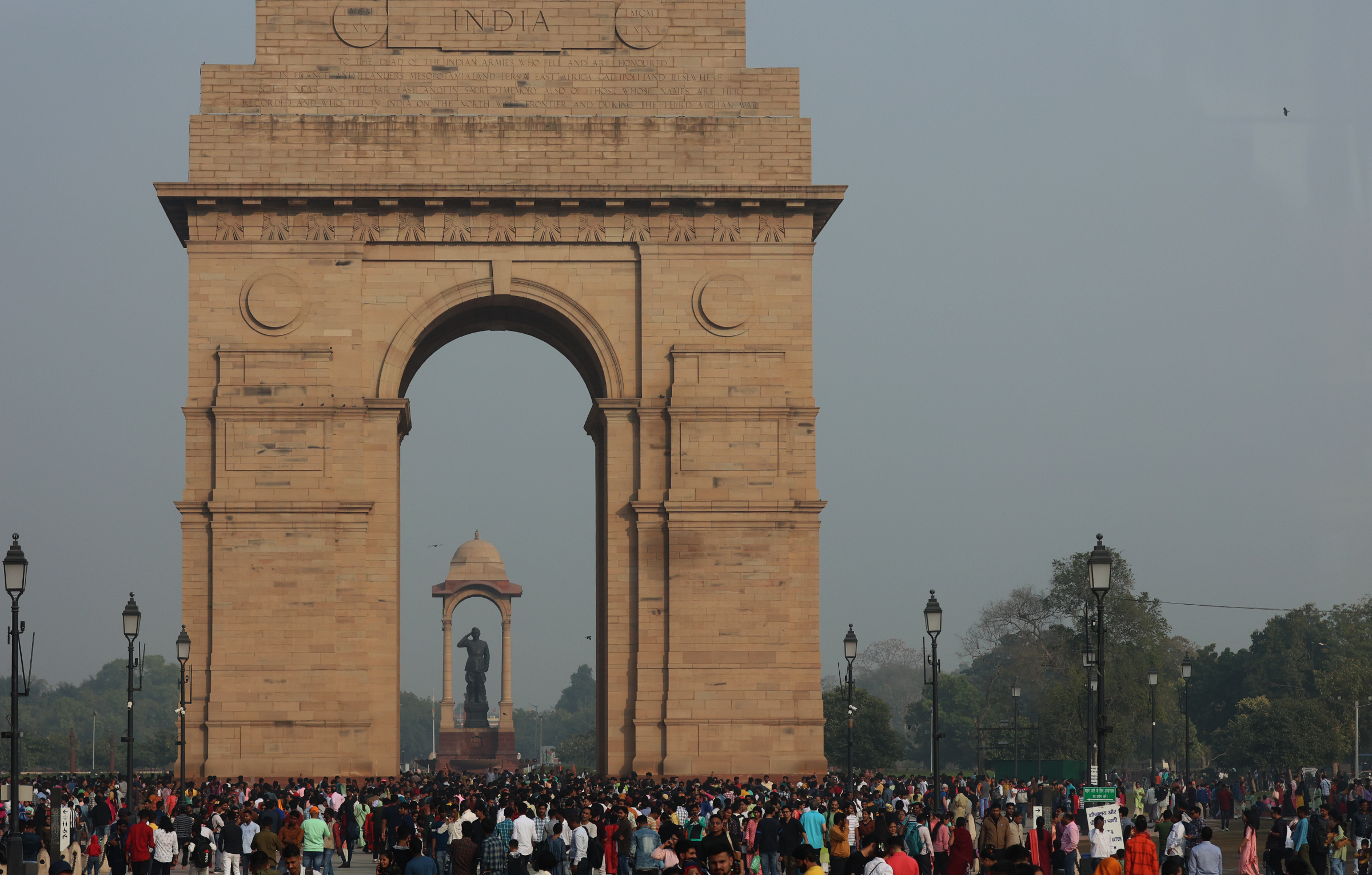
The first thing I noticed about India I saw even before we landed on Indian soil. Through the airplane window, as we were descending from the air into Delhi, I saw many buildings painted in beautiful reds, greens, and yellows. Immediately, I knew what a bright and beautiful country India is. Throughout the city of Delhi, there were walls full of paintings, bright colorful cars, and beautiful flowers embellishing the sides of the roads. From the green and yellow tuk-tuks, to the tulips, to the orange sun, these were but a few of many pops of color against the grey sky.
We soon embarked on a five-hour drive from Delhi to Haridwar, where the Sri Ram Ashram is located. As we drove farther from Delhi, the scenery changed. The big colorful buildings turned to agriculture fields growing sugar cane and wheat. On the sides of the road, little shops were buzzing with business, their roofs consisting of tarps of various colors. Statues of gods like Shiva and Vishnu were scattered around Haridwar, a holy city where many people do pilgramages. Women wearing beautiful Kurtas with colorful patterns walk up and down the bustling streets. My eyes, although stinging from the smoke, could not be kept from looking through the bus window. As the orange sun set, changing the sky to a dark grey, the bus lights flickered on. The bigger store’s neon lights did so too, illuminating the street with bright vibrant colors.
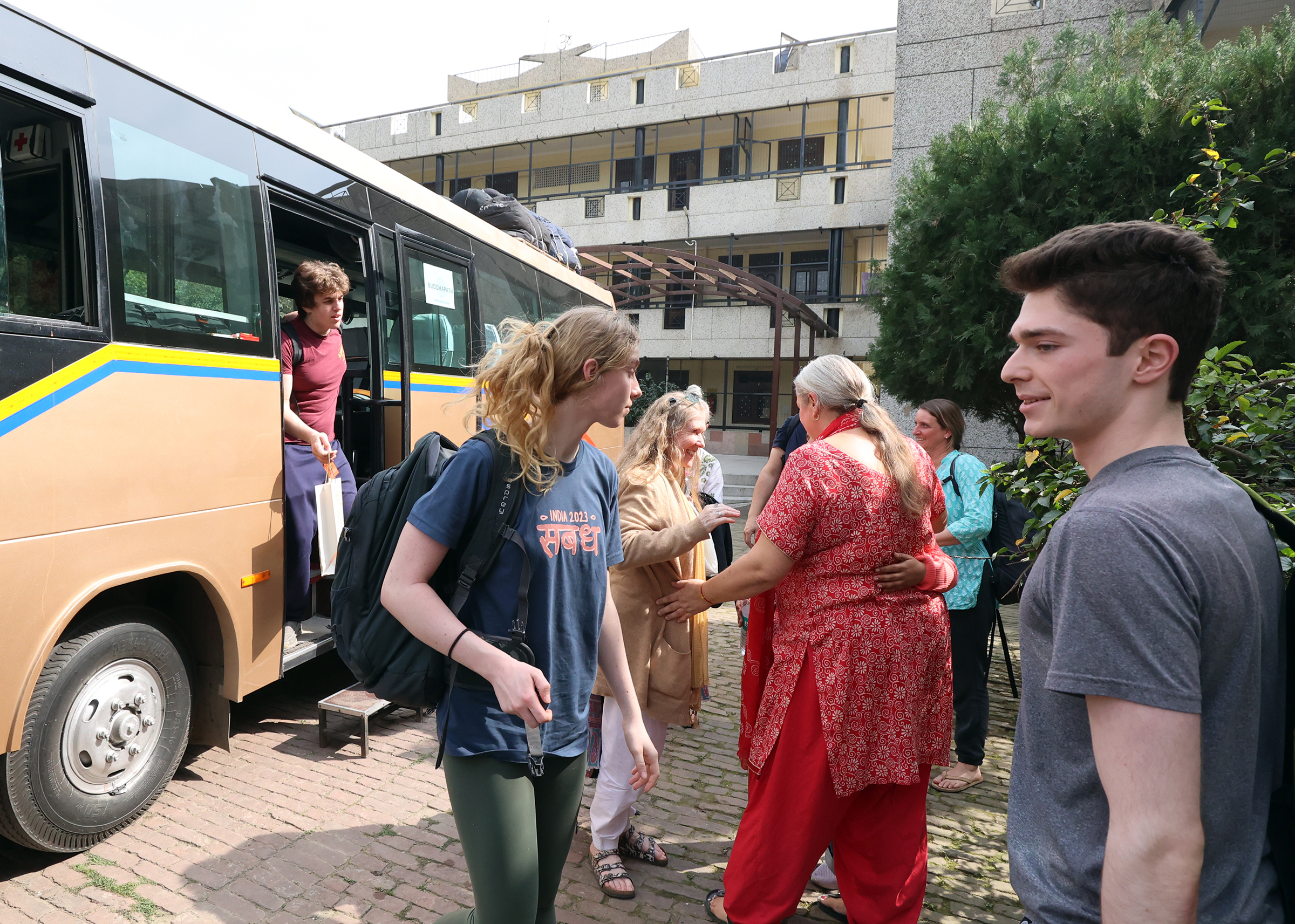
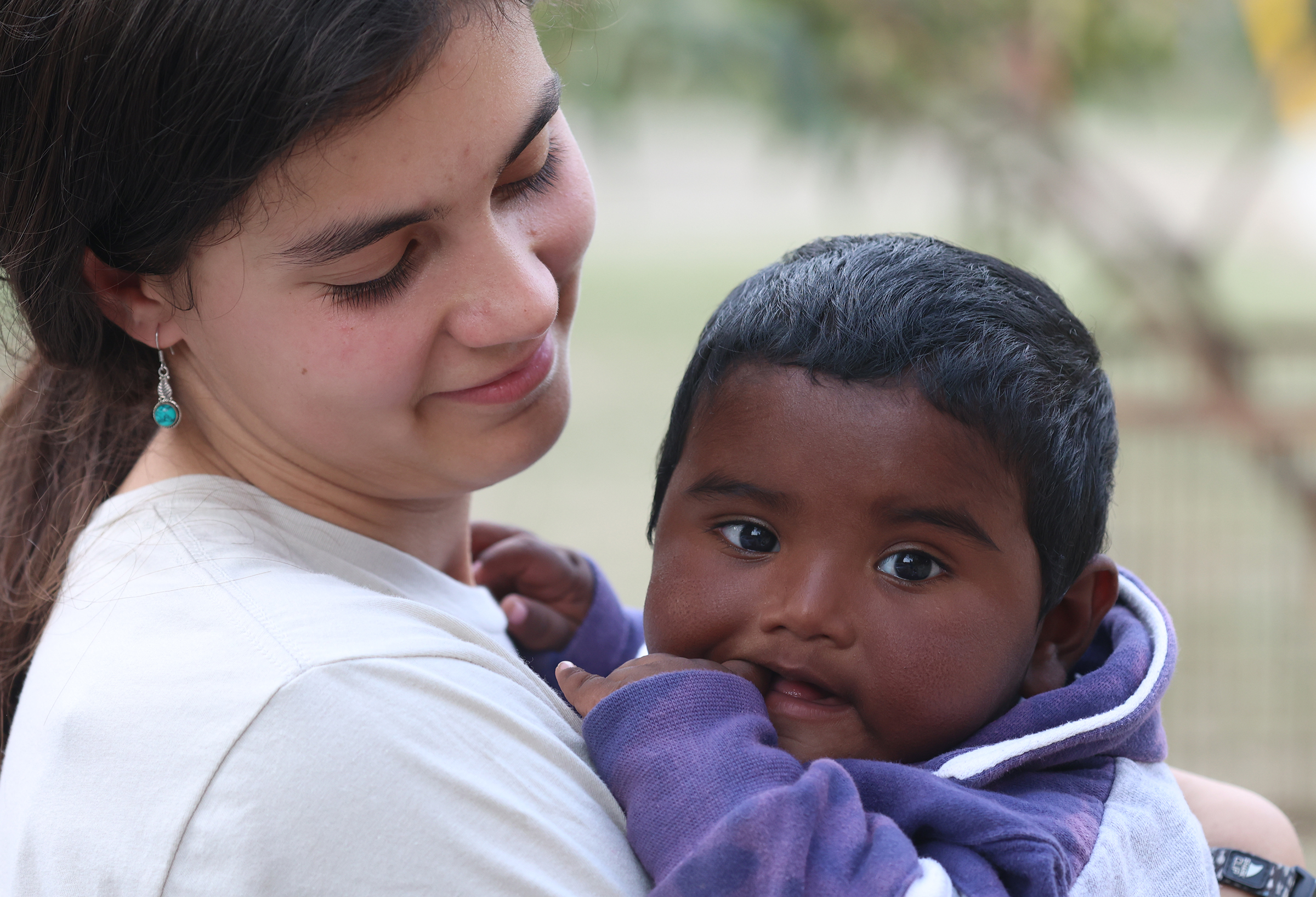
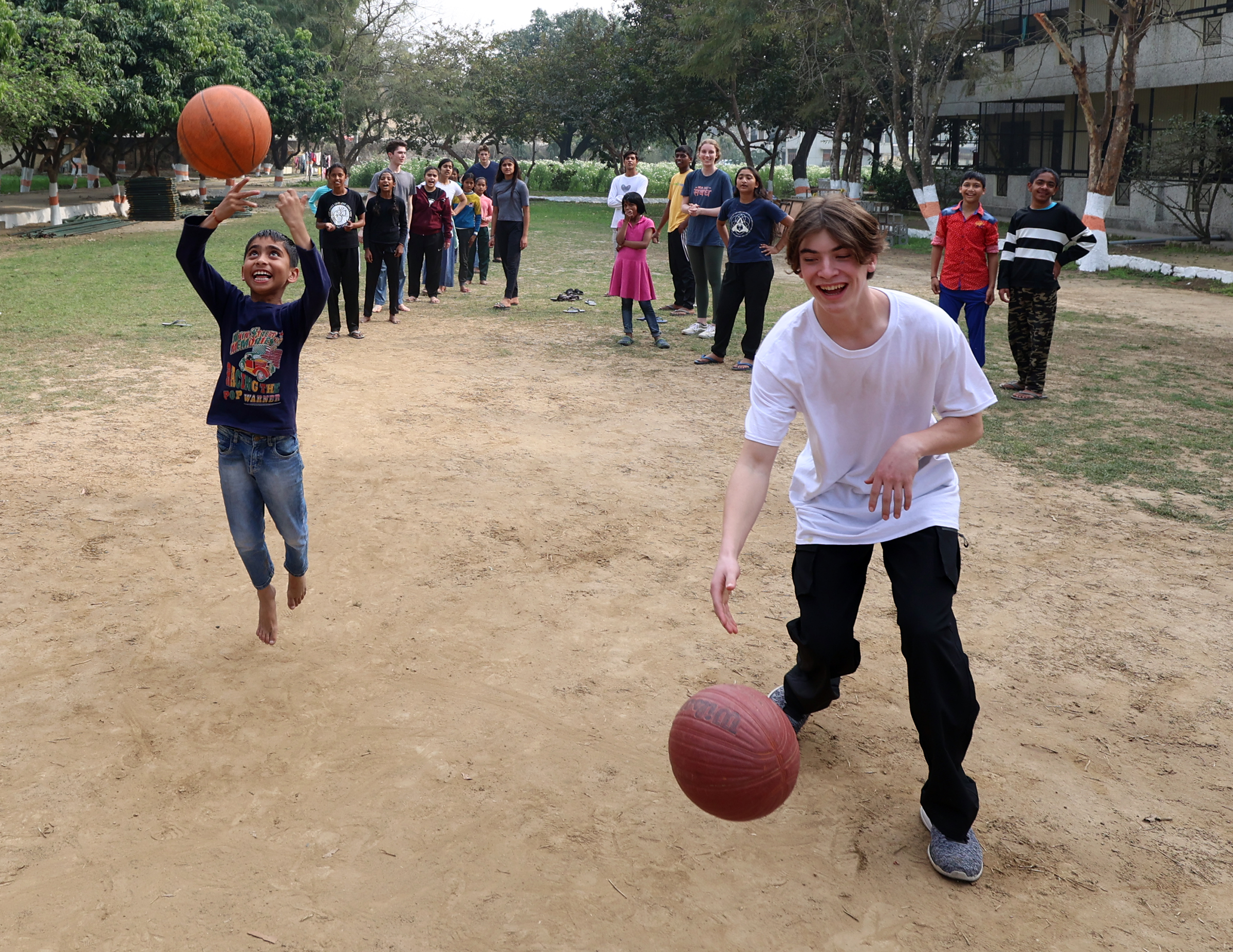
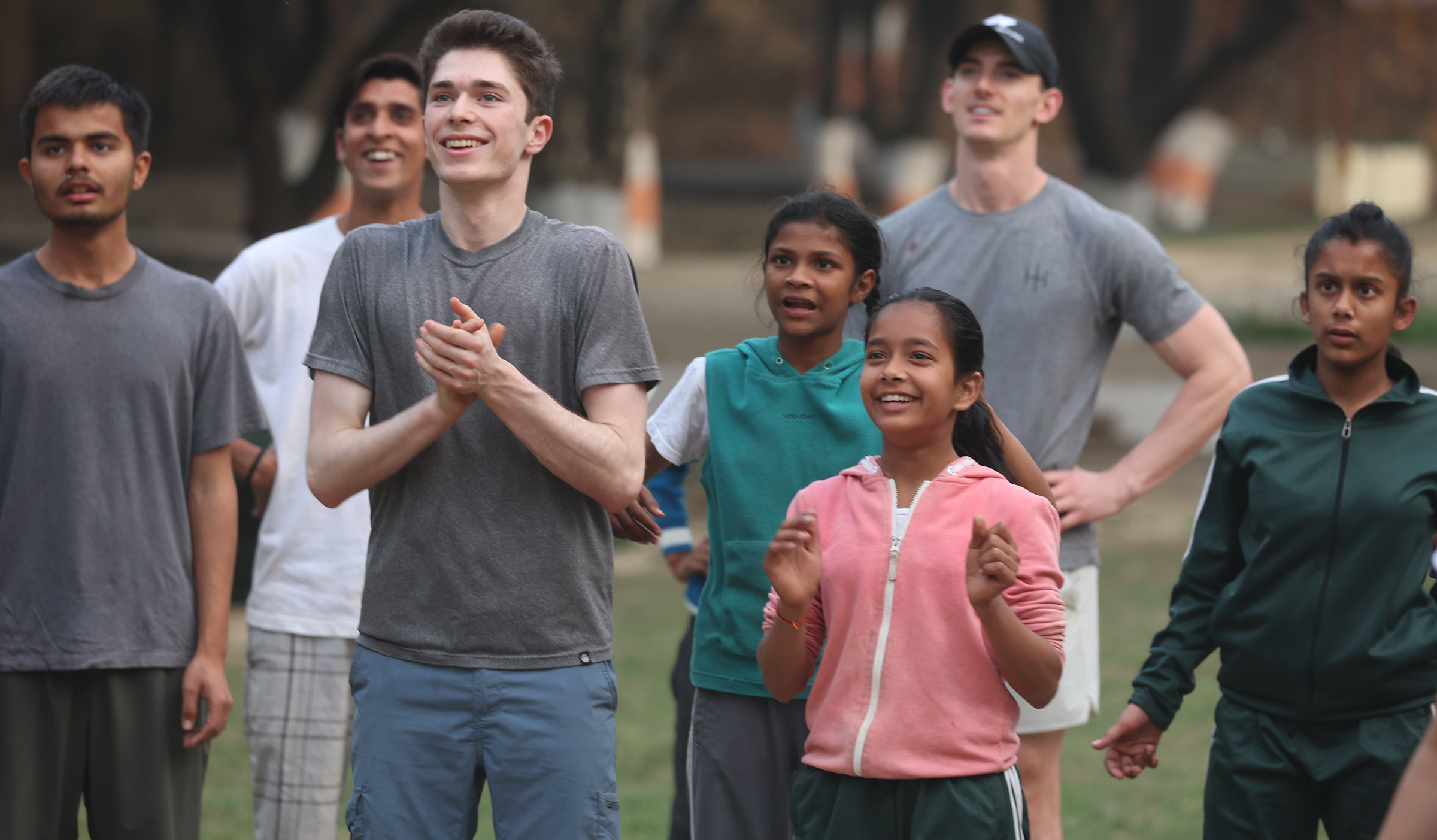
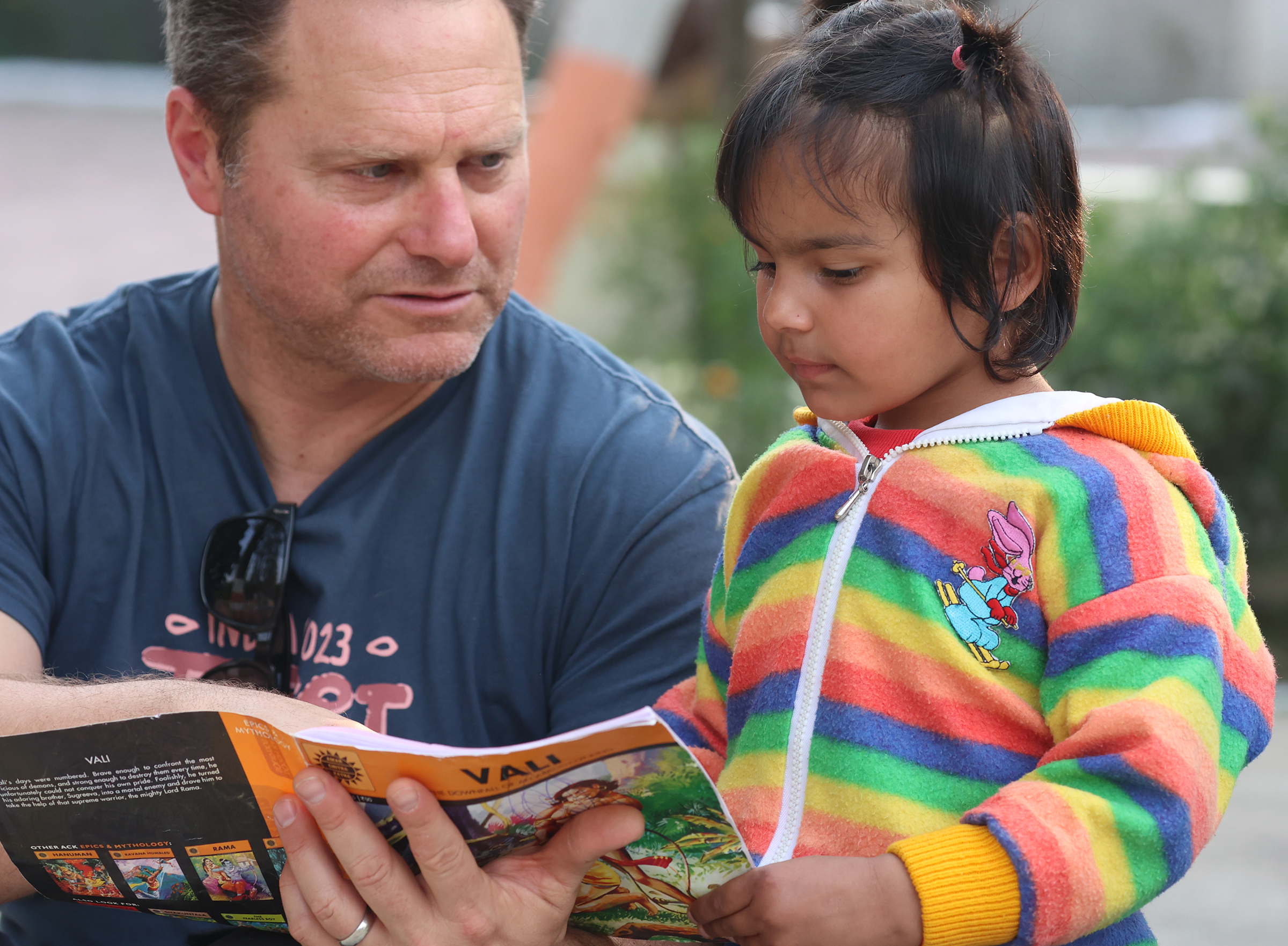
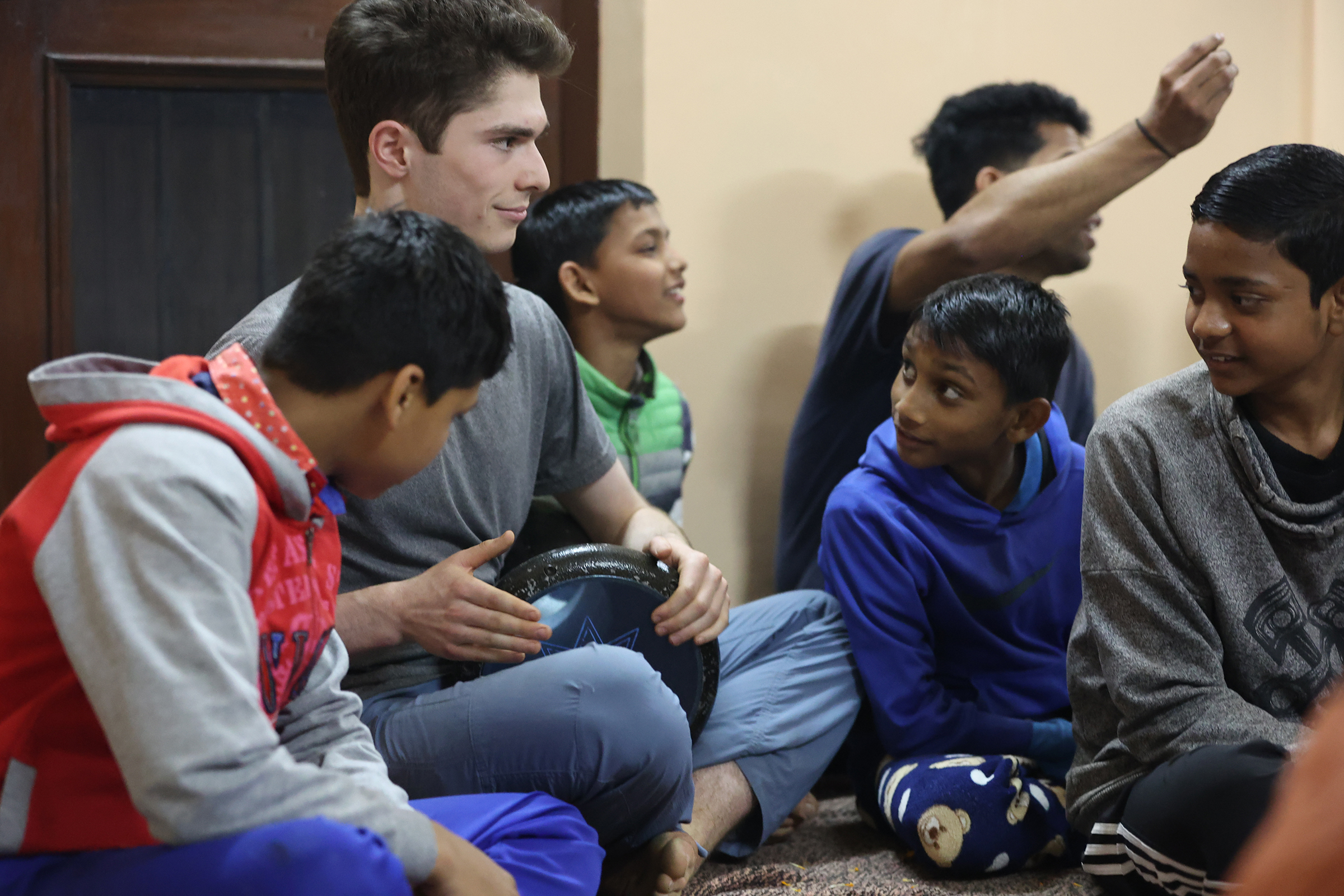
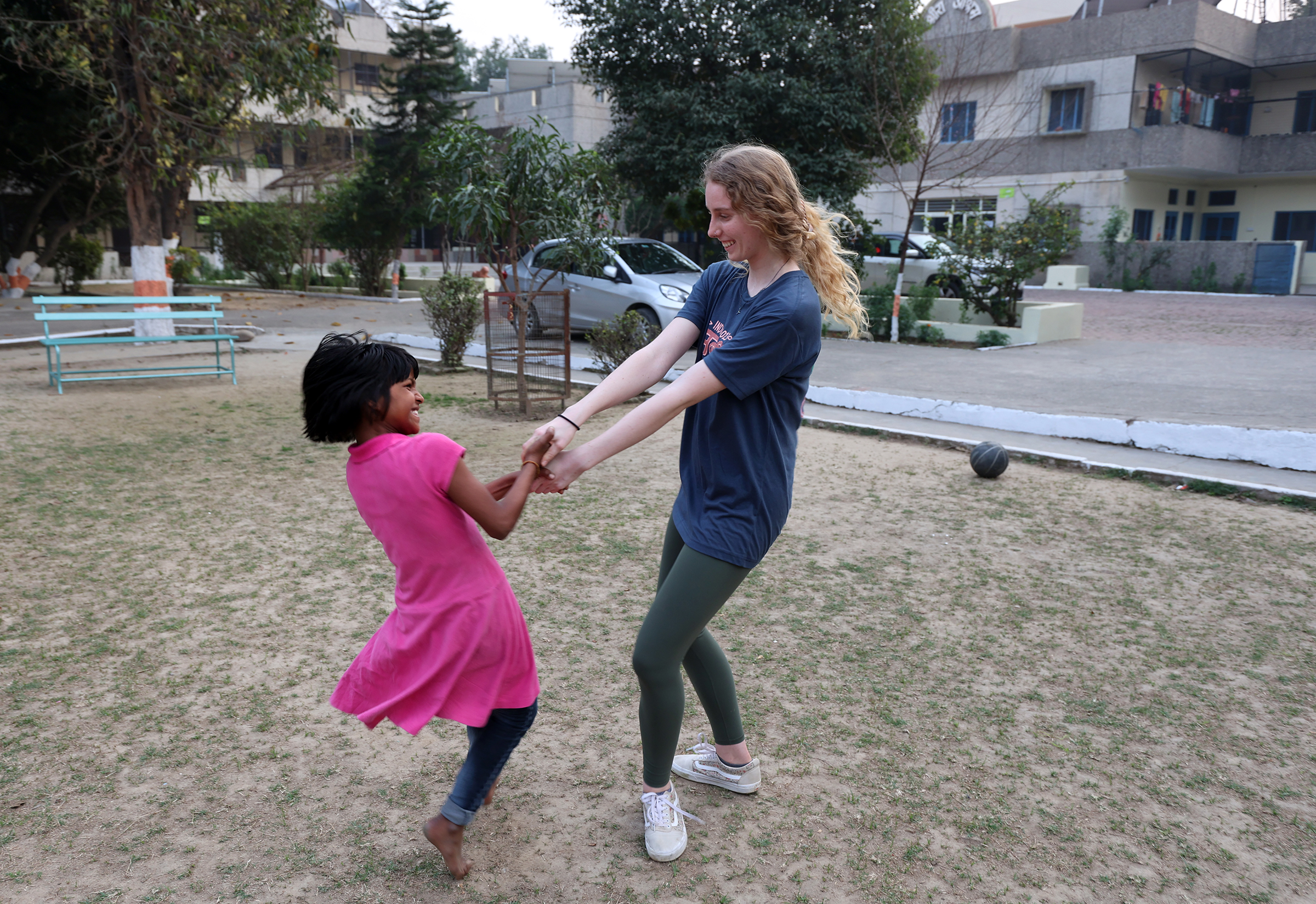
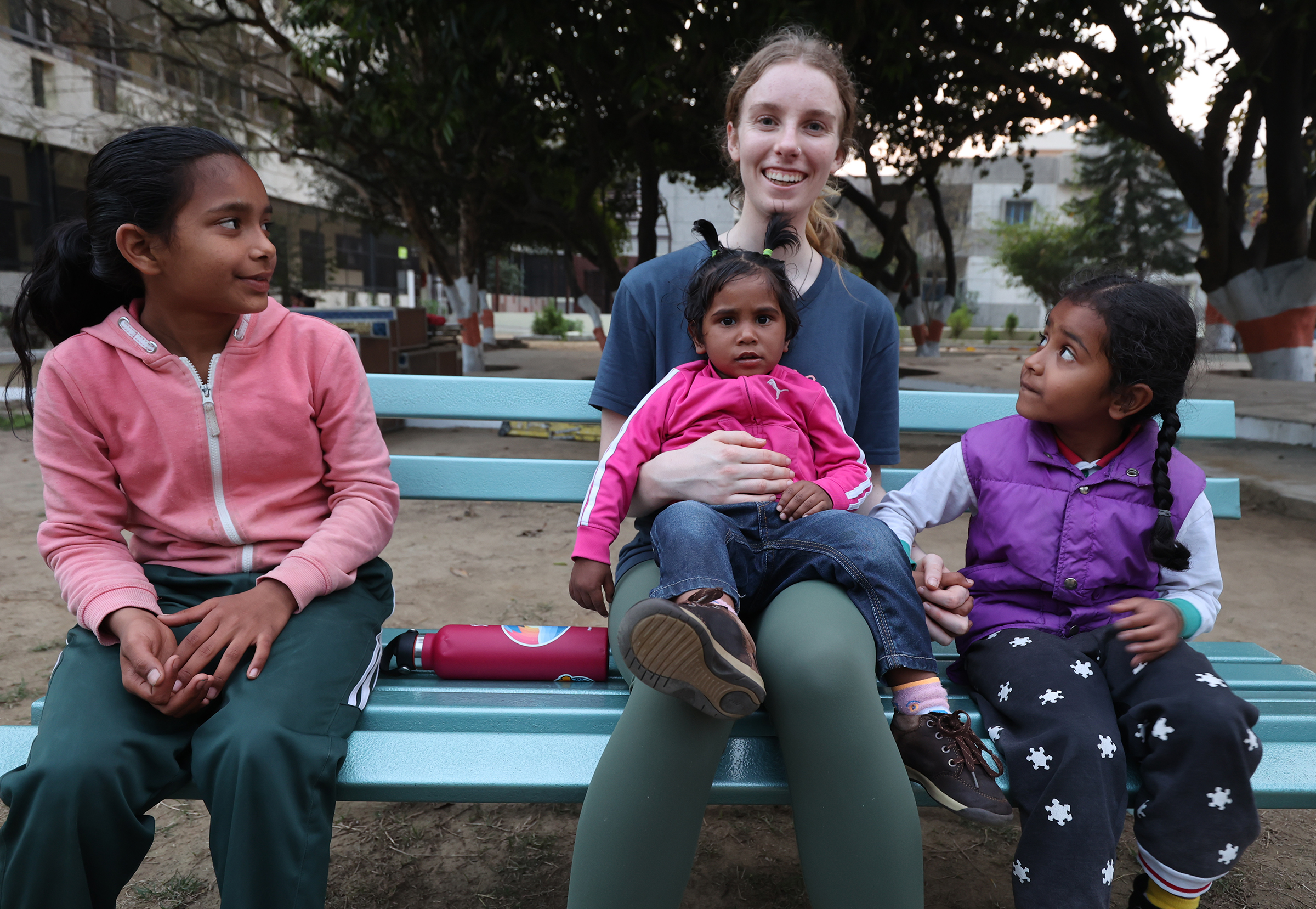
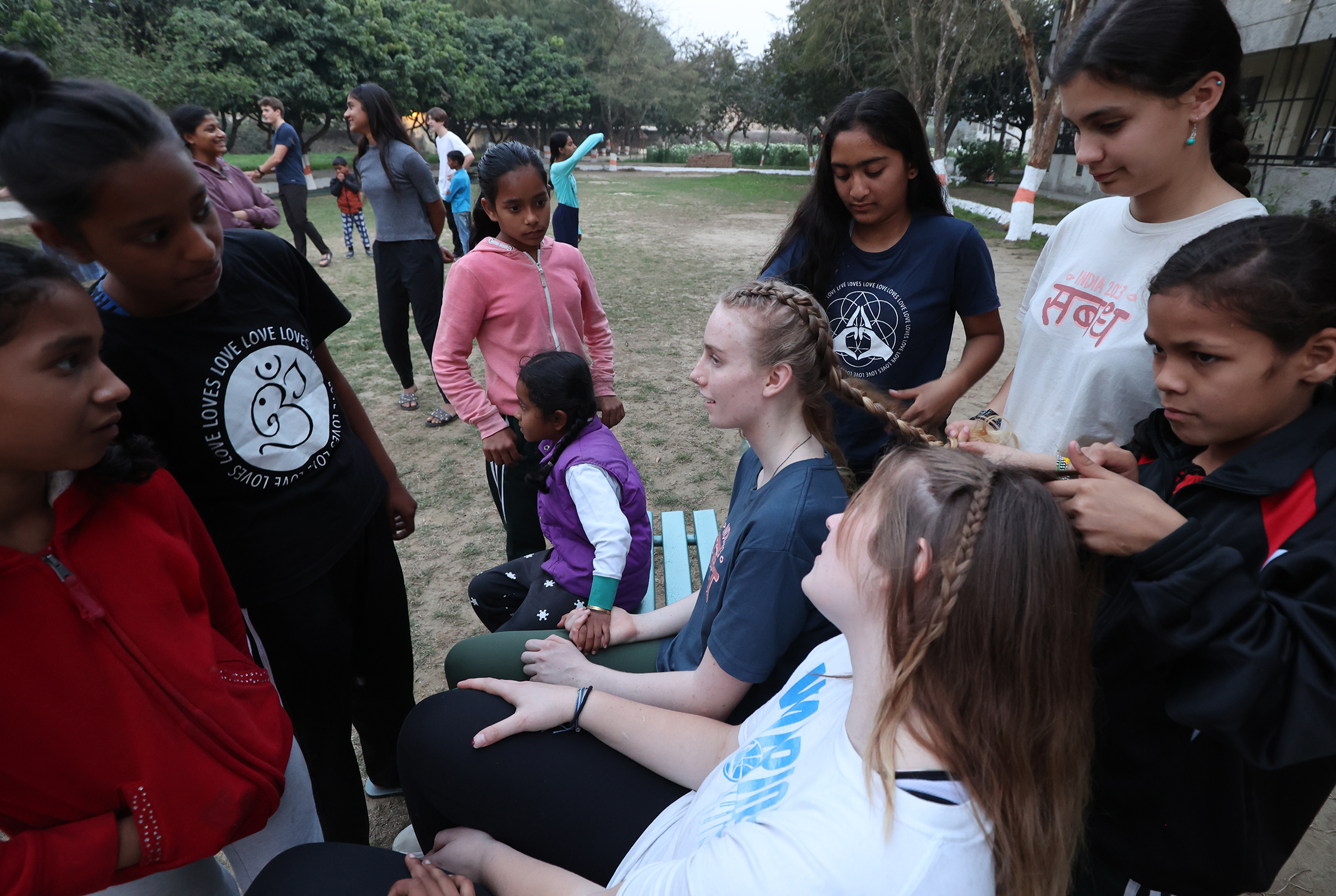
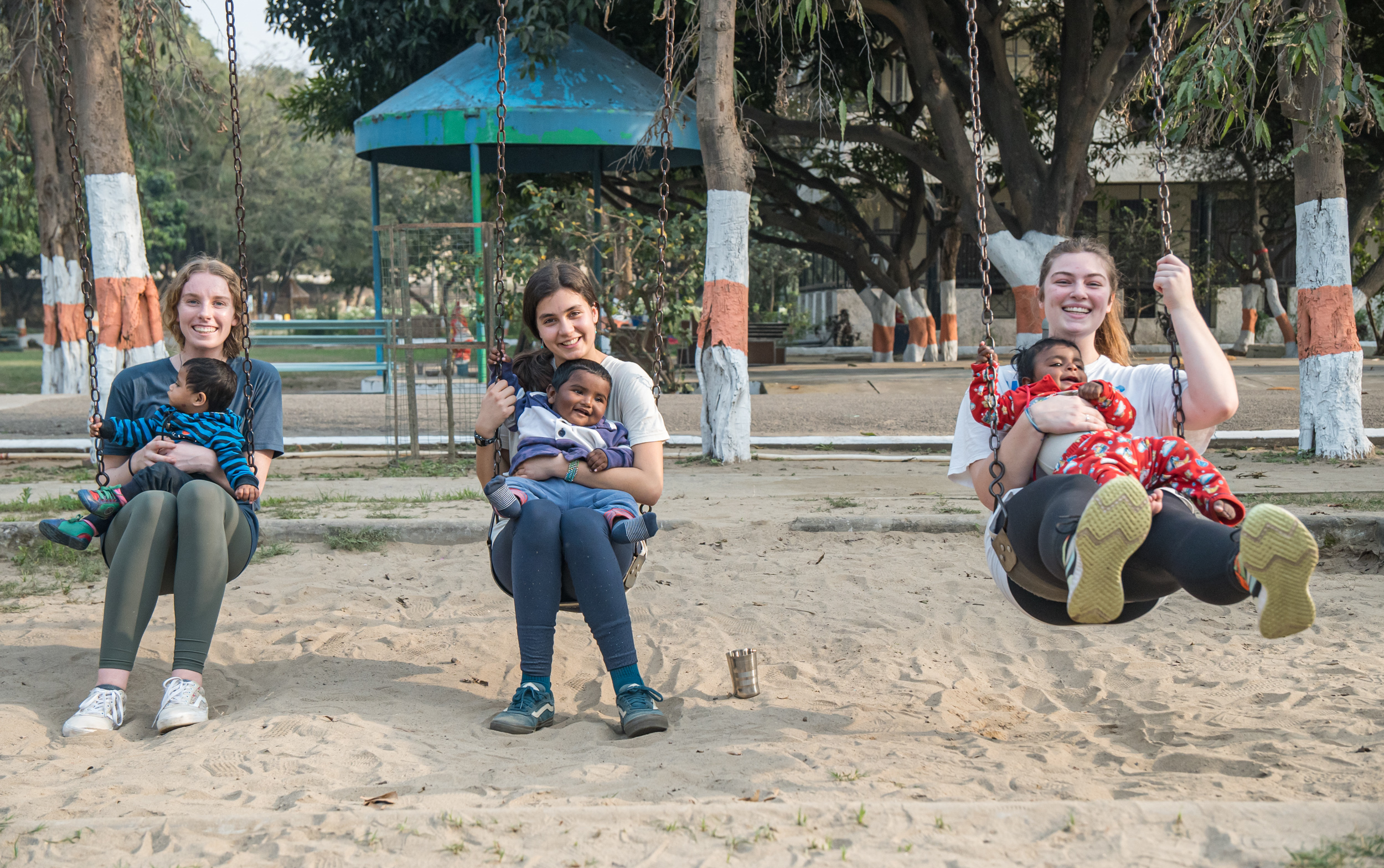
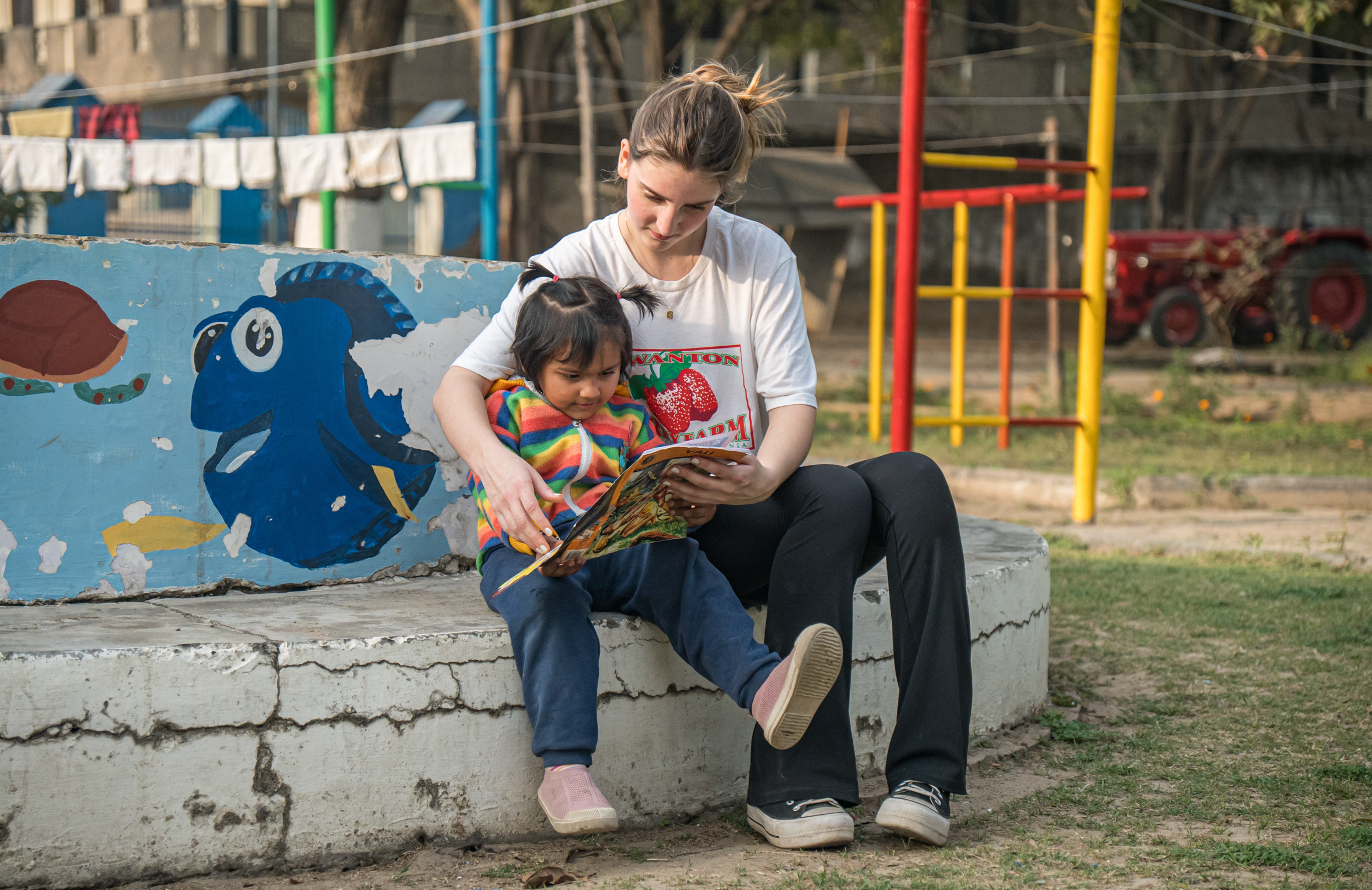
Our arrival at the Sri Ram Ashram did not come fast enough. Pulling up through the red and blue metal gate, a large group of children awaited our arrival to welcome us into their home. As soon as I saw them, I couldn’t stop my smile from forming. Off of the bus, the children immediately came to hug me with big smiles. I look around and see everyone together, their cheeks rosy from smiling. It was a beautiful start to our trip and I cannot wait to spend time with the children of Sri Ram Ashram this week.
Hindu Temple of Mansa Devi


Due to an unexpected turn of events, we got to visit the Sri Ram Ashram earlier than expected. It was a very welcome surprise, given that it was the part of the trip I was most looking forward to. Today, we visited the Hindu temple called Mansa Devi, which overlooked the city of Haridwar. The temple is known to be a place of worship for the goddess Mansa Devi. The term “Mansa” means wish, and it is believed that this goddess fulfills wishes, if you are a sincere devotee. To get to the temple, we had to take a short but steep walk up a windy path. In the temple, Shmuel, one of our chaperones, explained to us that through the temple, we’d be able to fulfill our mind’s desires. I found this very odd at first because I was wondering how it was possible to have our mind’s desires fulfilled by just walking through the temple. However, that’s when the self-reflection began. It’s not often you sit and wonder what your mind’s desire is. And the more I thought about it, the more I realized that the temple actually could fulfill my mind’s desire. The mind does not desire materialistic things, because it will never fulfill us, so the only thing that’s left is the epiphany that you can fulfill your mind’s desire by recognizing your thoughts and changing your mindset. The whole temple experience was contemplating what your desire is, and how easily you can achieve it through acceptance or taking internal action. After our voyage through the temple, I asked some classmates what their mind’s greatest desire was, and I was happy to know my hypothesis was correct. They had not wished for materialistic things, but instead for self-improvement or connections with others. I am very grateful for this experience. It made me realize how powerful the mind is because it is not a physical thing, but very abstract, so it is capable of anything we decide to believe.
Haridwar’s Moti Bazaar

Today we took the bus from Sri Ram Ashram. We got to drive through a lot of the city of Haridwar, see the river Ganges, and go to a Hindu temple up in the mountains with some very enthusiastic priests.
My most favorite part of the day was getting to shop in the street bizarre by the river Ganges in Haridwar. As we walked down from the Hindu temple, Devin, one of our chaperones, led us across the street down a set of stairs into a completely different world: streets lined with shops selling shiny knockoff Lamborghini jackets to intricate and colorful depictions of the god Shiva.

As we walked down the streets, bicycles, rickshaws, and tiny motorbikes with their horns would weave through the packed street. First, we walked down through the crowded bazaar to the river Ganges. At the Ganges, we were encouraged to dip our hands and feet in the water, but I was the only one who took that opportunity. As I walked down the steps to the edge of the river, I dipped my hand in and put the water on top of my head. Writing that, I feel I should take a shower now.
Then began our grand shopping adventure, walking through the street bazaar back the way we came. We were told to shop in groups no smaller than two, and I initially wanted to shop with one of our chaperones, Chelsea, who has shown herself in our previous shopping experiences to be a master haggler. But in the massive sensory overload that was the bazaar, I lost her and her group. Luckily, I used my 6 foot 5-inch height to find my classmates Ethan, Wyatt, Anya, and Peter in front of me. I worked with that group for a little bit until Ethan and I doubled back to take a closer look at brass shops. I hadn’t found anything in my walk in the bazaar that really caught my eye until I saw one of the most gaudy but fabulous pieces of clothing I’ve ever seen: a shiny iridescent silver puffer jacket embroidered with a sequin Lamborghini bull on the back. I immediately tried it on, and as Ethan and I laughed at the absurdity of this garment, we laughed even heartier after finding that it fit me and looked quite good! Sadly, with a price of 1250 rupees, I decided not to get it, a decision I now realize I will regret for the rest of this trip. But I did not leave the bazaar empty-handed! Towards the end of the bazaar, I found a tiny hat shop where I bought a small square cap to keep my head warm for the following adventure to Dharamsala. Then, at the very end of our adventure into the bazaar while waiting for classmates to catch up to the meeting point, I did some light shopping at a shawl shop where I bought a patterned cotton shawl for my bed back at home. But I have yet to tell you the funniest part.
The funniest tidbit of the day was people being in shock at my height walking around Haridwar. As I walked through the bazaar, my friends walking with me would say everyone was looking at me, and that they could tell because they would look way up and then way down. Throughout the street, shopkeepers would shout “Model! Model!” as I walked past. Overall, it was an incredibly fun day spent experiencing Haridwar and being at the Sri Ram Ashram.
Burger King Lunch

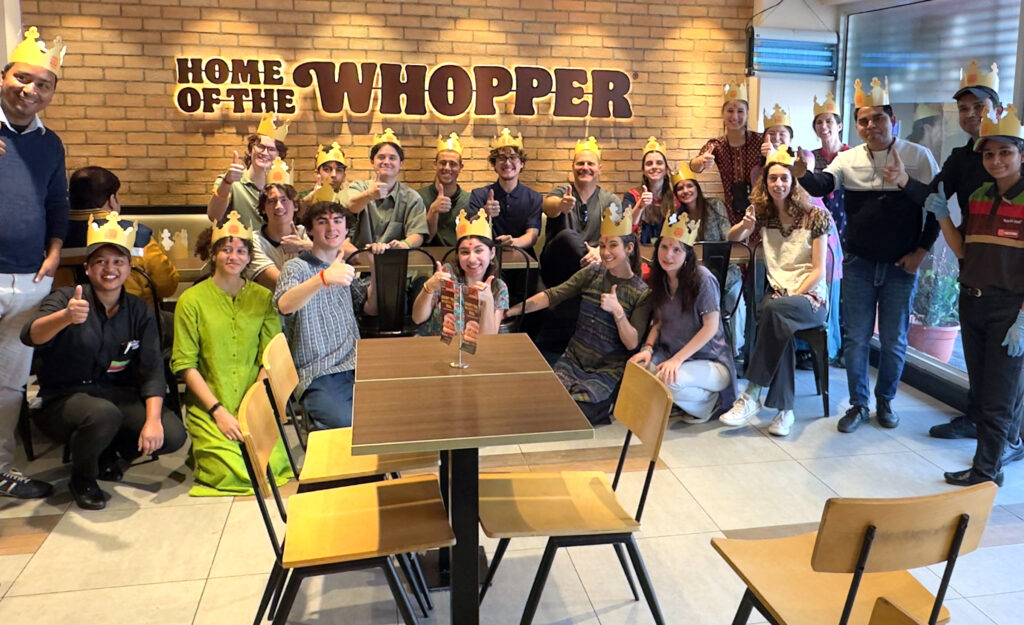
Today, our class went to the Mansa Devi temple, which overlooks the city of Haridwar. After a medium-sized trek up a mountain we reached the temple, and I was immediately struck at how colorful it was, and all of the ambient sounds around me. After receiving blessings from quite a few people, we descended the mountain to shop in the Moti Bazaar, which lies in the heart of Haridwar and sprawls for almost a mile. Regrettably, I left my wallet at the ashram today and I sadly couldn’t purchase anything, but it was still a beautiful sight walking through the bazaar and smelling all of the different spices and perfumes coming from all of the different stands. After that, however, was arguably the highlight of the day. We decided to stop for lunch in a Burger King, I think just to give us a little taste of home. Although it was vegetarian, as everything in the city was, it still gave me the little security blanket I had hoped for. After sitting down and getting all of our orders, the workers must’ve realized that almost all of us (being as childish as we are) were wearing the crowns that they hand out with their meals. Right before we left, the manager and some workers asked us to take a photo together, and it was genuinely hilarious. They seemed so grateful to have such a big group in their restaurant, and they were more than courteous at every possible interval. I hope to one day see all of our faces on a billboard, advertising the best Burger King in all of Haridwar.
Interview with Charlotte Clymer


Today, after a scheduling mixup, we finally interviewed Charlotte Clymer. An ally to the LGBTQIA+ community, she was by far my favorite interviewee. I found her diverse and, some might say, contradictory background incredibly fascinating, and the opportunity to speak with her is something I will always value. She began by talking about her military experience and her belief in the importance of public service, whether it is in the military, Peace Corps, health care or any other area that requires service to others. She had a lot of advice related to politics and social issues, the most significant of which to me was the issue of gender inequality. We discussed how both women and men are infantilized and how the only way to overcome this is to maintain high standards for others and ourselves. She stated that the “boys will be boys” attitude is the most offensive thing that can be said about boys or men. Society has a low standard for men. They are expected to be masculine, violent, and in control. When men don’t display these traits, they aren’t seen as men. However, when they do demonstrate these traits and their actions become extreme, we make excuses for them and say, “boys will be boys.” She wants us to raise our standards and show greater respect for men and women alike. Holding a high standard for ourselves makes us good people and encourages those around us to be better as well.

She also spoke on our shortcomings as a country – not to demoralize us but to motivate us. We as a society need to act on the opportunities that are presented to us. A great example is how countries around the world responded after the attacks on 9/11. Countries around the world, including “enemies” such as Iran, reached out in peace to pay their respects. Unfortunately, we did nothing to foster those potential relationships. On the topic of gun laws, she said that the fact that some states regulate gun purchases responsibly while others do not is ridiculous. The result is that a person can purchase a gun in one state and then travel to another state and use that gun to wreak havoc, and everything up to the point that the gun is used is perfectly legal. This situation results in distrust of our government and our fellow citizens. More effort needs to be put into the fight to change gun laws, international relations, gender inequality, LGBTQIA+ rights – and so much more – but we can do it.


On our final morning in DC, I was excited to interview our last interviewee, Charlotte Clymer. Charlotte is a transgender activist and serves on the DC Commission for Persons with Disabilities. She works to educate, advocate, and create equity and equality in our country.
I had been very interested to hear from her, specifically on her views of the new generation as we come into positions of power. Something interesting that she said is that only those who have no power understand power. In other words, those who face racial, gender, or other forms of discrimination best understand the effects that decisions by people in power have. Officials who have never had the experience of feeling dehumanized or weak do not really understand the power that they wield. I found her perspective very illuminating, as I had never thought about the effects the decisions of unprepared leaders can have on others, especially when those leaders have no connection to the people affected by their decisions.
Charlotte has made me think about how I should see others. I should assume that everyone has their own experience with pain in their lives. By not immediately assuming that people are bad just because they think or act differently than I do, I can avoid projecting my own ideas onto them, and I can see them better as real human beings.


Charlotte Clymer gave me the most unique perspective on my own outlook on our world. She spoke about many different topics, from her connection with God and her faith to controversial topics like gun laws. One of the topics she spoke about that really resonated with me is understanding people from different communities.
She stated that you can only understand other people that have different backgrounds if you interact with them and hang around them. You have to get a sense of the community that they are a part of, such as—LGBTQ+ communities in this case. This statement opened my eyes to see how isolated we can be and how much we really don’t understand one another. We have to wake up and realize that for our world to be the peaceful sanctuary that we strive for, we need to come together as one by respecting each other’s views and developing the capability to understand each other.

A little later in the interview, she expressed how our task as the future of our nation is to create conversations that lead to consensus, and consensus can only be created if we listen to others. In this day and age, we are focused on what’s right in front of us in the present moment, which can keep us from thinking about the future. An example of this that I see that Charlotte discussed as well is the crisis regarding gun ownership. I see posts on social media platforms that have been expressing their concerns for many years, but no real action has been taken to prevent the abuse of gun rights. In order for us to accomplish the task, we have to be able to push beyond what we know and not only listen but understand.
Our interview with Charlotte was the most mind-altering experience that I have had since coming to DC. I really learned a lot from her regarding what we have to do in order for our country and our world to be the place that we want it to be.


Our last day in DC was wonderful. We had the honor of speaking with LGBTQIA+ activist Charlotte Clymer. She is one of the sweetest and most down to earth people I’ve met. It was incredible the way she carried herself with grace and spoke knowledgeably. This interview was the perfect way to wrap up our trip.
One of my favorite things she said to us is that it’s up to our generation to make a difference. She mentioned that her generation won’t have to deal with the full effects of certain things like climate change, whereas our generation will, and it’s up to us to make a difference. She talked about how hard work can get us anywhere, an idea that all the interviewees this week discussed. I’ll keep that in mind when I’m back home. Another thing she said that’s “coming home with me” is that “hurt people hurt people.” Related to this idea is the idea that the most dangerous person is someone who doesn’t feel heard, and I think it’s our job as a generation to help change that by working to give a voice to everybody.


Today we decided to take advantage of the beautiful spring weather and explore the city. We left around noon in our city style fits and walked to the National Mall. My group decided to rent bikes and get some exercise. We rode around the Mall, enjoying the fresh air and stunning views of the Capitol and the Washington Monument. We came upon an ice cream truck and decided to treat ourselves.
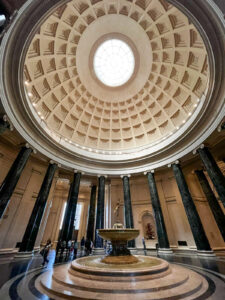
After biking some more, we headed over to the National Gallery of Art, and after consulting our maps we made our way to the modern art exhibit. On the way we rode in an elevator that was so big we were able to play a small game of tag in it. Inside the exhibit, we paused briefly to view Barnett Newman’s “Stations of the Cross,” but then the vibrant colors of the Mark Rothko exhibit caught our eye. One painting in particular, “Orange and Tan”, impressed us. Our art teacher, Angela, had talked about this painting in class and said that she was so moved by it that she cried. Rothko’s use of color and space is mesmerizing, and the sheer magnitude of the walls of color left us spellbound.
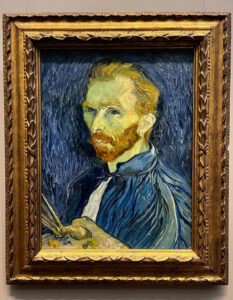
We continued our way through the rest of the exhibit, which included paintings by Picasso, Max Urnst, and other artists. Next up was the French impressionist exhibit, where we viewed works by some of the greatest artists of the nineteenth century. I marveled at Renoir’s skill and the beauty of his paintings, which featured dreamy, romantic scenes and figures from everyday life. We finished our visit with a trip through the Vincent Van Gogh exhibit, where we were all amazed at the intensity of emotion in his paintings.
It was a great day of biking, eating ice cream, and viewing art. We got a little exercise, ate a sweet treat, viewed some great art, and enjoyed a nice break from the rigors of interviewing public figures.

Today we visited several of the Smithsonian museums. My first impression of them is that they are much bigger than I imagined they would be. I have heard stories about how large the museums are and how many there are, but, as is the case with the memorials and monuments, their enormous scale took me by surprise. The shining glass dome of the Botanical Gardens caught my eye, and I was happy to wander over towards it with a group of friends. Walking through the huge first set of doors, I was surprised by how warm and humid it is inside. The fragrance of the beautiful flowers, combined with the warmth and humidity, gave the sensation of being wrapped in a blanket.
We walked through a second set of doors to enter the botanical garden itself, which features a little path running through the different sections of the garden. I appreciated that the garden doesn’t just feature plants from one region but from a number of different regions around the world, with each section sealed off by automatic sliding glass doors. If you are ever in DC and are wanting to visit the Smithsonian museums, I highly recommend including the botanical gardens as part of your visit. Even if, like me, you aren’t especially interested in plants, a trip to the gardens is an amazing experience.

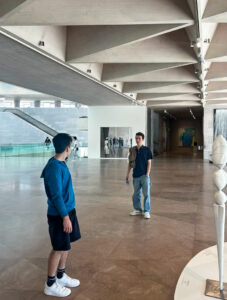
Today, a group of us visited the National Gallery of Art. Until today, I had not been a big fan of art, and what little art I do enjoy typically involves “real life” images of people, places, or objects. I’ve never enjoyed looking at abstract art. However, after visiting the museum today, my outlook on art has changed.
The first exhibit we visited was the modern art exhibit. The exhibit included works by many famous artists, but the only artist I knew was Pablo Picasso. He was one of the founders of cubism, a form of art that uses geometric shapes to form broken and oddly figured images. Before going to the museum, I was not a fan of Picasso or cubism, but there was something about seeing the actual paintings that made me stop and say to myself, “Wow, I don’t understand this at all, but it’s kinda cool.” After viewing other cubist works, I decided that although I don’t particularly care for cubism, I do respect the artists and admire the complexity of the art.
We then looked at paintings from the Renaissance. Prior to visiting the museum, I thought that Renaissance art was cool looking, but I didn’t like that they all have a similar “feel.” Much of the art is religious in nature, so it gets a little repetitive for me. However, when I saw the paintings in person I was genuinely impressed. I didn’t realize until I viewed them that the canvases were anywhere from three to ten feet tall. I was amazed to think about how someone could paint something that big without a photo to look at while painting. Despite the religious themes of the paintings, I really enjoyed looking at their impressive detail and vivid colors.
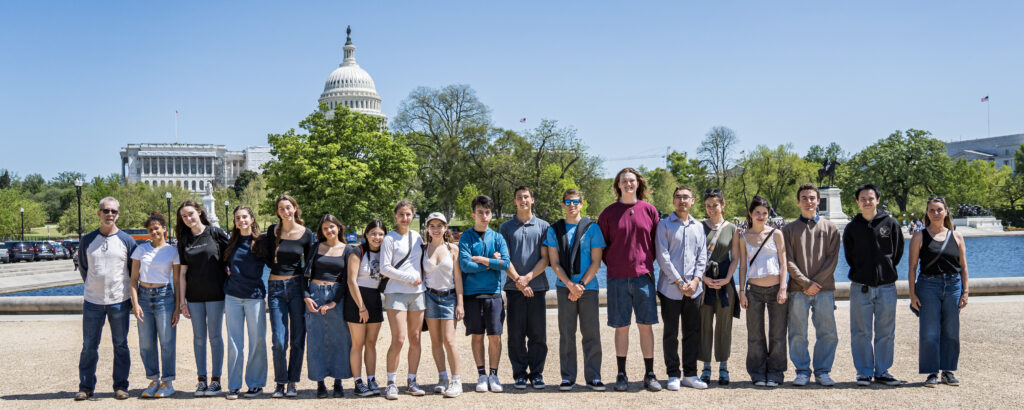

New Delhi, the capital of India, is a city steeped in history and culture. It is a place where ancient traditions and modernity coexist, and where visitors can explore the fascinating stories that have shaped India’s past and present. One of the most intriguing aspects of New Delhi for me is its connection to Mahatma Gandhi, the father of the nation, who led India’s independence movement in the early 20th century.
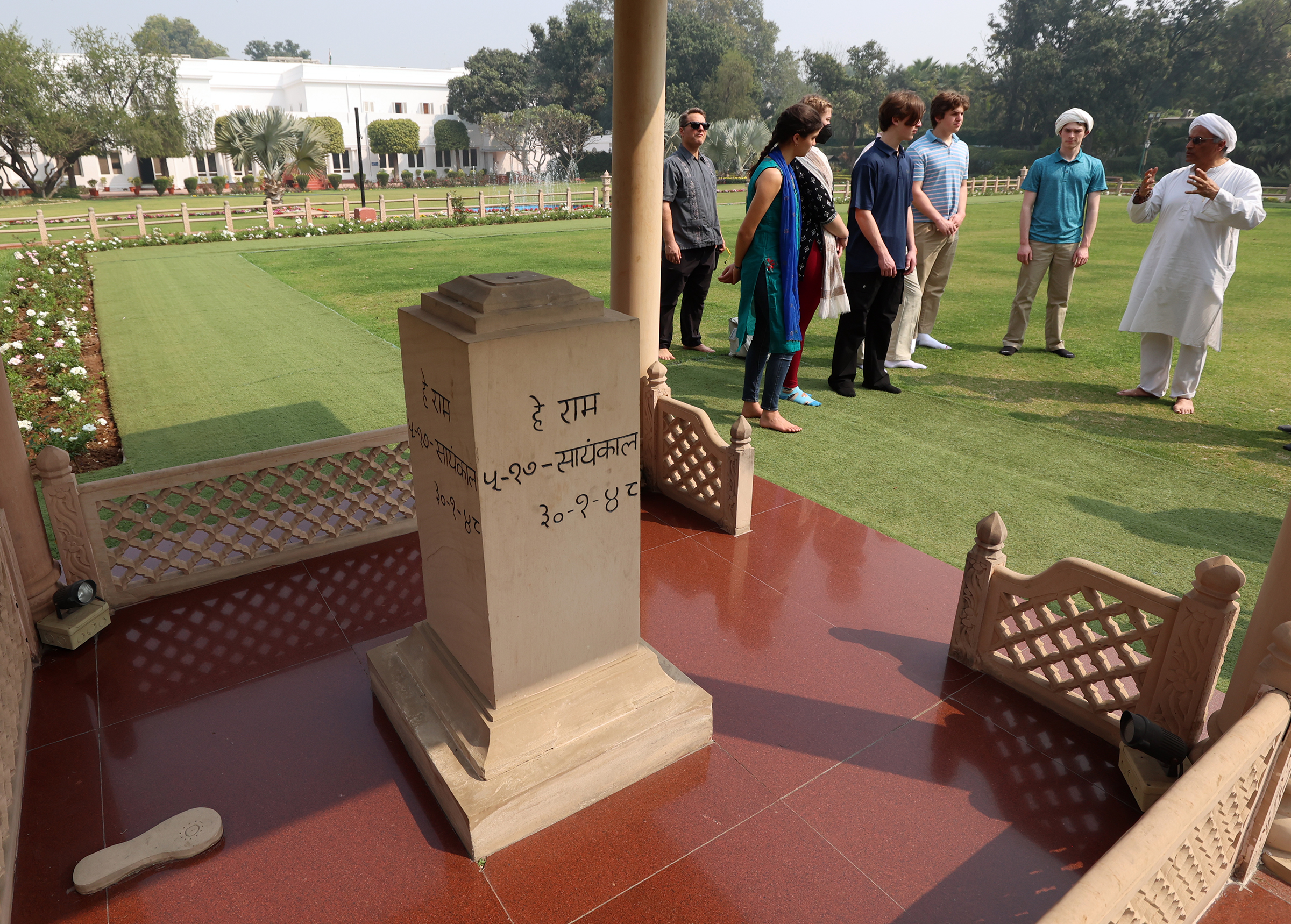
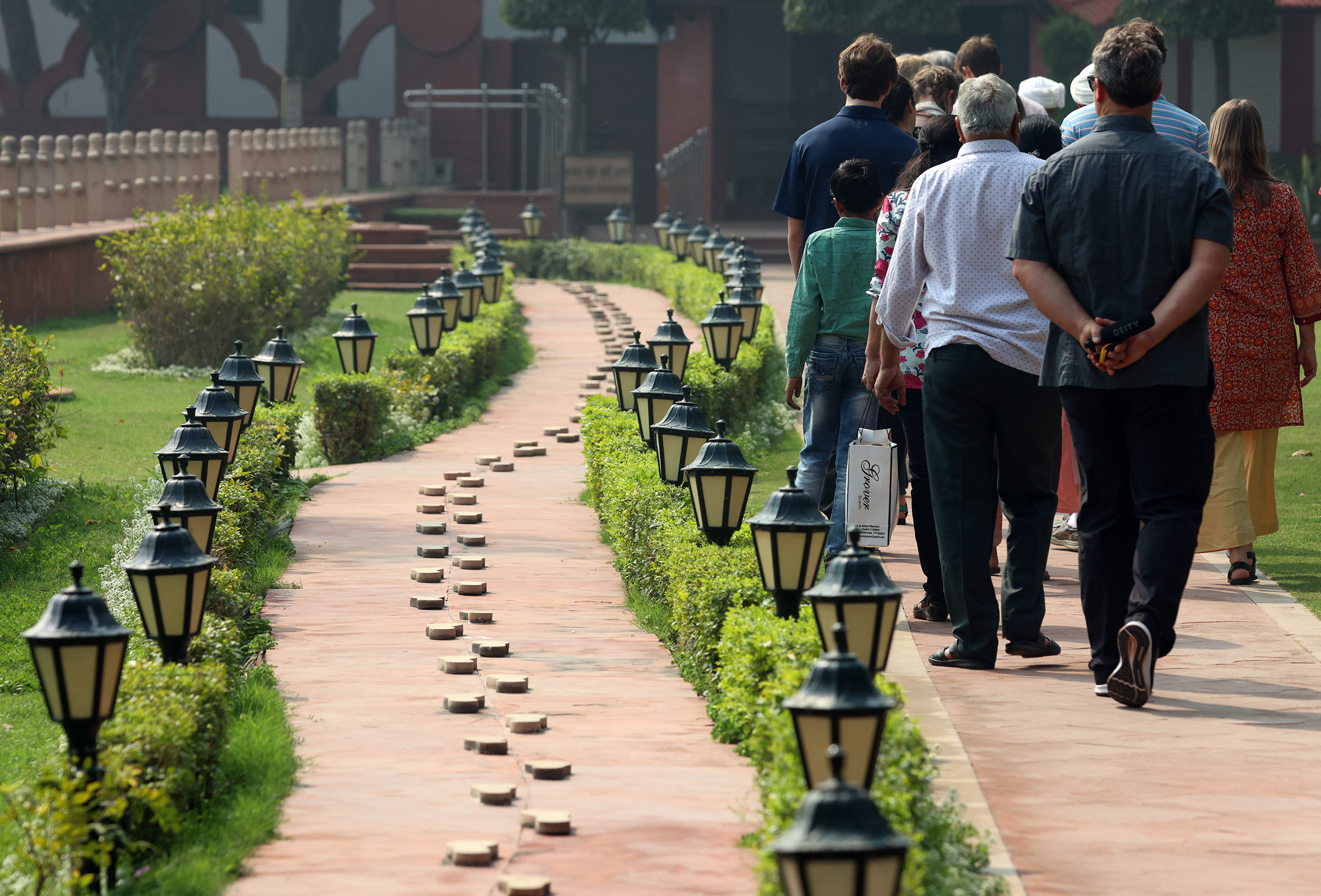
Today, we visited Gurudwara Shri Bangla Sahib, a Sikh Temple, and Gandhi’s house, two landmarks with a lot of history and significance. Gandhi’s house, also known as the Gandhi Smriti, is where Mahatma Gandhi lived for the last 144 days before he was assassinated in 1948. The house has been turned into a museum and we explored the rooms where Gandhi lived and worked. We also saw the Martyr’s Column which was built upon the spot where he was shot. This was a reminder of the ultimate sacrifice that Gandhi made for his beliefs.
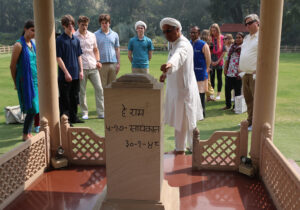
As I stood in front of the column, I felt a deep sense of gratitude for the sacrifices that Gandhi and others had made to create a more just and peaceful world. One of the most striking aspects of Gandhi Smriti is the simplicity of the space. The house is not grand or elegant, but rather humble and unassuming. We saw the room where Gandhi slept, the desk where he worked, and the gardens surrounding the house. This simplicity is a reflection of Gandhi’s own values, which were grounded in non-materialism and a commitment to serving others. We learned about Gandhi’s life and his philosophy of nonviolent resistance. Numerous photographs, letters, dioramas, and films offered a glimpse into his remarkable journey. Gandhi’s impact on India’s struggle for independence and on the civil rights movement around the world was clear.
On our visit, I was struck by the simple yet powerful message of Gandhi’s life. He was a man who passionately believed, protested, and fought for India’s independence through peaceful means. His life and legacy continue to inspire people around the world, and visiting his house was a powerful way to connect with this important historical figure. This experience reminded me of the power of values like compassion, forgiveness, and his sense of non-violence, which are essential to creating a better world.
Today, we visited Gandhi Smriti, the property on which Mahatma Gandhi was assassinated in 1948. When we arrived, our tour guide, Shantam, showed us how to practice walking meditation. We were told to match our breathing to our walking rhythm, to walk in silence, and to focus on the present moment. This experience was powerful because it allowed us to really take in the importance of the location we were visiting and to think about the importance and influence of Gandhi. During our walking meditation, we were moving to the exact location Gandhi was shot. When we arrived, we took our shoes off and walked into a large grass field that contained a memorial. Our tour guide told us the tragic story of the shooting and gave us context about Gandhi’s mission, political power, and ideals. One thing that really struck me about this experience was when he told us about how the BJP, the largest political power in India, is trying to harm Gandhi’s image and discredit his ideas. This is because Gandhi believed in respect for all religions and their cultures as well as stopping class and caste discrimination, whereas the BJP is essentially a Hindu nationalist party that believes the opposite. It was pretty shocking to hear that someone who is often thought of as the embodiment of positive virtue is having his image tarnished for political reasons.
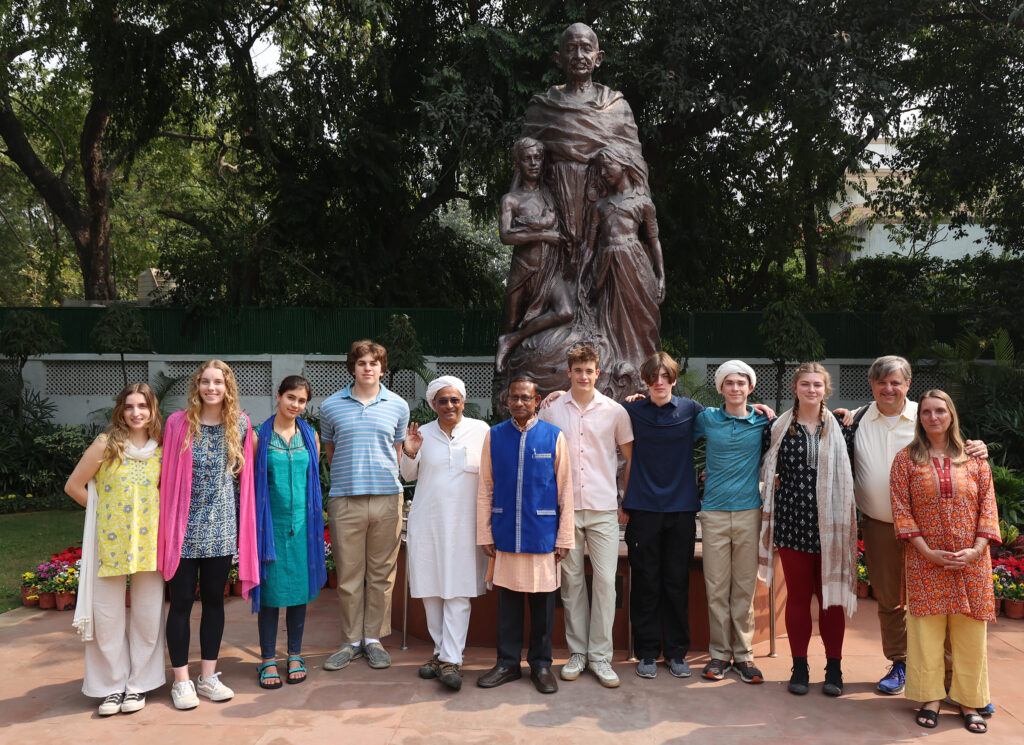
After we saw Gandhi’s memorial, we went to the house he lived in for the last year of his life, which has been converted into a museum. One of the most interesting things about this was when Shantam told us that as Gandhi traveled around India, he would always choose to live with the lowest caste in that area, which was often made up of toilet cleaners, and they were always severely impoverished. He had only been living temporarily in a room of the house, known as the Birla House, because of a severe disease outbreak. Inside the museum was the room he lived in, some of his known possessions, and a series of dioramas telling the story of his life. One of the things that struck me about his room was the simplicity. The room was essentially just a bed and a writing desk. Simple living was very important to Gandhi. Inside the room with the dioramas, Shantam told us essentially the whole life story of Gandhi, which was absolutely fascinating. My favorite part was when he was invited to Buckingham palace and wore only a loincloth. He later told a reporter “Do not worry about my clothes. The king has enough clothes on for both of us.”

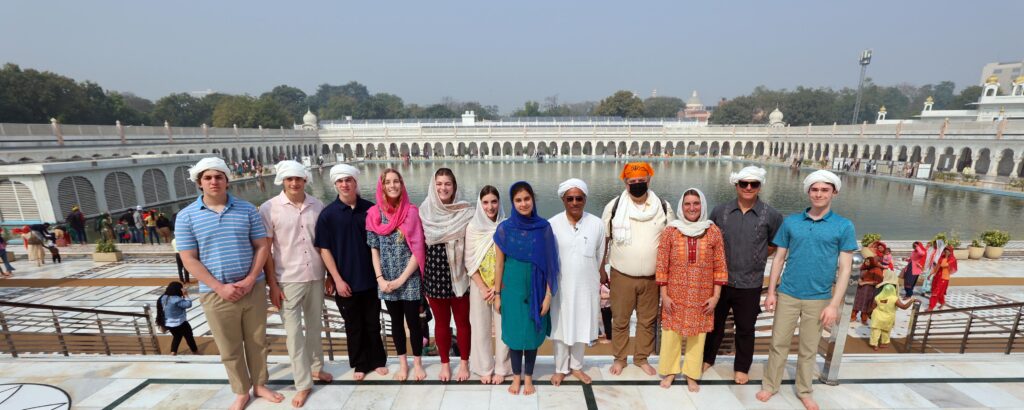
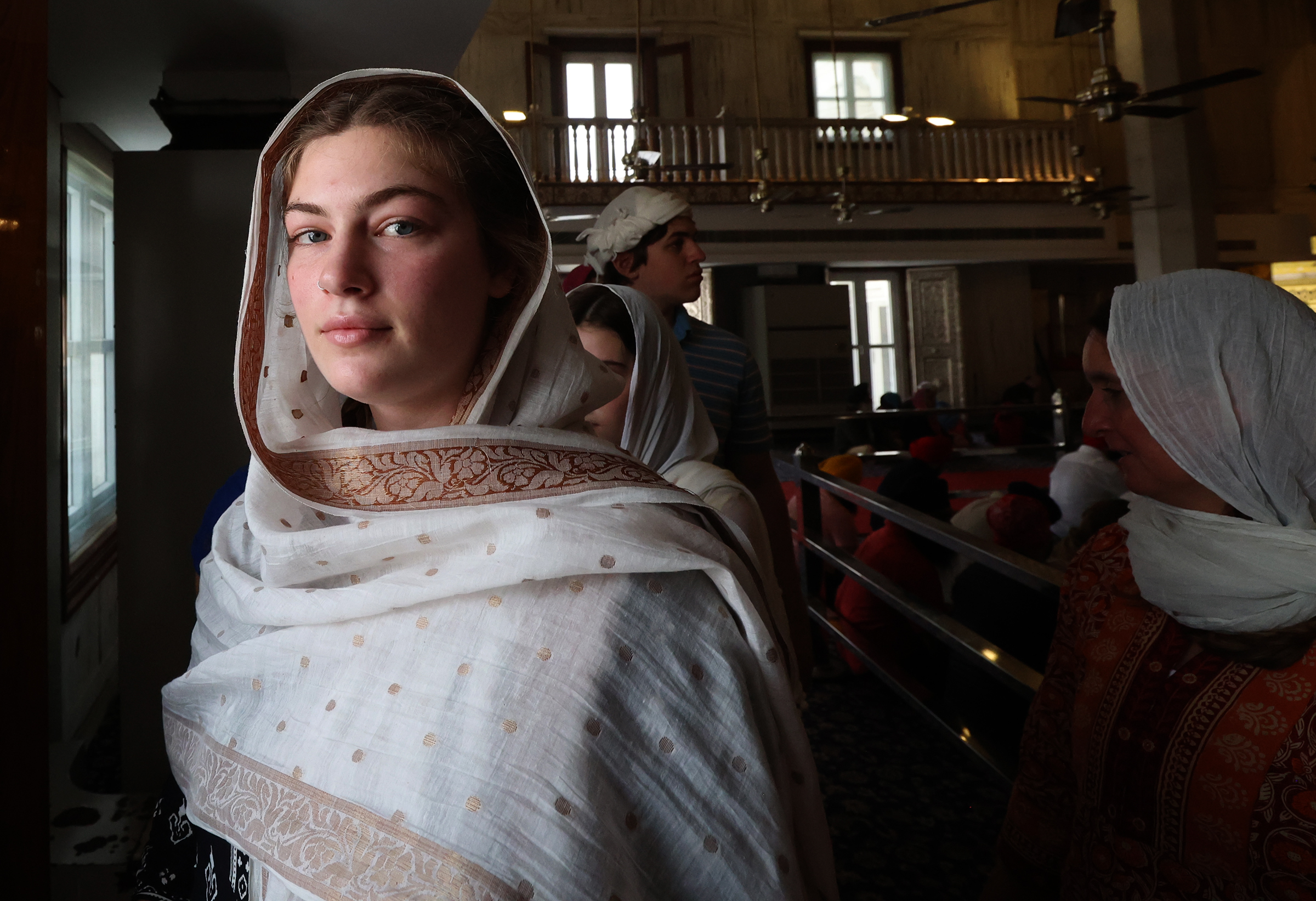
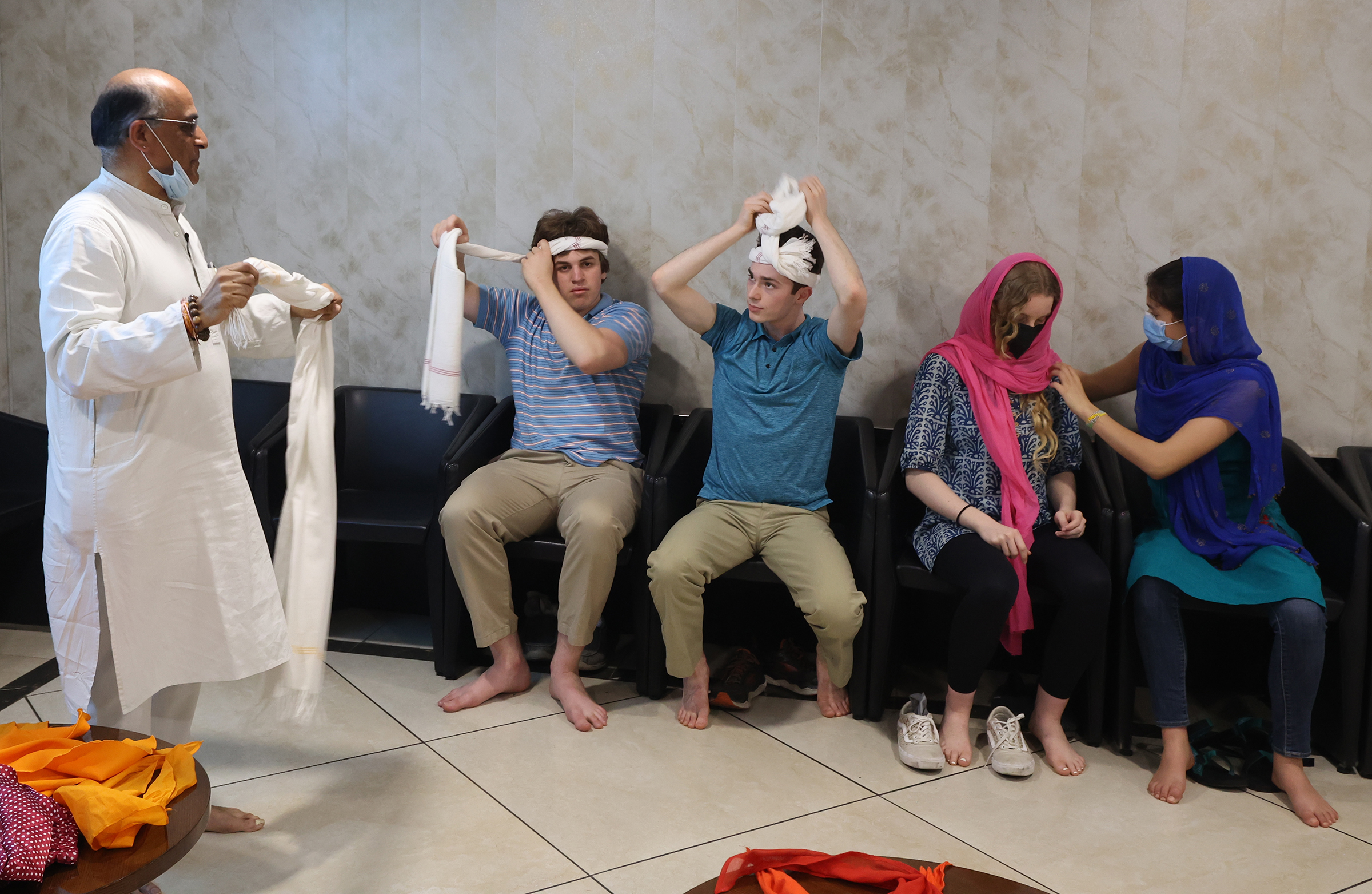
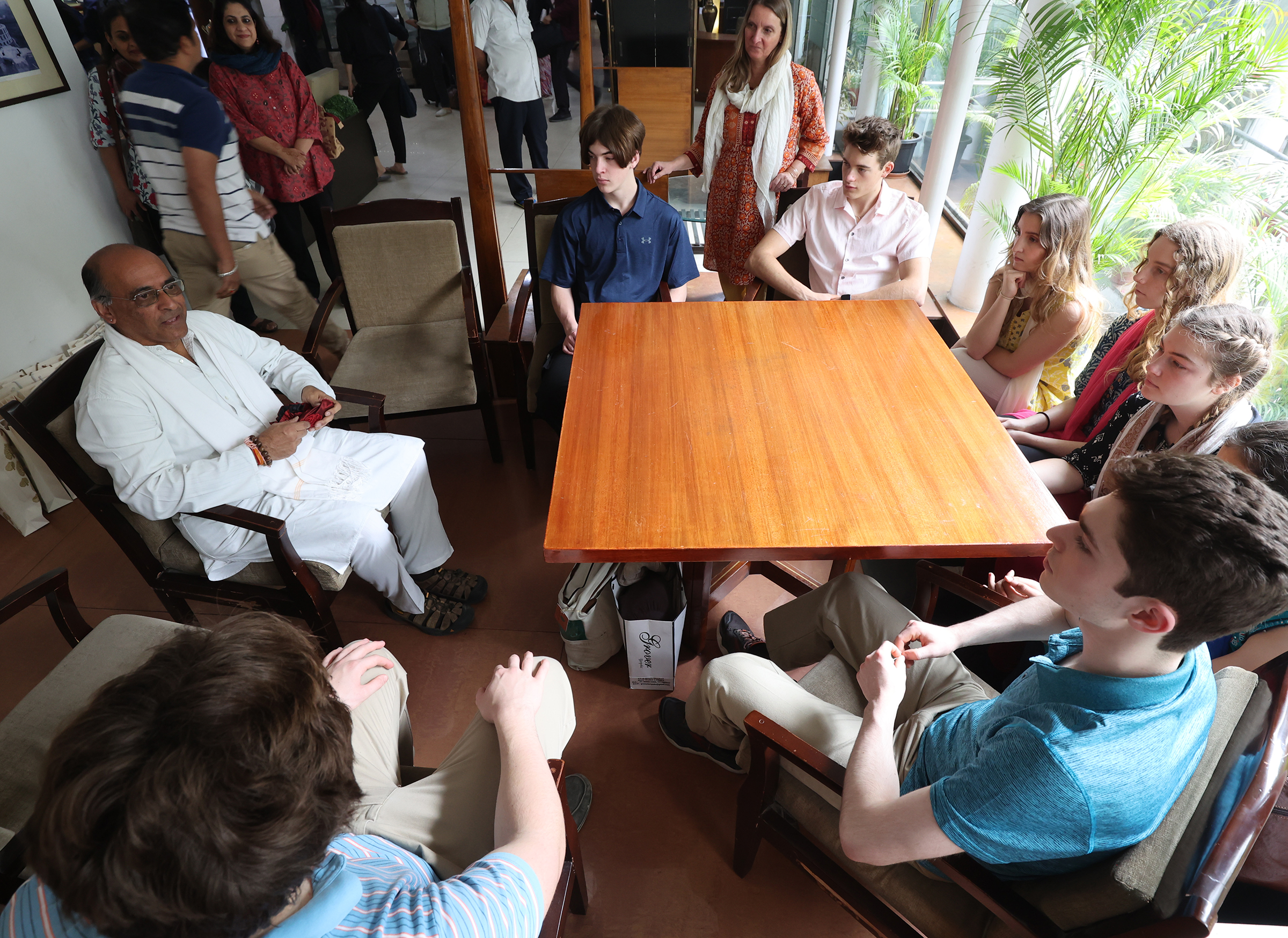
After breakfast in the YMCA dining room this morning, we met with Shantam, our guide. He gave us bags full of all kinds of useful things such as hand sanitizer, notebooks and a scarf-like piece of fabric called a gamcha. The gamcha was a very important thing to have, as we were about to visit the Gurdwara, a Sikh temple. One important element of Sikhism is to always keep the top of your head covered in public, and all visitors to the Gurdwara must observe this rule. The Temple is located right in the heart of New Delhi. I had observed it as we were driving to our lodging at the YMCA the previous afternoon. It is adjacent to a Christian church and various market stalls that embody the lively hustle and bustle of life in the capital of India.
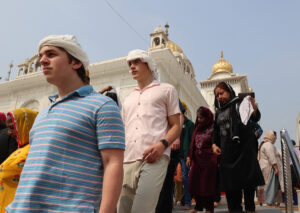
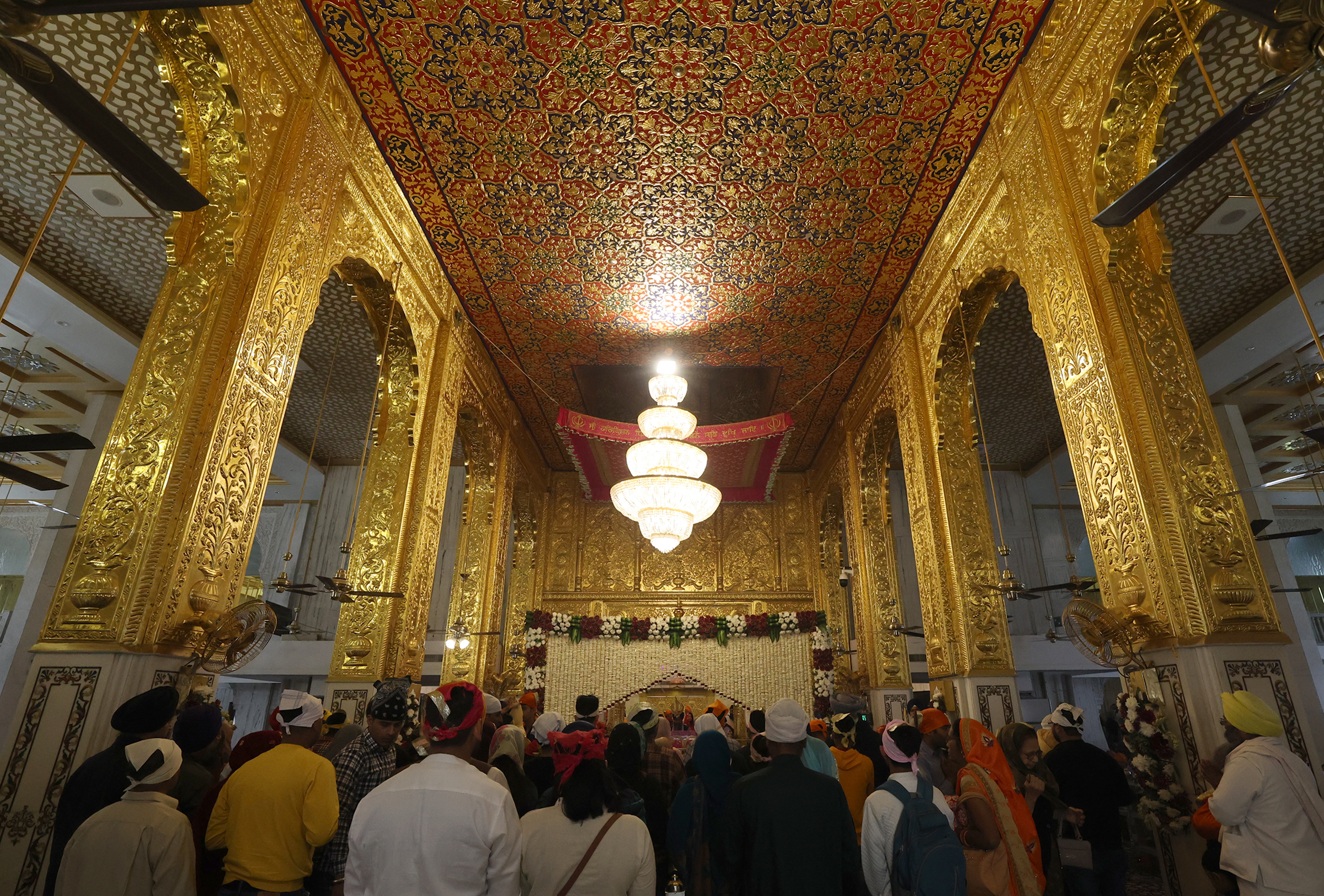
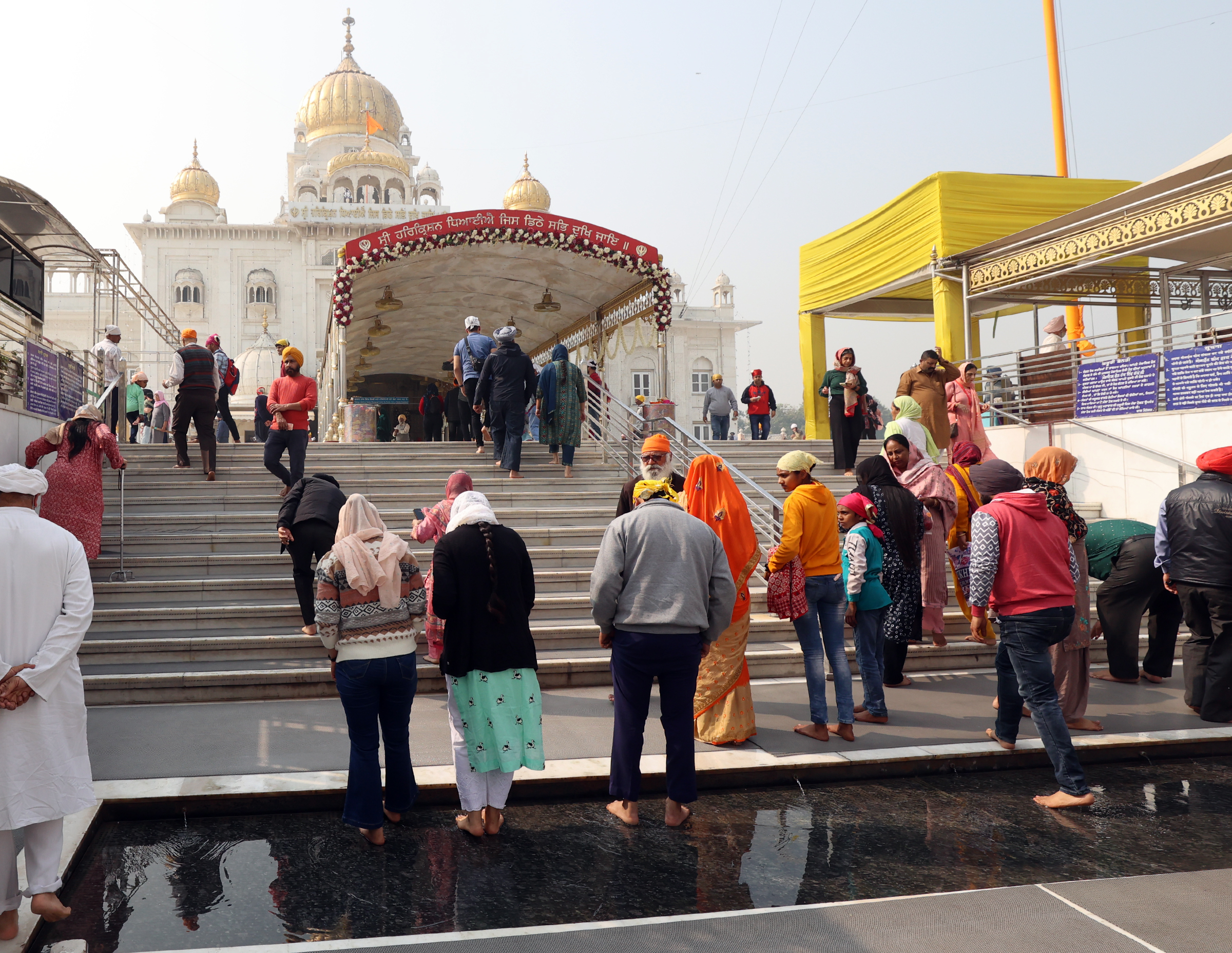
Shantam led us to a room for foreigners, where we left our shoes and socks, and where the boys tried to figure out how to tie up our gamchas. He explained to us many things about the history of the Sikhs throughout the centuries and told us about the structure of Sikhism. The religion follows the teachings of ten gurus, a lineage of teachers stretching from the 15th to 18th centuries. The gurus all contributed to a book named the Guru Granth Sahib, and the 10th guru named the book as his successor, enshrining the book as the eternal 11th guru. We then proceeded to the main temple, walking through a small puddle of water that cleanses your feet, and then up some stairs into the main temple where a trained classical singer was singing the words of the book. This was the main area of worship and the interior was golden and opulent.
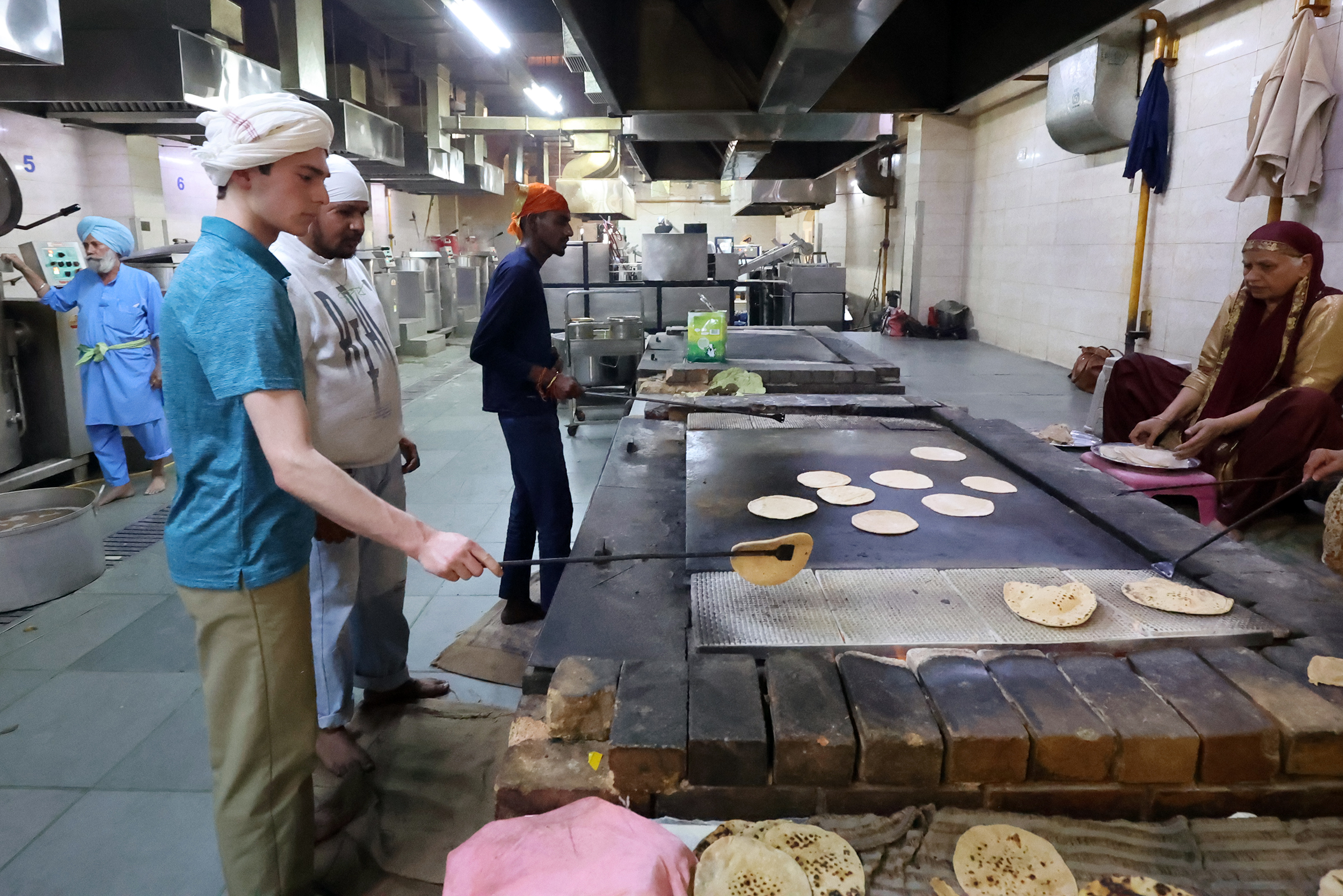
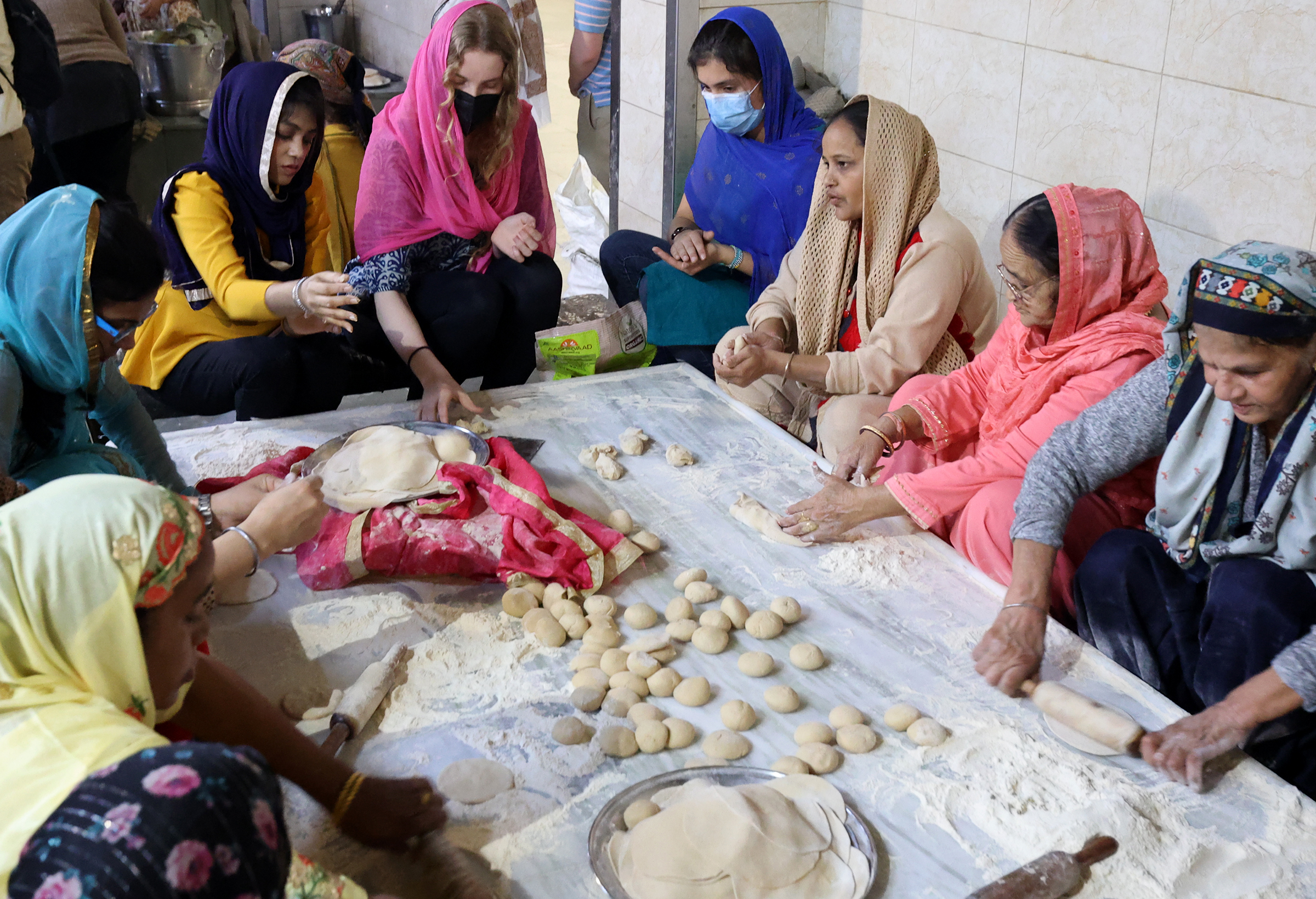
After a quick picture at the pool of holy water outside, we went to the communal kitchen, where they make all kinds of Indian food, available free to everyone that comes. Our guide took us back to the food production area, where some of us had the opportunity to help roll dough and toast the dough into roti, a whole wheat version of naan. Afterward, we went back to the room where our things were stored and had prasad which was a sweet wheat pudding-like dessert, served out of pressed leaf bowls. The part of the morning that most impacted me was without a doubt the visit to the kitchen. Everyone cooking was doing so with no expected payment, purely for the reason that it helps the community and is the right thing to do. It is as our guide said, “There are no hungry Sikhs, if someone were to see a Sikh begging they would tell them to go to the temple, they will take care of you there.” This type of community is something that I admire and wish that we could have in the USA. One reason I think this is so difficult is that a large part of why the kitchen can exist is the fact that the Sikh religion has this generosity as a core tenant of the religion. I can certainly say that this kind of unconditional willingness to help is something I haven’t seen before. -Sandy Astone

When I go to churches or synagogues, I am always amazed how religious institutions have the funding to build such elaborate places of worship. They often subsist purely on donations and yet, unlike many charities, it seems like they never lack resources.
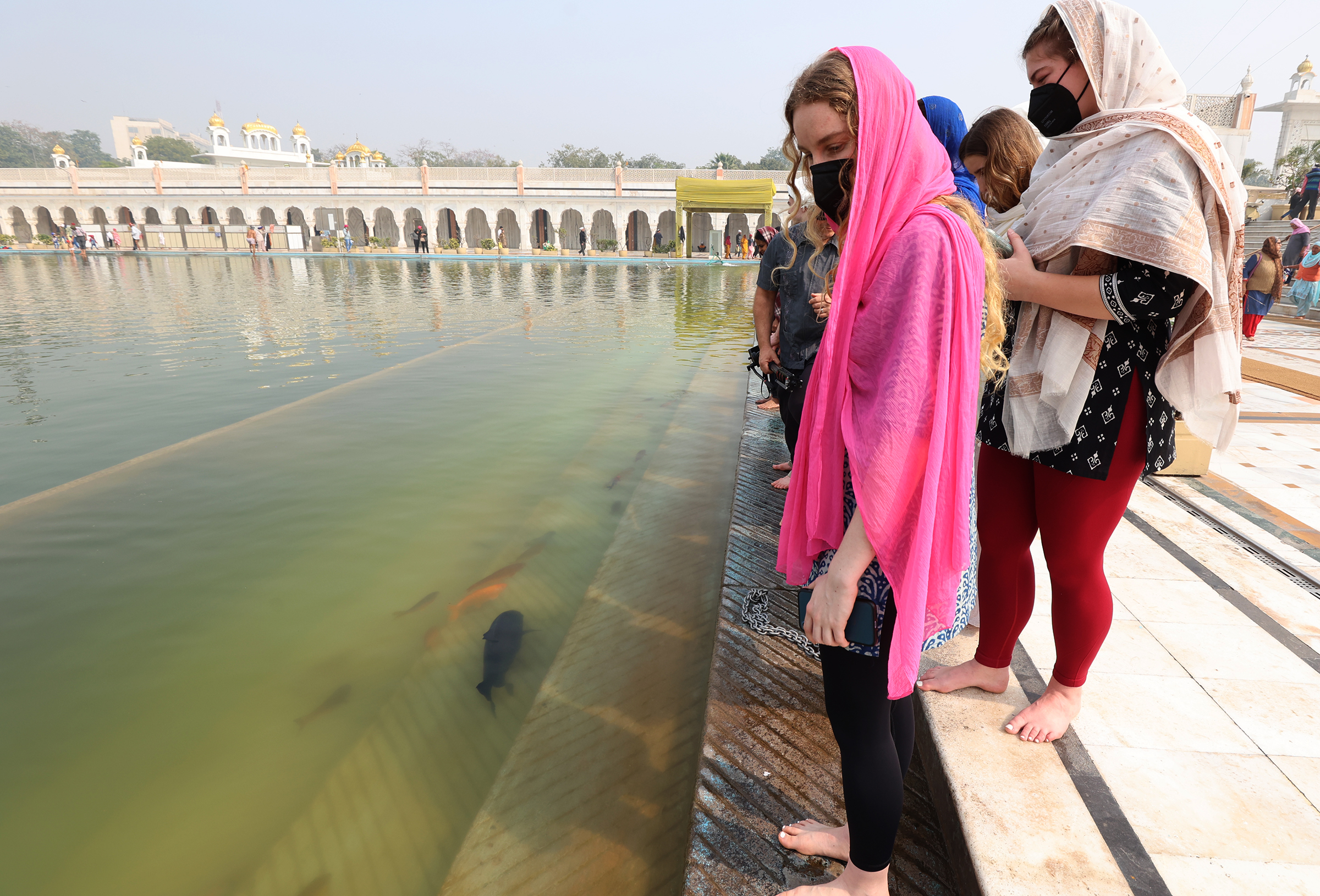
Today we visited a Sikh Gurdwara (temple), which is the place they keep and sing aloud their holy book, Guru Granth Sahib, the Living Guru. I was both surprised, encouraged, and awed by the way it was structured. To enter is free, the only thing required of you is that you cover your head and take off your shoes, and they provide you with cloth if you have none of your own. This Gurdwara was once the home of a king and it is massive. Outside the main building there is a huge courtyard and a large rectangular pond. Across, the whole area might have been 100 meters. Pretty much all of it was built out of white marble and it was very well maintained. On the path to the central building petals were strung, clearly replaced regularly on an elaborate awning. Inside was even more decorative than outside. Square pillars, covered with golden carvings surrounded the Guru Granth Sahib which was treated like a person. Someone was always singing the book and someone else was whisking the air in front of it, keeping away flies and negative energy. The Sikhs inside the temple sat on soft carpet, listening to the song. That was a form of prayer.
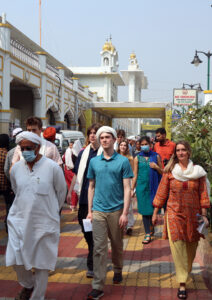
After leaving the building we went to the Langar or Sikh kitchen. There they prepared and served food to anyone and everyone who wanted it, around 25,000 thousand people a day. Our guide for the day, Shantam, said that he even ate there on occasion. The kitchen was also open to anyone who wanted to work in it or help out and the whole thing was run almost entirely by volunteers. While some of it was mechanized with big machines that made large amounts of dal and rotis, you could still flip rotis or roll them out by hand.
I couldn’t help smiling. The entire kitchen, with its big machines and massive amounts of food, was designed to help people. And every Sikh Gurdwara has a Langar. So many people give so much of their time, energy, and money to ensure people don’t go hungry. It isn’t a small soup kitchen that operates once a week, and it isn’t an agency that requires a food stamp or some kind of proof that you need the food. The Gurdwara even has a tall orange post at the center of it that is a beacon to everyone to come and eat if you are needy. Shantam said that you won’t really see Sikh beggars because they can always go to the nearest Langar to get food. It is true that other religions have charitable projects, but the way that people donate often seems so individualistic. You pay and in return you will get some kind of distinction, you pay and you will get your name on the temple etc. Here it seemed much different, every Sikh must contribute some of themselves to the Gurdwara, and the Gurdwara in turn feeds both the spiritual and physical hunger of every Sikh. In a nutshell, the ideas I took away are unconditional giving, giving being a part of a societies or religion’s responsibility, and the gift of the oasis of food and beauty. In America we are so rich, yet we provide nothing as non-discriminatory and helpful at reducing hunger as the Langar. Coming from that culture I would’ve thought it impossible to feed people the way that the Gurdwara does. But the beacon still stands tall.

Today we went into the heart of Delhi to explore the city, go to a Sikh temple, and go to the house Gandhi lived in in his final days to learn more about him and his life. After that, we got lunch in the city and then went shopping at FabIndia to get clothes for the wedding at Sri Ram Ashram, on Wednesday.
This was very exciting and the process was surprisingly similar to what I’ve experienced back at home. I didn’t really know what to expect, but I knew this store was going to be a lot of fun when I first walked in. There were so many beautiful colors hanging everywhere, I didn’t know where to go first. I was a little overwhelmed, especially because I didn’t know exactly what I was looking for. None of us have been to an Indian wedding before, so we were very grateful to have all the help we were offered between all the workers and Radha, who grew up at the Ashram and is coming to the wedding. The workers were helpful and showed us what sizes we needed and what colors go well together.
I really liked talking and being with Radha because she kept it real. She told me to never overpay for anything and she helped me find cheaper clothing that was still beautiful. She talked to people for me so I didn’t have to ask dumb questions. She saved me. I left the store with a beautiful turquoise skirt and kurta set that I am very excited to wear. One of my favorite things about being in India is how beautifully people are dressed. Walking down the street, you see all the colors of the rainbow and more, it just makes you feel happier. I like being a part of that, and going shopping in Delhi made me love the culture even more because I got to see many different styles and colors all in one place.