This video was played at the students’ presentation to their community on May 12, 2017 and is a 20 minute overview of the Karuna Project.
Filmed and edited by Devin Kumar.
Karuna Project Reflections
Here are some post-trip reflections from the seniors of Mount Madonna School on their experience of the Karuna Project

Unlike many others, India did not “change” my life. Instead, and in my opinion more importantly, India broadened my perspective of the world we live in. India is a culture with a rich history, tradition, and people. The people of India are some of the kindest, most genuine people I have had the pleasure to meet. They shower you in love with the first hello, and treat you as if you are family even as you get to know each other.
As a story teller, I have learned that you must first experience a story before telling it. And, as a writer, I often feel this itch for stories of exploration and adventure. However, I have had trouble writing about a hero who leaves his home and jumps into the unknown to find out what’s out there. After India, I finally feel my thoughts flow through my pencil with these stories. And, I am very grateful to be able to finally call myself an adventurer.

Upon stepping out of the airport in New Delhi, I immediately noticed how different everything was. Cars and motorbikes zip by missing you by mere inches. It’s scary, and new at first, but it only takes a few minutes to adjust. On the first day, our first stop was Jama Masjid, one of the largest Mosques in India, placed in the heart of Old Delhi. It’s an extravagant piece of architecture, and beautiful too. Being there, and at the Golden Temple in Amritsar made me realize how much cultural diversity there is in India. Hindus, Sikhs, Muslims, Christians, Buddhists and many other faiths are able to live together harmoniously. Everyone I met seemed to not care about race or religion. This was one of the things about India that truly surprised me. Another thing that I noticed was how friendly everyone is. Many people came up to me to ask me where I was from and what I was doing in India. They weren’t asking to be rude, they were simply curious about us. From the very beginning, I felt welcomed in India. On the first day, riding around Old Delhi on the rickshaws, I noticed how different a culture and country India is from the United States. However, even though India is like nothing I had ever experienced, I didn’t feel out of place. I still felt at home.
Karuna Completion
Thanks to everyone who followed along our learning journey to India! Check back here over the next couple weeks for some final reflection from the students, photos, and a full video of the entire trip.
A big thank you to everyone who made this possible especially our on-the-ground support in India. The Karuna Project was a great experience. The Mount Madonna students will give a presentation on their journey at Mount Madonna School on Friday May 12th at 9am in the Assembly Room at Mount Madonna School. Please join us if you are able!
Gallery: Chinmaya Organisation for Rural Development

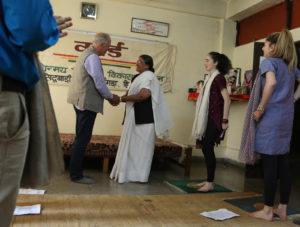
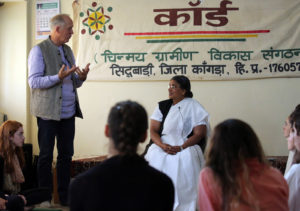
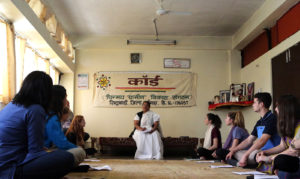
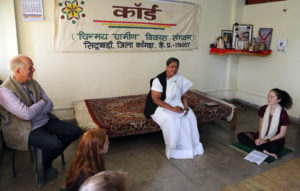
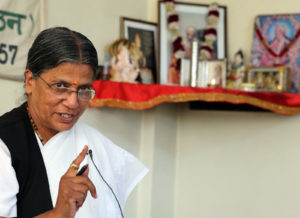
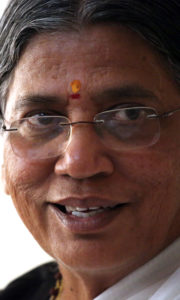
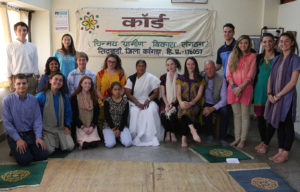
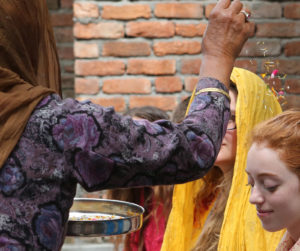
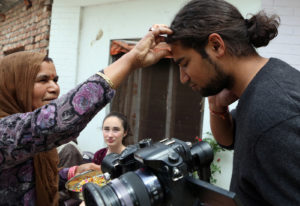
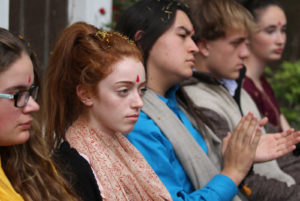
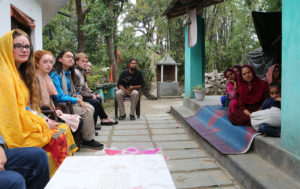
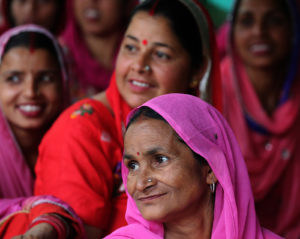
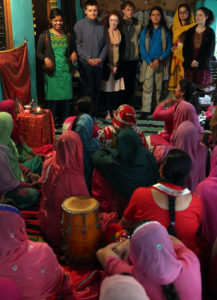
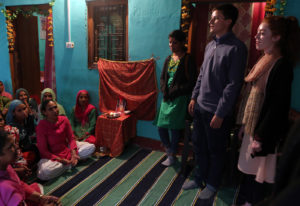
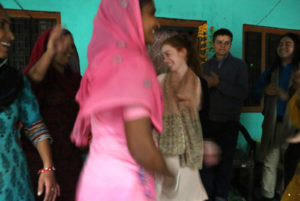
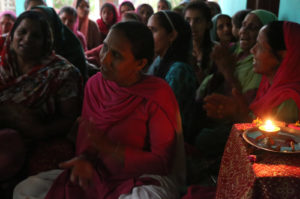
Photos by Shmuel Thaler
Know Yourself
Interview with Dr. Kshama Metre of the Chinmaya Organisation for Rural Development (CORD)
View the video of the interview here.

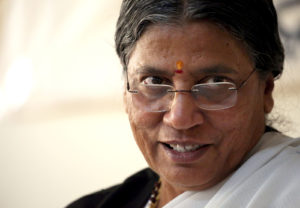
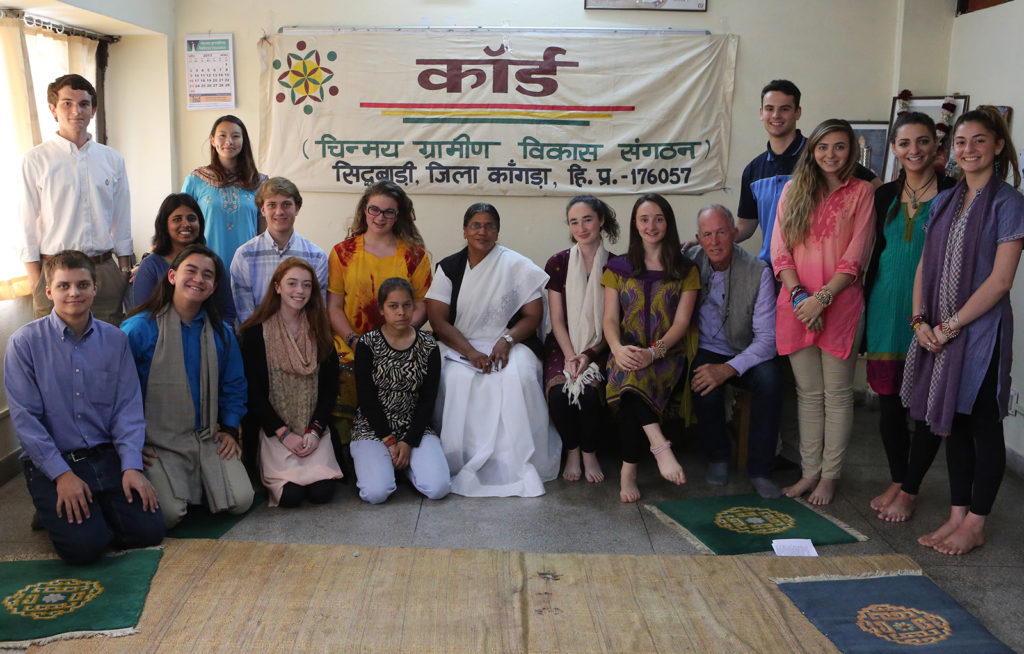
Sometimes simplicity can be the most enlightening thing a person can offer. One might expect pieces of advice that are the most detailed, lengthy, and well-explained to be the greatest in terms of their impact and effectiveness, but this is not always the case. Dr. Kshama Metre made this perfectly clear. She has the mind of an intellectual and one might assume that it is constantly whirling with strategies for achieving equality, and ethical solutions for problems facing Indian women. While this may be the case, the way she externally conveys her thoughts is almost the exact opposite. Dr. Metre communicates many philosophical ideas in a stunningly simple and understandable manner. For example, when asked about the “journey within” and its importance she relayed a story about a little girl at an ashram who told her about “mind baths,” little five-minute periods in one’s day that you use to check in with yourself and see how you’re doing. She didn’t call them “introspective expeditions,” or “existential explorations,” just “mind baths.” Nothing more, nothing less. Normally when we ask for advice from the inspiring people we interview, we often get a wholesomely stirring response that’s about a minute long. When we asked Dr. Kshama Metre for advice she shared only two words but they spoke volumes about her profound understanding of the human spirit and its needs. Those two words were, “Know yourself.” Simple.

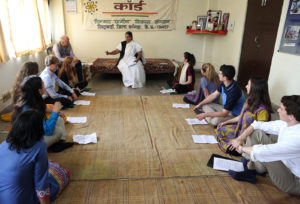
The first question was asked, and Dr. Kshama Metre took a long time to think. Her mind swirled with ideas, and what came out was a concise, well-worded answer. Each question was answered with a humble and short reply after only a second of gathering her thoughts. I was a little surprised at how simple and confident she was in her responses, considering the complex ideas she was explaining. When asked what true equality meant to her, she answered simply, “Equality is not being greedy.” She acknowledged the dimensions of the term, but emphasized the three-word response. Another three-word response was about love; “love is expansive.” Her ability to describe these words, which have countless complexities, with such simplicity made her answers genuine and sincere. I haven’t met many people with the ability to answer our questions so thoughtfully yet concisely. Because of this, I felt drawn into everything she was saying. Dr. Metre has achieved extraordinary things in her life, and her humble demeanor was inspiring. To finish the interview, she gave us some advice for our lives going forward, another short answer that I know I will carry with me; “Know yourself. Once you know yourself, you will know everyone else.” In most interviews, the answer to the advice questions draws a long answer, but this was her entire response. It was simple, confident, and humble, perfectly reflecting her personality.

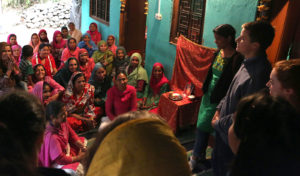
After our inspiring interview with Dr. Metre, we split into two groups and went into the villages to see some of the self-help groups we learned about at CORD (Chinmaya Organisation for Rural Development). Once we arrived in the village, we walked toward a group of about twenty women. They arranged a line of chairs for us and asked each of us to introduce ourselves, which we gladly did. We learned a lot about how the group functions, and how they help the women involved. Each woman pays a set amount of rupees to the group monthly. If someone gets sick or needs money for another reason, they can take a loan out from the group. This is helpful as it allows the women to have some level of economic independence from their husbands.
We were all surprised when they wanted us to sing them something. With half of our class, including our ukulele player, in another village, we weren’t sure how it was going to go. We ended up surprising ourselves by sounding pretty good. In response to our song, the group sang their own. Some of the women stood up and started dancing to the song as we clapped along. They took Izzy, Savannah and me, by the hand, put us in a circle and asked us to dance. We tried our best to do the dance moves they had been doing moments earlier, but their laughs and chuckles told us we weren’t quite doing them right.
Although I won’t remember that trip to the village for our stellar dance moves, I’m never going to forget how much fun we had and how connected I felt to the women.
Treasures in the Market

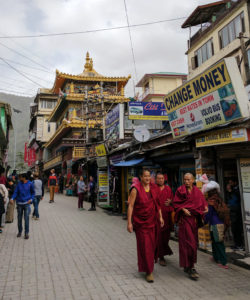
Of all the amazing places we have visited during this trip, Dharamsala stands out as my personal favorite. Not only is the shopping sublime, but it also is host to a large portion of the Tibetan people in exile. Due to this demographic, much of the city has noticeable Buddhist influences, and serves to be an interesting contrast from the Hinduism that we have experienced so much.
However, what stands out to me the most is the shopping. I have found a number of treasures in the market, including items such as Tibetan singing bowls, fur hats, and yak wool blankets. Most of the group’s money was spent while wandering these streets, and what continues to amaze me are the low prices, which have remained consistent throughout all of India. Every time I make a purchase, it is for just a fraction of what it can be sold for in the U.S. Now as we are beginning our return home, I must accept that back in the U.S. it is not the same, and the prices of items will inevitably be higher. India has been the shopper’s paradise, and I will miss it very much because of my affinity for shopping. Bargaining with the shopkeepers and finding the best deals was extremely enjoyable, and I had a great time exploring the streets of Dharamsala with my class.
Video: Golden Temple
Mount Madonna School students visit the Golden Temple in Amritsar, India as part of their Karuna Project.
Tibetan Luminaries

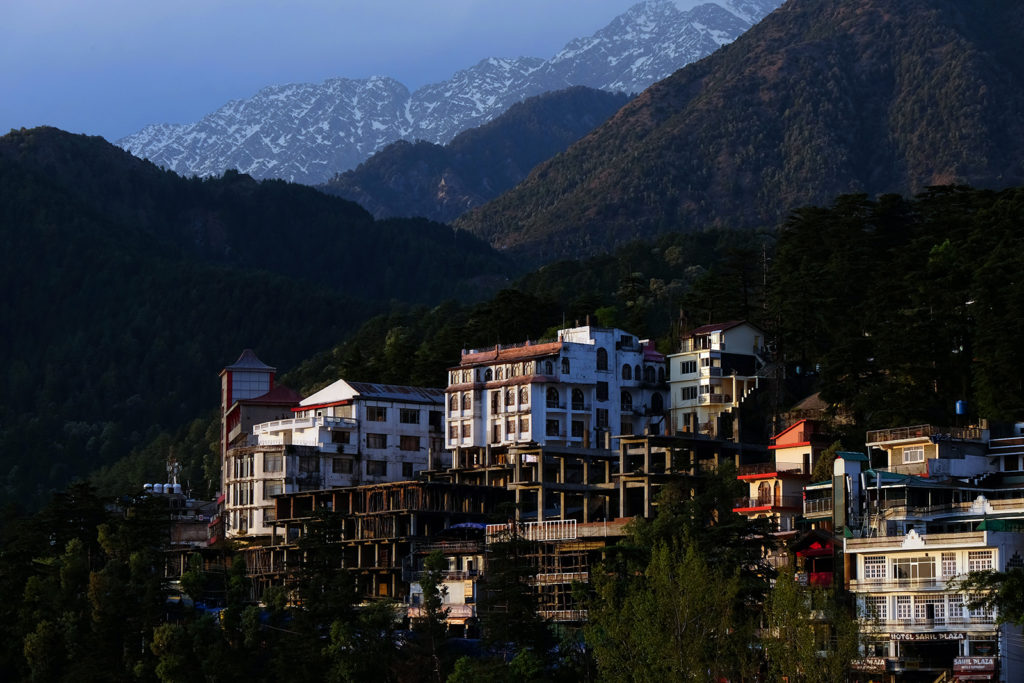
Today was my first day feeling fully recovered after a brief spell of dehydration. I am so happy that I was back for today because it was probably one of the best days of my life. I cannot imagine a life where I do not return to McLeod Ganj. I love waking up to look out at the incredibly beautiful Himalayan Mountains dotted with colorful rooftops. It’s also nice to be surrounded by the Tibetan culture which more familiar to me. It’s comforting to be surrounded by ringing bells, chanting, and flowing vibrant red and yellow robes.
We started off our day with our first interview of the trip, Rinchen Khando. Rinchen Khando is the leader and founder of the Tibetan Nuns Project. As soon as she began talking she became my role model. She spoke beautifully about the value of educating women just like men. She said that in the beginning there was talk of offering the nuns an easier scholarly path, littered with concessions like a lower passing grade or an easier textbook, but that we should take no concessions, because it is important for the welfare of society that women and men are educated equally. She said that when women and men are taught the same it will be easier to stop seeing the distinction between the two, and simply view everyone as human. I thought this was powerful, especially coming from a culture where traditionally nuns could not receive a Ngagrampa degree, only monks could.
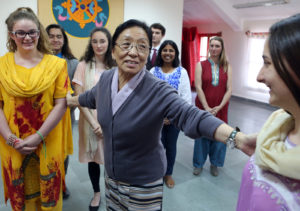
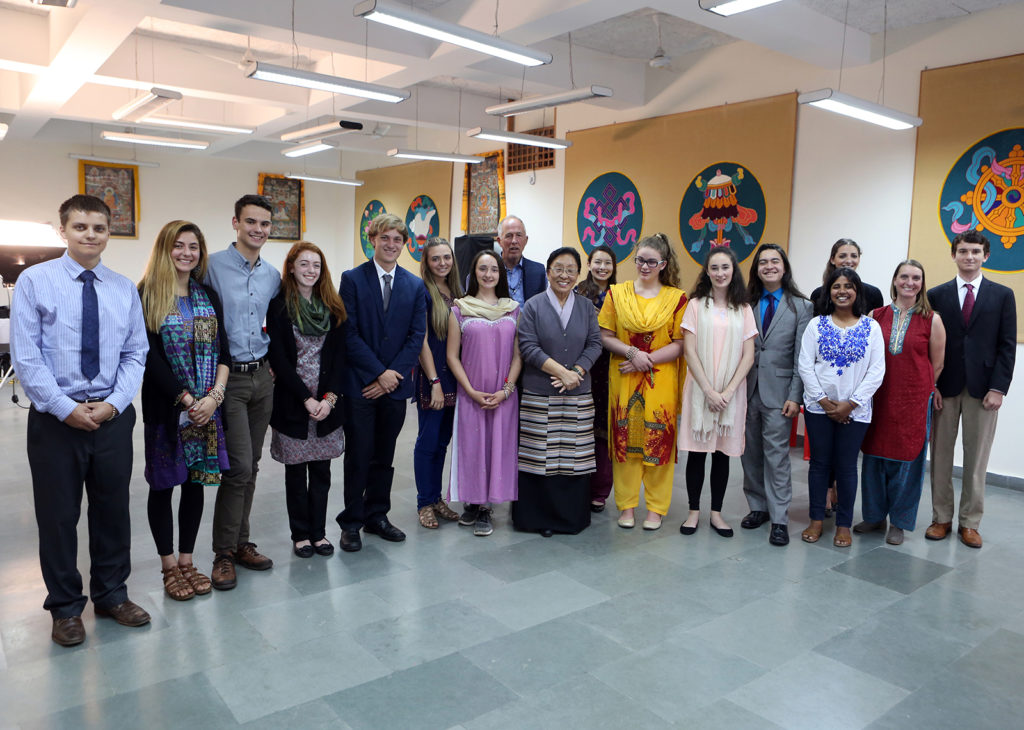
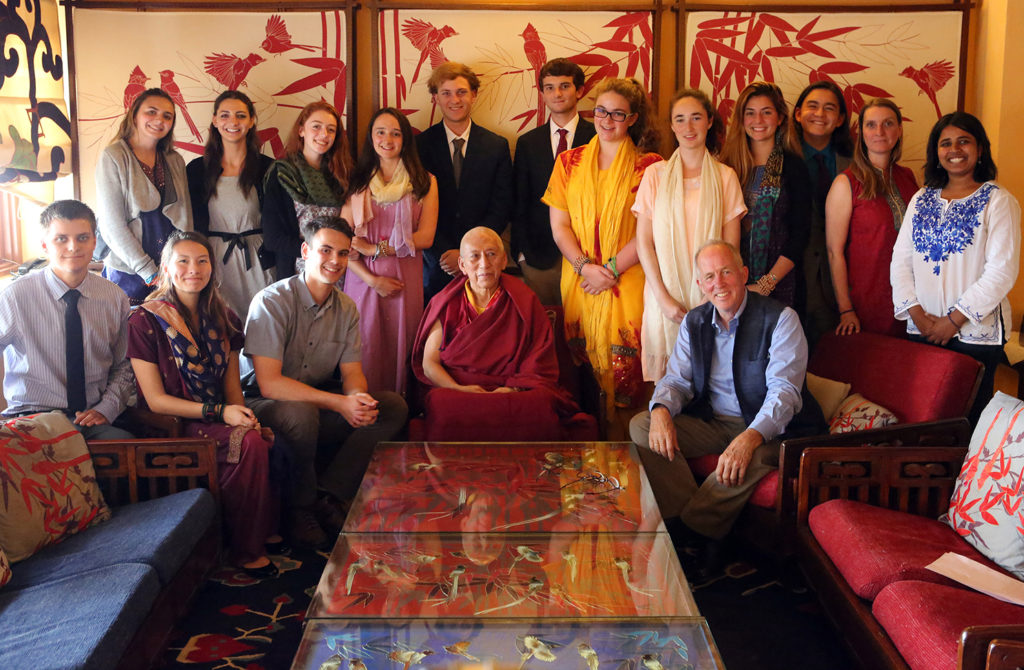
What struck me personally was when she answered the question that I asked, she answered and looked at me with raw attention and care, as though I was one of her family members. I asked her about the importance of art in her work, which is relevant to me because I intend to pursue art and animation in the future. She said that art is so influential, and that with animation, I could really distribute my message and make an impact. She talked about its relationship to journalism, and how there are artists and journalists who can be told to create information for the sake of money, bribery, or other reasons. But she said that if I do not do that, if I stick to my own wisdom and my own truth, then what I create will be powerful. She made me realize that by going into art, I am not just going into an uncertain future, I am going into a life where I create art that is a force to be reckoned with. At the end of the interview, after we took a group picture, she turned to all of us and said that when she looks at us, it is as though she is looking at a group of Tibetan children. In that moment I honestly wanted to walk out with her, ask her to mentor me, and follow her for a few years. Meeting her was truly inspirational and I am eternally grateful for the experience.
After waking up to a big storm and no power in the hotel, we struggled to get ready for the two interviews we had lined up today. With no internet and no printer, our interview questions for Samdhong Rinpoche were polished and printed while we ate lunch at a nearby restaurant. We rushed through our meal and in no time, he was walking around the room shaking everyone’s hand.
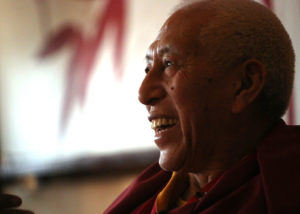
Samdhong Rinpoche thought long about our questions before giving us his detailed, eloquent answers, pausing every once in a while, to ponder or gather his thoughts. Although almost everything he said had extreme depth and struck me in some way, I was especially interested when he spoke to us about the concept of non-violence. He told us that non-violence as a strategy is not true non-violence. This is very similar to John Lewis’ belief that you can’t turn non-violence on and off, it is a way of life. I began to think more deeply about this and was reminded of the Dalai Lama’s book, Ethics for the New Millennium. In his book, the Dalai Lama speaks of suffering, and specifically how sharing in another’s suffering can in turn, alleviate your own. However, sharing in another’s suffering for the sole purpose of alleviating your own is not truly sharing in another’s suffering, therefore, your suffering is not alleviated. This is similar to what Samdhong Rinpoche was telling us because by using non-violence as a strategy, you are using it for the sole purpose of getting something you want, rather than for the purpose of living by the non-violent belief.
I had never thought about the difference between using non-violence as a strategy and living by non-violence but now the difference seems extremely clear. I thoroughly enjoyed our interview with Samdhong Rinpoche because it caused me to think deeply about Buddhist beliefs such as non-violence which I had only thought about on a surface level before.
Between Grace and Chaos

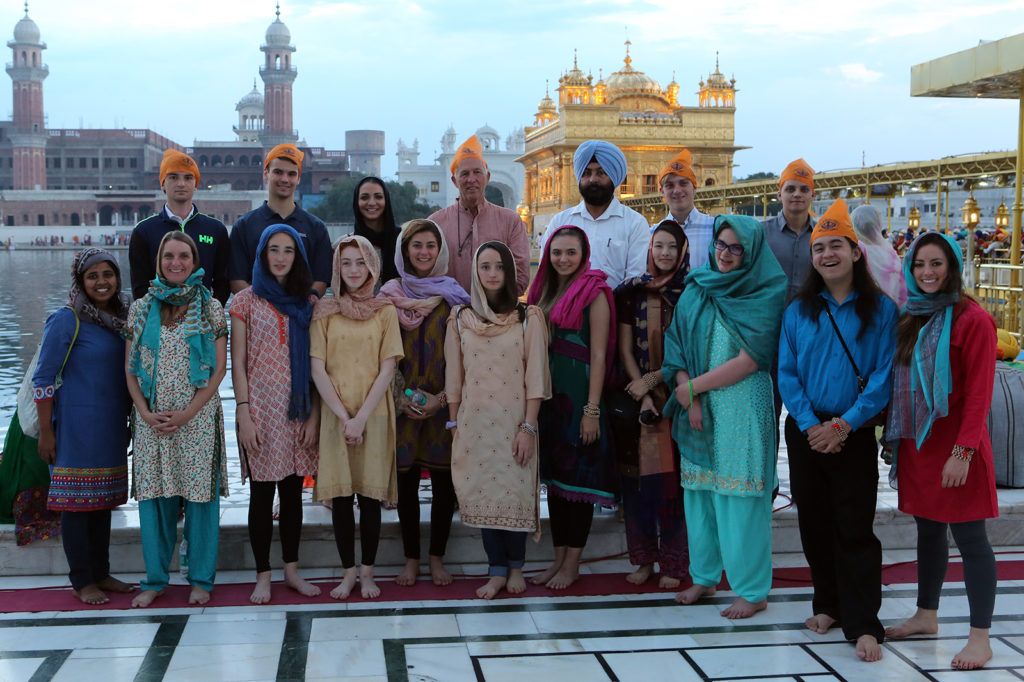
As I approached the Golden Temple I could feel the reverence of those who strolled past me. Everyone moved with a purpose that showed how excited they were to be in this holy place. I walked over the steps that led to the grand courtyard. In the center of the courtyard sits a gigantic pool that contains a temple covered in gold. Hundreds of people stood on the bridge that reached across the rippling water. They waited patiently for their turn to walk inside and pray in the shimmering and ornate building. Slowly, as we circumnavigated the massive pool, the now rising sun cast its orange glow above the wall of the compound. We took a moment to sit and listen to the soothing prayers that were being sung. Their beautiful melody gave life to the temple.
I sat, feeling the presence of the thousands of people who filled the courtyard. I gazed across the water, taking in the stillness of the place despite the movement of people. I stood to pose with our group for a few more photos then felt myself float out of the peacefulness that I felt moments before. We crossed the threshold of the compound back out into the open world. I felt the busyness hit me like a wall. It’s incredible that in just a matter of moments you can be transported between two completely different worlds. I’ve learned that in India three steps can be the difference between grace and chaos.

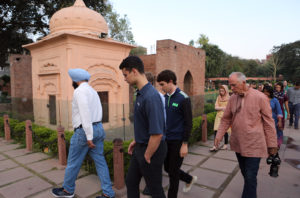
I reached my arms and saw that there was only a few inches keeping my fingers from sliding against the orange cement walls. These walls were the only way to enter and exit the courtyard of Jallianwalla Bagh, the historical site where a peaceful protest inspired by Gandhi ended in a massacre of hundreds of people. As I entered the garden, I tried to swallow away the pain that harvested in my chest. I pictured crowds of nonviolent protesters, cooped up like livestock, running from British bullets, and my ribs tightened around my heart beat. The bullet holes still remain in the weathered brick walls that stand in the garden. I could hear the 1,650 rounds being shot into the crowd, the hot cartridges dropping to the ground as the sounds of bodies followed; my ears burned. I began weaving myself through a crowd to the well that people hurled their bodies down in order to not have their lives be taken by the violent bullets, that brutally interrupted a non-violent protest. I watched flower petals settled to the bottom of the well as silence placed itself onto the lips of the observers. Yet, I could still hear the beating of those hearts around me. Hearts that felt the same pain I did; hearts that wanted to reconstruct the past.
Pool Party!


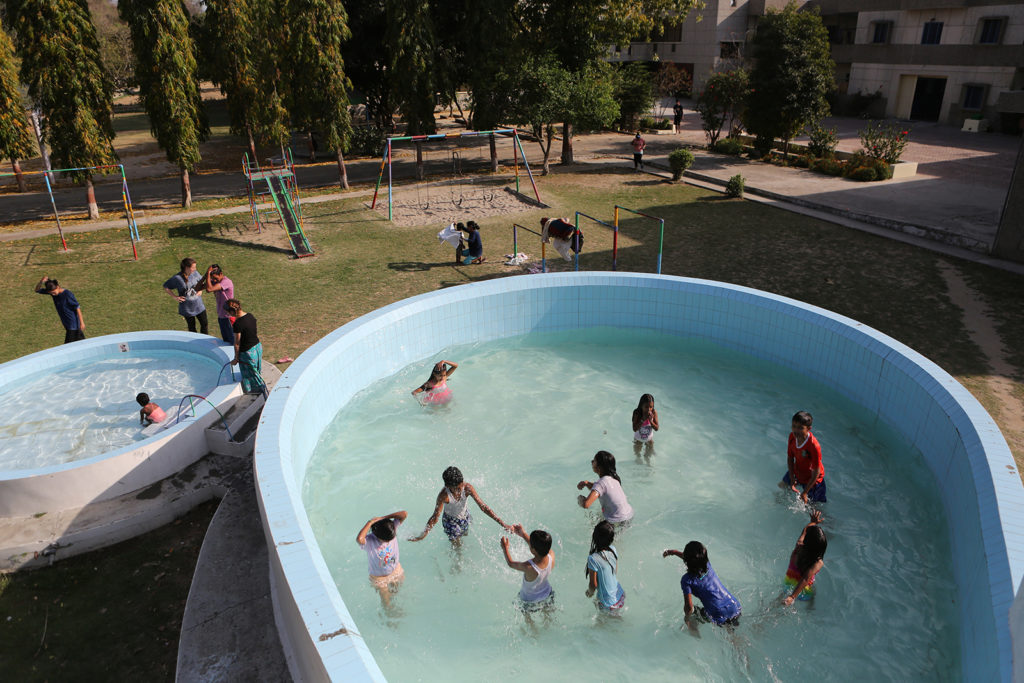
Due to the graciousness of Rashmi, we got to experience “swimming” at the ashram. The pool was only going to be filled a little more than knee height, and to be honest I wasn’t expecting much. After all, knee height doesn’t offer much for my “thick,” 6’2” body. Yet, considering the heat, the call of the cool water was just too enticing.
As soon as we were released from dance practice Devyn, Isaac, and I sprinted over as a cohesive unit ready to dive into the shin deep water. As soon as we arrived, we realized it was filled to the brim with all the kids. We hesitated but the lure of cool water was too strong. Our entrance seemed to be the spark of the GREAT SPLASH WAR and as we engaged in battle we tried to keep the water out of our mouths. Our efforts were made even more futile when Naresh, a 16-year-old ashram brother, entered the war by immediately tackling me into the water. Devyn, Isaac, and I almost instantly had our backs against the wall as the whole pool turned on us as we desperately defended our position. After successfully defending ourselves from the first round of attacks, I found myself betrayed by my former comrades. I was getting bombarded from every direction. My attempt at the fetal position against the wall offered little refuge.
Over all, this was a great way to end my day. In addition to having a blast, the pool party served as an opportunity to interact with the younger kids I had not yet gotten to know. Unique moments like this, at Sri Ram Ashram, allow us to deepen our relationships and encourage cross-cultural interactions. This is one of the many attributes of the ashram that makes it the special place that it is.