
The Gift of Education

Langa Township
Given Reyhani

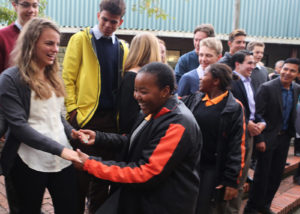
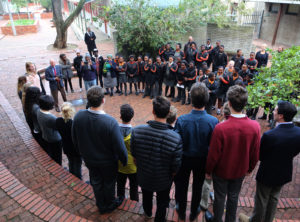
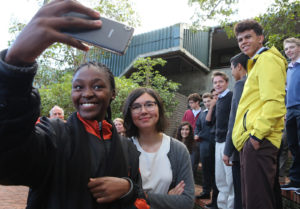
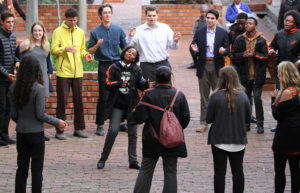
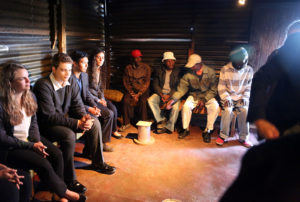
Today we ventured to LEAP school, a Science and Maths high school in the township of Langa. Right when we arrived, we were greeted by a group of students and we spent time getting to know each other. After a while talking, we sat down and they started to perform for us. They started with a traditional South African gumboot dance, and then went into singing. As I watched them sing and dance, I noticed how talented they were and how seriously they take music. I also noticed how seriously they take their academics and how they really push themselves to do well.
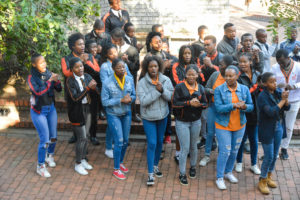
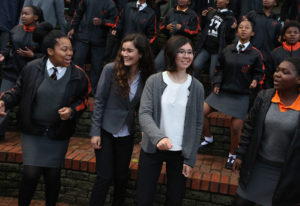
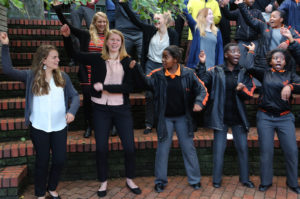
After they sang, which they were very good at, it was our turn. Although they had beaten us in this field, we still did great. Eventually, they came up and joined us and we sang together. I feel like the singing really brought us together as they sang our songs and we sang some of their songs. We got to connect with them on a different level through singing, which is one of the biggest ways of connection throughout the world.

After performing together, we sat down in groups of three and we were asked to discuss the question, “If there was something that we could change about school what would it be?” In my group, we discussed the mandatory uniform that the LEAP students must wear. We talked about how wearing a uniform restricts you from expressing yourself, and that if you want to wear something you should be able to wear it because how you dress shows a little of who you are. This struck me because back home we don’t have a dress code and I never really thought about how we dress being a way to express ourselves.


Paola Jacobs

I felt a flood of emotions during my time at LEAP school today. Walking in, I was immediately greeted by Cetitu, a student who set my mood of the day with her joy and happiness. Her inviting energy made me feel accepted and the openness allowed for the both of us to get to know about each other’s lives easily. Throughout the day, I was surrounded by more and more kids my age, and noticed how well my classmates and I connected with everyone. We all live such different lives but I feel like that fact didn’t have a negative effect on the friendships and connections that I formed today. The differences just made the experience that much stronger.
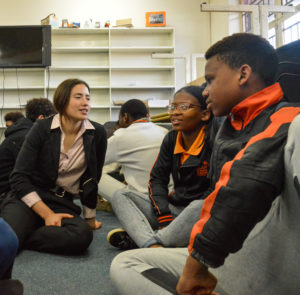
After the school tour, we performed songs for the students and visitors at LEAP and they sang some songs for us. Their performances were amazing and they made me realize that community and culture are important. They opened their hearts to us, and the way they sang gave me chills. We sang them our songs and they were supportive of us; they clapped and smiled for us. I felt nothing but love for them. I felt a powerful community as we were all singing together. I felt so much appreciation and I enjoyed getting to know the kids through such a creative space. It made my visit to the LEAP school impactful.

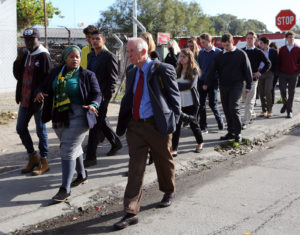
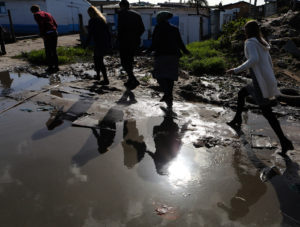
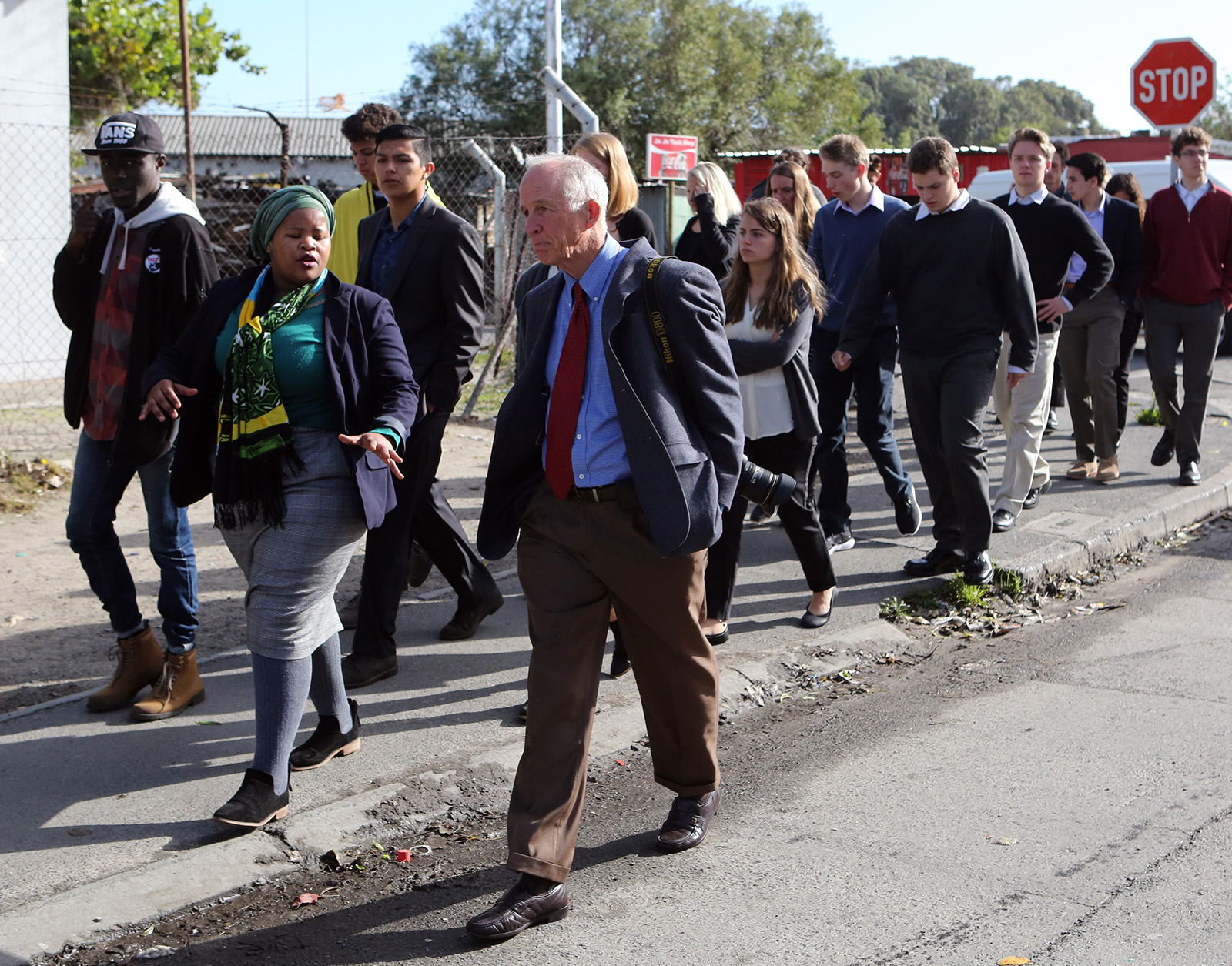
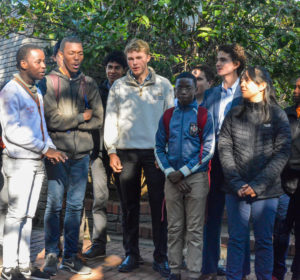
After our time at the school, we all walked through the Langa township, talking and getting to know each other even more. It was interesting for me to walk through a town completely different from what I see in California. It really opened me up. It was like a big family. I saw a community where people helped people for the benefit of their own community. I saw children running around smiling, enjoying themselves. We were welcomed into their community and it seemed like they enjoyed our presence. We eventually stopped at a barbeque restaurant and shared lunch with our new friends. Sharing food and stories with them was so much fun, it felt like all I did was laugh today. It didn’t matter that we were from different countries. I find it amazing that people from two parts of the world can hang out without having a barrier or culture shock. I loved that there were so many unexpected similarities between all of us.

Maverick Bettencourt

“I value my school and my education a lot.” My new friend, Aluta, said this today during our time together at LEAP school. I would like for you to think about that for a second, and reflect on the average student in the United States and how they think of school. When we visited the Leap School of Science and Maths, I was in awe of how the students felt about school. I go through school not giving it my full attention, not valuing the very expensive, special, and amazing school that I attend. I go to Mount Madonna High School because my parents and I decided it was the right place to learn and grow.

The kids at Leap School had to take a test just to get into their school. They value each class. Each student takes very advanced and difficult classes. Classes like these would be taught in college in the United States. A good education is very hard to commit to in South Africa because of the lack of financial means. The average family only makes $6 a day, so higher education is not a viable option for many households. Leap School pays for clothes and food, in addition to education. These three items are hard to come by for many South Africans and this limits the success of students. I know that I have taken them for granted.
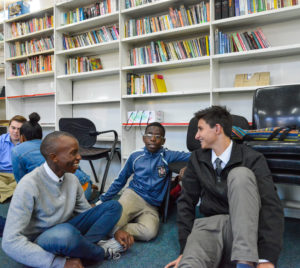
When we arrived at Leap School we were paired with a student to give us a tour of the school. I was the last through the door and there was one student standing alone. No one was paired with him. I went straight up to the student and introduced myself. His name is Aluta and he is the nicest person I have ever met. He was kind of shy.  I kept most of the conversation going but shy in South Africa is a bit different than the United States. In South Africa, most people seem outgoing in one way or another but compared to the rest of the students, he was a bit shyer. I spent the whole day with Aluta. I asked him about his school and his family life.

Aluta has no mom or dad. He lives with his grandparents. His mom passed away when he was very young age and his dad is out of the picture. Aluta values the opportunity of the school more than anything in the world. We were given a talking point during the day to share with each other, “What would you change about school?”  He said, “Nothing. School is so perfect and the chance just be at school is good enough for me.” He wants to be a doctor when he finishes school and move the United States of America. I have faith that he can but the problem is that his family does not have enough money to send their kids to college. Aluta showed me how much I take for granted, and that I should be more appreciative of the fact that my parents sent me to my amazing school that offers so many opportunities. I see that I should try my hardest.
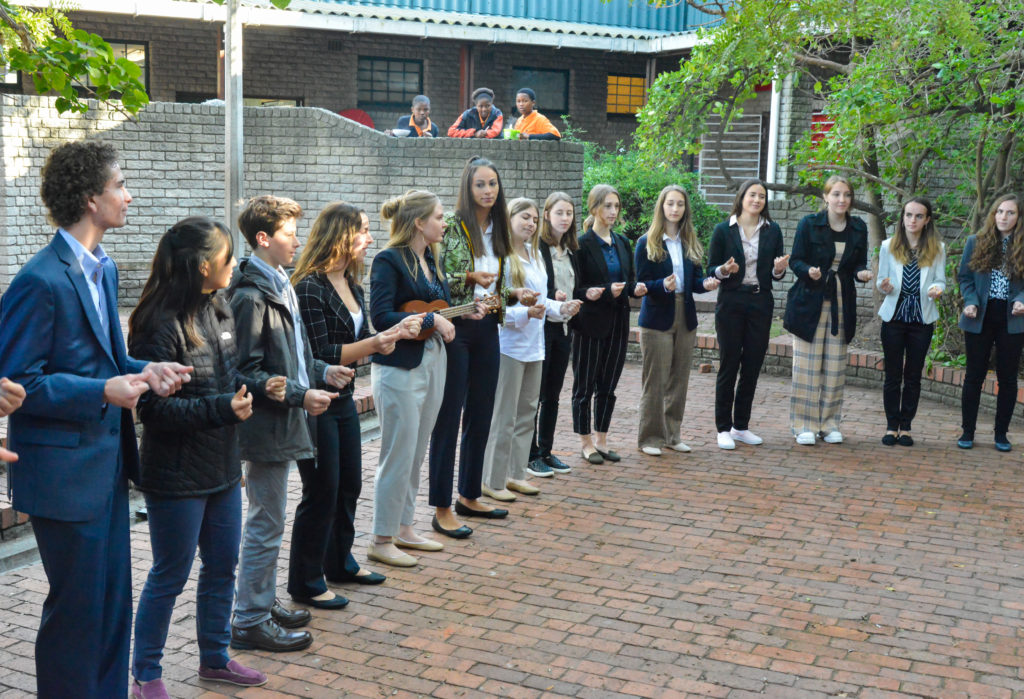
Singing at LEAP School
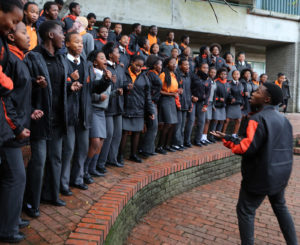
Langa Township

Lucas Caudill

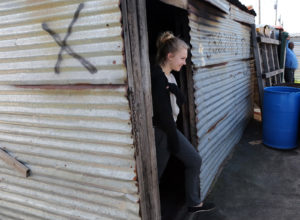
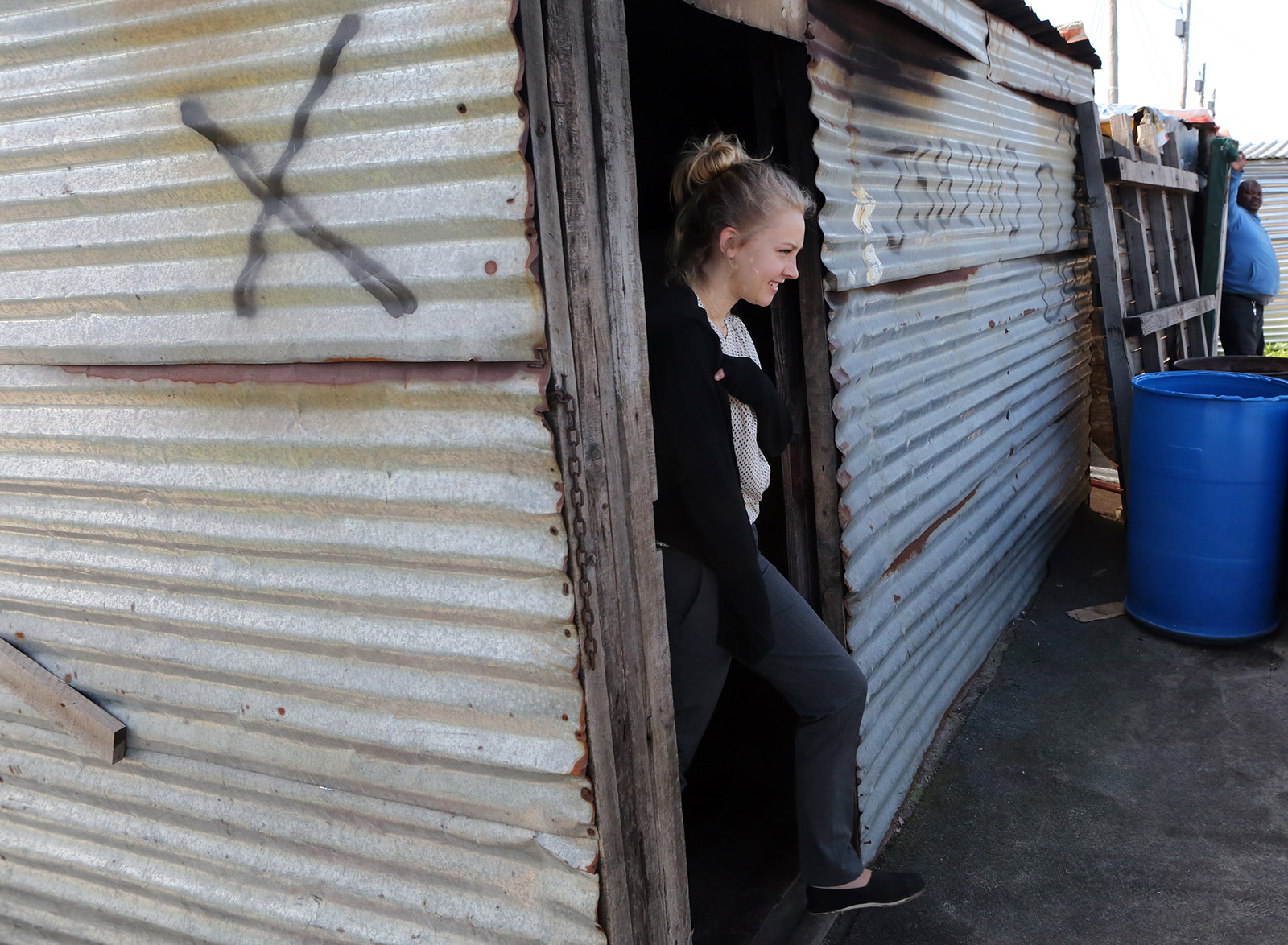
After our morning visit to LEAP School, we departed for a tour of the surrounding township, Langa. Langa’s appearance was like that of Khayelitsha: people living shoulder-to-shoulder in small houses made of corrugated metal, concrete, wood, old shipping containers and any other resources available for such a purpose. Our guide from LEAP School told us that many of these houses lacked running water, which led to sanitation issues. Furthermore, their proximity to one another means there is always the possibility that a single fire outbreak could rapidly spread, destroying countless homes, a threat that is further exacerbated by the scarcity of water.

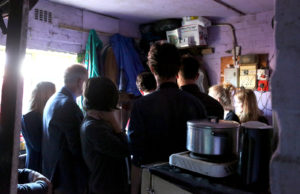
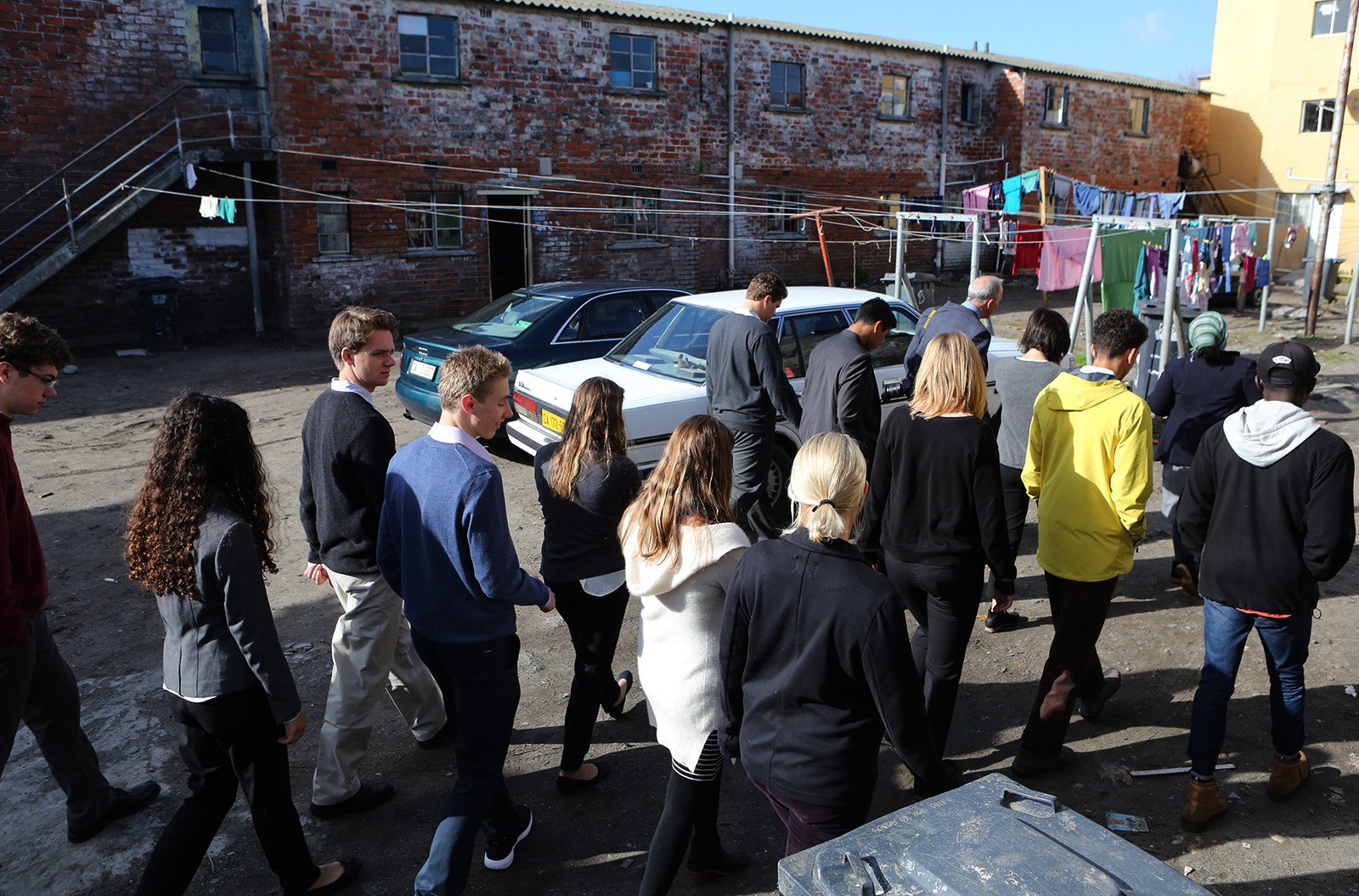
One of our first stops on the tour was a former hostel. During apartheid, buildings such as this housed migrant laborers from the so-called “homelands,” who were forced to live away from their families while working in the townships. Today, these buildings are still used for housing and, despite the abolition of apartheid over two decades ago, they continue to afford their residents little in the way of comfort. The one we visited was a two-story brick building which was divided into several sections, each of which could be accessed by a separate door on the outside of the building. The tour brought us into one of these sections, which consisted of around six rooms with a single bathroom at the far end of the building which the residents shared. As our large group filled the room, I started to become aware of the unusual nature of our visit. This was not some exhibit at a museum, it was somebody’s home. I could see residents in their room through a door left ajar. People were making their way in and out of the building, avoiding the gaze of this group of strangers. I began to feel a creeping sense of guilt. It seemed as though we were intruding on their lives, and I could imagine how they saw us, a group of rich Americans, here to gawk at their poverty.

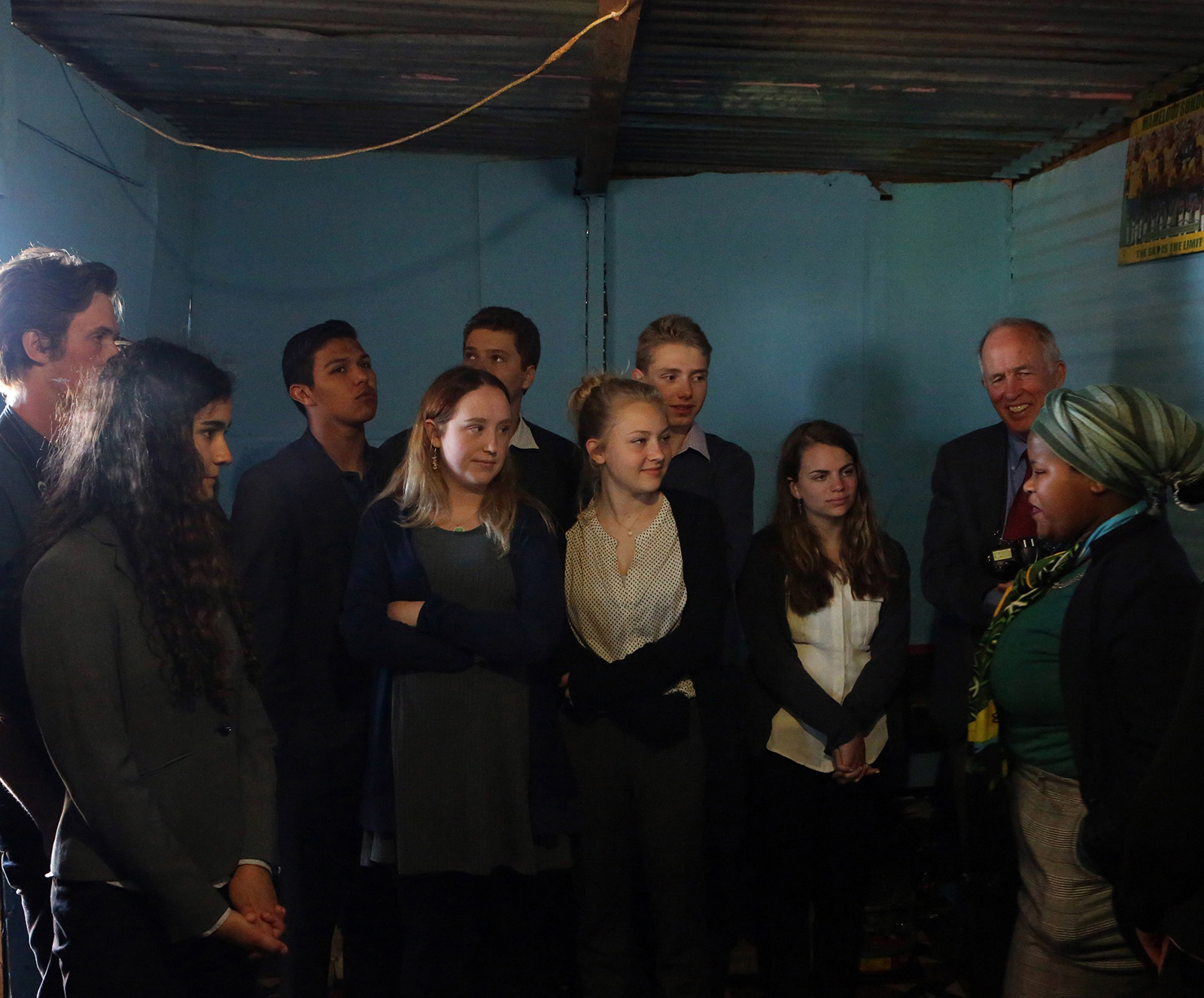
I thought of how angry I would be had our circumstances been reversed. I kept these thoughts in mind as we continued the tour, which brought us into one of the rooms in this section of the building. The room was relatively small by most standards, and couldn’t have been much larger than 8 feet by 12 feet, roughly the size of a modest American bedroom. But this was not a bedroom. There were two beds piled with folded clothes on either side of the room, between them a mere 2-3 feet of space. Next to these beds was a small television set. Beside the door, at the foot of one of the beds, was a small refrigerator, on top of which sat an electric stove. These two appliances made up the room’s kitchen. Our group filed in, almost completely filling what little space was available. On the bed opposite the door sat an old woman. Seeing her made me feel worse. What did she think of our presence? Once again, I felt like I was trespassing. The guide asked her how many people lived in the room. She replied that ten-people lived there. I began to imagine how ten people could live together in such a confined space. The members of our group in the room, numbering somewhere around 17, had to stand shoulder-to-shoulder with one another. I couldn’t see that ten people would be much more comfortable. I then thought about the other five rooms in this section. If they each held the same number of occupants as this one, that meant that around sixty people lived here, all sharing a single bathroom. The guide then asked the woman how long she has lived in this building, to which she replied forty years, more than two times the time that I’ve even been alive.

To live in these conditions for so long is something I’m not sure I’m even capable of comprehending. This information was not lost on me, however. The message was clear: this life is all the woman has ever known. It’s all anyone in the township has ever known. This is a sobering thought. Cliché though it sounds, in our country we often take the things that we have for granted. Though it was difficult see the things we saw in Langa, our visit there taught me a very valuable lesson. For the first time in my life I could see the privileges that life arbitrarily granted me simply because I was born in California rather than Langa or Khayelitsha or Soweto or Tembisa. As we go about our own daily lives, it is important to remember that for countless people around the world, “daily life” is a struggle for survival amidst circumstances which we in America cannot even begin to understand. Therefore, although I may have looked the part, I feel as though I wasn’t just some tourist gawking at poverty in Langa. I believe that what we saw in Langa was an example of all the good that has yet to be done. As Ward put it, there is an immense amount of inequality in the world, and it is everyone’s obligation to try to make a difference in any way possible, that we may push the world to a better future.


Zach Wagner

My first reaction when I learned that we would be going into a township was one of anxiety because I did not know what to expect. I had observed, from a distance, the abject poverty experienced by the inhabitants of the townships the day before on our visit to Philani. Every time we had been in or near a township previously in the trip, we were inside a gated compound. But as has been so common on this trip so far, my expectations were absolutely shattered. We were first taken in vans to the heart of the township, and showed a shop. It was explained to us that many of the shops are built in shipping containers so they can be more easily moved if business is not successful in one area. This struck me as interesting because it added to my notion of just how volatile and hand to mouth these people’s lives are. We then walked down the path past a butcher shop, a small shack with a fire pit and a bag of sheep heads, and then proceeded to see one of the hostels set up by the government. In these hostels, there are often three families to a room, and no privacy whatsoever. We walked into one of the rooms and spoke to a woman who had been living in that room for 40 years. She told us that ten people lived in this room that was no more than 3×2 meters. Being able to actually go into these homes and meet the people living in them allowed me to experience what their lives are like. Lastly, we walked to the informal housing, the shantytown section of the township consisting of non-government tin shacks, and visited one to see what they were like inside. We also visited a brewery of traditional African beer and learned about the beer’s significance to the culture, as well as the process by which it is made. After today’s experience, I feel like I have a far deeper understanding of township life than I did before. It is one thing to read about it, and a completely different experience to be immersed in the township itself. This experience has definitely made me reflect upon what a privilege it is to have privacy, and to be sheltered from the elements. However, the township’s people are far from letting suffering consume them. Everyone I have met, from the little kids at Philani, to the kids our age at the LEAP School, have an aura that cannot be ignored. They are loving, cheerful people, and face their respective situations with dignity, courage and joy. I cannot wait to further connect with these wonderful people as we continue our learning journey.

Walking through Langa Township